Vulnerability Management vs. Patch Management Explained
Mar 3, 2026
Vulnerability Management vs. Patch Management Explained
In cybersecurity, two of the most commonly referenced but often misunderstood practices are vulnerability management and patch management.

NDSS 2025 – A Comparative Evaluation Of Large Language Models In Vulnerability Detection
Mar 3, 2026
Vulnerability Management vs. Patch Management Explained
In cybersecurity, two of the most commonly referenced but often misunderstood practices are vulnerability management and patch management. The key difference is that vulnerability management is the broader process of identifying, assessing, and prioritizing security weaknesses across an environment, while patch management is the specific act of applying software updates to fix known vulnerabilities. While closely related, they serve distinct roles in the vulnerability management lifecycle. Understanding their differences and how they complement each other is essential to reducing risk, improving response times, and strengthening your cybersecurity strategy.
What is Vulnerability Management?
Vulnerability management is a continuous process for identifying, assessing, prioritizing, and remediating security weaknesses across systems, applications, and networks. It extends beyond scanning for flaws and includes analyzing potential business impact, determining risk levels, and coordinating remediation actions across teams.
An effective vulnerability management program typically includes:
Asset discovery
Vulnerability scanning
Risk-based prioritization
Reporting and tracking
Coordination with remediation teams
This process helps security teams stay ahead of threats by managing weaknesses before they can be exploited. Discover our blog on why vulnerability management automation is essential.
What is Patch Management?
Patch management is the process of acquiring, testing, and applying software updates to fix known vulnerabilities or improve functionality. These patches are issued by software vendors or internal development teams to address flaws discovered post-deployment.
While patching is an essential part of reducing exposure, it is often one of many possible responses to a vulnerability. Not all vulnerabilities have available patches, can be resolved with only a patch, or can be addressed immediately due to operational constraints. This is why patch management is only one component of a broader vulnerability management strategy.
What are the Main Differences Between Patch and Vulnerability Management
Differences
Vulnerability Management
Patch Management
Objectives and Strategic Goals
Reduces the organization’s attack surface by identifying and addressing security weaknesses
Keeps systems current and secure by applying vendor-issued updates
Tools, Techniques, and Technology
Uses scanners, threat intelligence feeds, and prioritization tools
Uses configuration and deployment tools to apply updates
Scope of Responsibilities
Covers discovery, analysis, prioritization, and oversight of remediation efforts
Covers execution and validation of software and operating system updates
Required Skill Sets and Team Roles
Managed by cybersecurity teams skilled in risk analysis and security architecture
Managed by IT operations teams with expertise in system integrity and configuration
Ownership Across the Organization
Typically owned by security or governance teams
Typically owned by IT or infrastructure teams, with necessary collaboration
How Vulnerability Management and Patch Management Can Work Together
When these two functions are aligned, organizations can move faster from threat detection to risk mitigation.
1. The Integrated Workflow: From Detection to Remediation
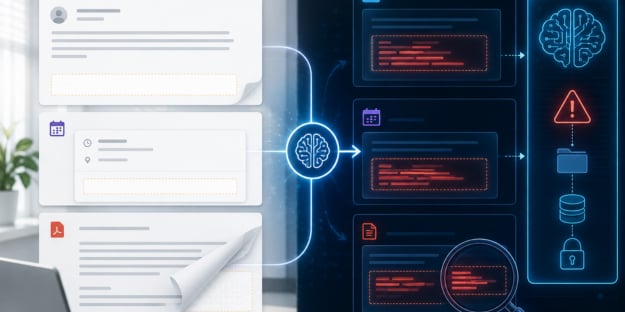
An ideal process begins with vulnerability detection, followed by automated risk analysis, and then transitions into patch evaluation and deployment. This coordination ensures that critical issues are addressed efficiently, with minimal business disruption.
2. Using AI Automation to Bridge the Gap
Agentic AI automation helps connect the dots between security findings and IT response. By using AI agents to handle repetitive tasks, correlate vulnerabilities with patches, and escalate when necessary, organizations can accelerate resolution and maintain better control over risk.
3. Reduce Dwell Time and Improve MTTR with Swimlane Turbine
Swimlane Turbine closes the loop by automating the workflow between detection and remediation. Using adaptable playbooks and a centralized system of record, Swimlane Turbine enables security teams to reduce dwell time and improve mean-time-to-respond (MTTR). It empowers teams to respond at the point of inception, when a vulnerability is identified, not hours or days later.
How to Automate Vulnerability Management with Swimlane
Swimlane enables teams to scale vulnerability management efforts through agentic AI automation. At the heart of the Swimlane Turbine platform is a dynamic, centralized case management application that leverages AI agents and automation to streamline decision-making and orchestrate complex workflows.
With Swimlane, security teams can:
Ingest and enrich vulnerability data from scanning tools
Prioritize risks based on threat intelligence and business context
Launch remediation workflows automatically
Track metrics like MTTR, MTTD, and remediation progress through customizable dashboards
Vulnerability response management doesn’t have to be manual, reactive, or fragmented. With Swimlane, organizations can unify people, processes, and tools under one system of record to deliver faster, more informed, and more scalable security outcomes.
TL;DR: Vulnerability Management vs. Patch Management
Vulnerability management and patch management are essential but distinct components of a strong cybersecurity strategy. Vulnerability management focuses on identifying and prioritizing security weaknesses, while patch management applies fixes to known issues. Together, they form a critical workflow that helps reduce risk and improve response times. By integrating both practices and automating them with agentic AI automation, organizations can reduce dwell time, improve MTTR, and gain better visibility and control over their security operations.
Swimlane Vulnerability Response Management
Discover how Swimlane automates the entire vulnerability management lifecycle, helping security teams reduce dwell time, improve MTTR, and eliminate manual handoffs. See how agentic AI automation delivers scale without complexity.
Explore
Related Posts
Request a Live Demo
MktoForms2.whenReady(function(form) {
form.onValidate(function() {
var email = form.vals().Email;
if (email) {
if (!isEmailGood(email)) {
form.submitable(false);
var emailElem = form.getFormElem().find(“#Email”);
form.showErrorMessage(“Must be Business email.”, emailElem);
} else {
form.submitable(true);
}
}
});
});
function isEmailGood(email) {
for (var i = 0; i
The post Vulnerability Management vs. Patch Management Explained appeared first on AI Security Automation.
*** This is a Security Bloggers Network syndicated blog from Blog Archives – AI Security Automation authored by David Irwin. Read the original post at: https://swimlane.com/blog/vulnerability-and-patch-management/
About Author