Finally, CTEM and MITRE INFORM Without the Jargon
Your vulnerability scanner just came back with 10,000 findings. Your pen test report has a 47-page appendix. Your threat intel feed is piling up faster than anyone can read it.
Finally, CTEM and MITRE INFORM Without the Jargon
Your vulnerability scanner just came back with 10,000 findings. Your pen test report has a 47-page appendix. Your threat intel feed is piling up faster than anyone can read it. And somewhere in the middle of all of it, a real attacker is quietly looking for the one gap that actually matters.
The problem isn’t that you don’t have enough security data. It’s that you don’t have a clear, continuous way to cut through the noise, focus on what’s truly exposed, and validate that your defenses hold up against real threats. That’s the problem Continuous Threat Exposure Management (CTEM) was designed to solve.
You’ve heard of CTEM. You’re ready to learn more and get started. But where do you even begin?
That gap between awareness and operational execution is what this guide aims to address.
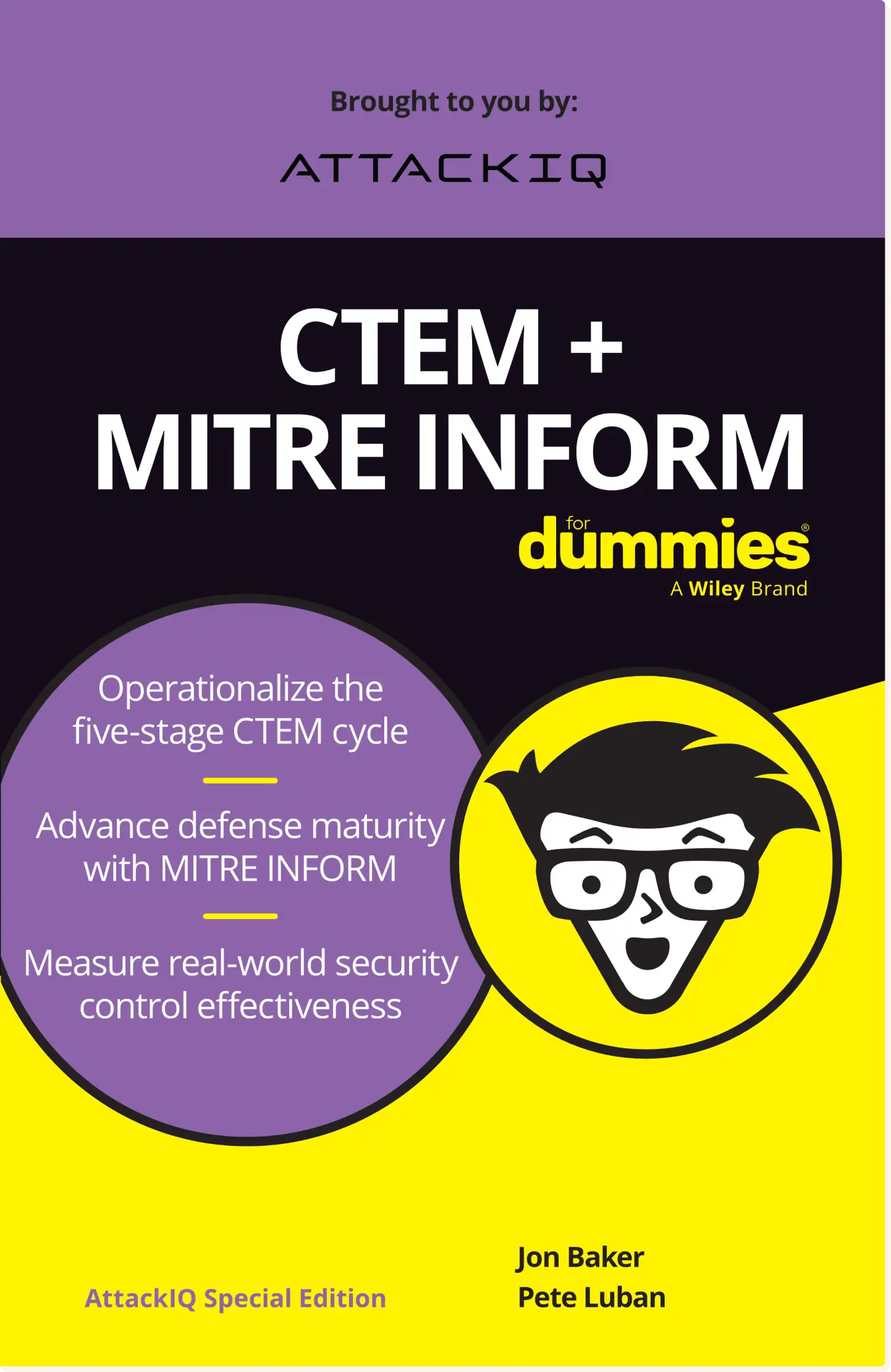
Introducing CTEM + MITRE INFORM Guide For Dummies
CTEM + MITRE Inform for Dummies is a no-nonsense, jargon-light, actually-readable introduction to understanding CTEM, building it on a strong threat-informed defense foundation, and getting your program off the ground. Whether you’ve never heard of CTEM until last Tuesday, have been circling it for months without knowing where to start, or have taken a few first steps and already feel lost, the goal of this guide is to provide structure and practical direction for navigating early CTEM adoption.
We walk you through how Threat-Informed Defense and MITRE INFORM, gives your CTEM program the adversary-focused foundation it needs to actually work. Because a CTEM program built around real attacker behaviors isn’t just more effective. It’s more efficient, more defensible, and a lot easier to explain to leadership.
The focus is not complexity for its own sake. It emphasizes practical application, operational discipline, and measurable outcomes. And more importantly, we’re here to help you stop guessing if your security works and start proving it.
What’s Inside
The book starts by tackling the new reality of exposure management head on — why the security landscape has shifted, why point-in-time assessments and compliance checklists can no longer answer the questions boards and leadership are asking, and why continuous exposure management is no longer optional.
From there, we get into operationalizing CTEM, walking through the full cycle from scoping to mobilization and showing how to move CTEM from framework to function inside your organization. The most important shift CTEM introduces is the elevation of validation. Discovery tells you what might be wrong. Validation tells you what actually matters. When validation becomes continuous, you stop managing risk on assumptions and start managing it with evidence. The framework is designed to be repeatable and operational, not theoretical.
We then dig into MITRE INFORM and its role in maturing an adversary-centric foundation that makes CTEM more powerful. Threat-informed defense is built around three core dimensions: Cyber Threat Intelligence, Defensive Measures, and Testing and Evaluation. The INFORM maturity model gives organizations a structured approach to ensure that intelligence, defenses, and testing evolve together rather than in silos. The goal isn’t to accumulate more tools or controls. It’s to make sure what you already have is relevant, effective, and validated against real adversary behaviors.
And that’s where CTEM and MITRE INFORM really come together. CTEM provides the operational rhythm — what to test, when to test it, and how to act on the results. MITRE INFORM provides the threat-informed foundation that ensures your security program stays aligned to how real adversaries actually operate. Together they create a system where exposure is identified and prioritized continuously, defenses are aligned to adversary behavior, and results feed directly into governance, investment, and strategic decisions.
The guide concludes with ten practical implementation recommendations — practical, actionable moves like establishing a CTEM rhythm, linking security metrics to business outcomes, making threat intelligence operational, and leading with evidence. These are things you can start doing now, regardless of where you are in your journey.
Who This Guide Is For
If you’re a practitioner trying to figure out where CTEM fits in your day-to-day work, a program manager trying to build something your leadership will actually fund, or a security leader who needs to move the conversation from “are we secure?” to “here is what we can defend against and here is how we know” — this guide is designed to support that transition.
It prioritizes practical application and real-world relevance—approachable, grounded, and maybe even a little fun.
CTEM and MITRE INFORM are more powerful together, and when aligned, enable a more disciplined and defensible approach to modern cyber defense.
Jon Baker
Jon brings over 20 years of experience leading innovation in cybersecurity with a focus on making security more efficient and effective at scale. He is the former Director and Co-Founder of MITRE’s Center for Threat-Informed Defense (CTID), where he united sophisticated security teams to advance the state of the art and the practice in threat-informed defense globally. Prior to launching the CTID, Jon led MITRE’s Cyber Threat Intelligence and Adversary Emulation Department where he advanced those critical capabilities across MITRE, and managed the CALDERA and MITRE ATT&CK® teams. Jon led teams developing open standards including STIX and TAXII for threat intelligence sharing, and was the co-creator of OVAL while managing MITRE’s security automation program.
*** This is a Security Bloggers Network syndicated blog from AttackIQ authored by Jon Baker. Read the original post at: https://www.attackiq.com/2026/03/03/ctem-guide/
About Author