Microsoft’s April 2026 Patch Tuesday Addresses 163 CVEs (CVE-2026-32201)
8Critical
154Important
1Moderate
0Low
Microsoft addresses 163 CVEs in the April 2026 Patch Tuesday release, including two zero-day vulnerabilities, one of which was exploited in the wild.
Microsoft’s April 2026 Patch Tuesday Addresses 163 CVEs (CVE-2026-32201)
8Critical
154Important
1Moderate
0Low
Microsoft addresses 163 CVEs in the April 2026 Patch Tuesday release, including two zero-day vulnerabilities, one of which was exploited in the wild.
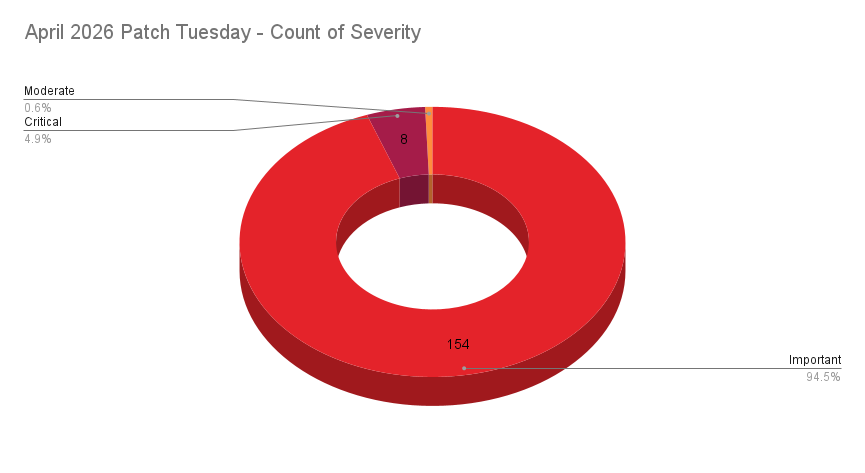
Microsoft patched 163 CVEs in its April 2026 Patch Tuesday release, with eight rated critical, 154 rated as important and one rated as moderate. This is the second largest Patch Tuesday release, nearing the record set by the October 2025 Patch Tuesday release with 167 CVEs. Our counts omitted two non-Microsoft CVEs from this month’s release.
This month’s update includes patches for:
.NET
.NET and Visual Studio
.NET Framework
.NET,.NET Framework, Visual Studio
Applocker Filter Driver (applockerfltr.sys)
Azure Logic Apps
Azure Monitor Agent
Desktop Window Manager
Function Discovery Service (fdwsd.dll)
GitHub Copilot and Visual Studio Code
Microsoft Brokering File System
Microsoft Defender
Microsoft Dynamics 365 (on-premises)
Microsoft Edge (Chromium-based)
Microsoft Graphics Component
Microsoft High Performance Compute Pack (HPC)
Microsoft Management Console
Microsoft Office
Microsoft Office Excel
Microsoft Office PowerPoint
Microsoft Office SharePoint
Microsoft Office Word
Microsoft Power Apps
Microsoft PowerShell
Microsoft Windows
Microsoft Windows Search Component
Microsoft Windows Speech
Remote Desktop Client
Role: Windows Hyper-V
SQL Server
Universal Plug and Play (upnp.dll)
Windows Active Directory
Windows Admin Center
Windows Advanced Rasterization Platform
Windows Ancillary Function Driver for WinSock
Windows Biometric Service
Windows BitLocker
Windows Boot Loader
Windows Boot Manager
Windows Client Side Caching driver (csc.sys)
Windows Cloud Files Mini Filter Driver
Windows COM
Windows Common Log File System Driver
Windows Container Isolation FS Filter Driver
Windows Cryptographic Services
Windows Encrypting File System (EFS)
Windows File Explorer
Windows GDI
Windows Hello
Windows HTTP.sys
Windows IKE Extension
Windows Installer
Windows Kerberos
Windows Kernel
Windows Kernel Memory
Windows Local Security Authority Subsystem Service (LSASS)
Windows LUAFV
Windows Management Services
Windows OLE
Windows Print Spooler Components
Windows Projected File System
Windows Push Notifications
Windows Recovery Environment Agent
Windows Redirected Drive Buffering
Windows Remote Desktop
Windows Remote Desktop Licensing Service
Windows Remote Procedure Call
Windows RPC API
Windows Sensor Data Service
Windows Server Update Service
Windows Shell
Windows Snipping Tool
Windows Speech Brokered Api
Windows SSDP Service
Windows Storage Spaces Controller
Windows TCP/IP
Windows TDI Translation Driver (tdx.sys)
Windows Universal Plug and Play (UPnP) Device Host
Windows USB Print Driver
Windows User Interface Core
Windows Virtualization-Based Security (VBS) Enclave
Windows WalletService
Windows WFP NDIS Lightweight Filter Driver (wfplwfs.sys)
Windows Win32K – GRFX
Windows Win32K – ICOMP
Elevation of privilege (EoP) vulnerabilities accounted for 57.1% of the vulnerabilities patched this month, followed by information disclosure vulnerabilities and remote code execution (RCE) vulnerabilities at 12.3% each.
CVE-2026-20945 and CVE-2026-32201 | Microsoft SharePoint Server Spoofing Vulnerability
CVE-2026-20945 and CVE-2026-32201 are spoofing vulnerabilities affecting Microsoft SharePoint. CVE-2026-20945 received a CVSSv3 score of 4.6, while CVE-2026-32201 received a score of 6.5. According to Microsoft, CVE-2026-32201 was exploited in the wild as a zero-day. Microsoft has released updates for SharePoint 2016, 2019 and SharePoint Server Subscription Edition to address these flaws.
CVE-2026-33825 | Microsoft Defender Elevation of Privilege Vulnerability
CVE-2026-33825 is an EoP vulnerability in Microsoft Defender. It received a CVSSv3 score of 7.8 and was rated important. According to Microsoft, this flaw was publicly disclosed prior to a patch being made available. While Microsoft’s advisory made no mention of public exploit code, the description appears to match a zero-day exploit, known as BlueHammer, with code posted to GitHub on April 3rd. A researcher using the alias “Chaotic Eclipse” released the exploit and expressed concern about Microsoft’s handling of the vulnerability disclosure process.
CVE-2026-33826 | Windows Active Directory Remote Code Execution Vulnerability
CVE-2026-33826 is a RCE vulnerability affecting Windows Active Directory. It received a CVSSv3 score of 8, was rated as critical and was assessed as “Exploitation More Likely” according to Microsoft’s Exploitability Index. Successful exploitation requires an authenticated attacker to send a specially crafted RPC call to a vulnerable RPC host, resulting in code execution with the same permissions as the RPC host. Despite the exploitation assessment and severity, the Microsoft advisory does note that an attacker would need to be in the “same restricted Active Directory domain as the target system” in order to exploit this flaw.
CVE-2026-33824 | Windows Internet Key Exchange (IKE) Service Extensions Remote Code Execution Vulnerability
CVE-2026-33824 is a RCE affecting Windows Internet Key Exchange (IKE) Service Extensions. It received a CVSSv3 score of 9.8 and was rated as critical. This vulnerability can be exploited by an unauthenticated attacker by sending crafted packets to a target with IKE version 2 enabled. Microsoft’s advisory includes some mitigations that can be applied in the event immediate patching cannot be performed. This includes firewall rules for UDP ports 500 and 4500.
CVE-2026-27913 | Windows BitLocker Security Feature Bypass Vulnerability
CVE-2026-27913 is a security feature bypass vulnerability affecting Windows BitLocker. It received a CVSSv3 score of 7.7 and was rated as important. Successful exploitation could allow an attacker to bypass Secure Boot, a UEFI firmware security feature used to allow only trusted and properly signed software runs during the startup process. While there’s no known exploitation of this vulnerability as of the time this blog was published, Microsoft assesses this vulnerability as “Exploitation More Likely.”
CVE-2026-26151 | Remote Desktop Spoofing Vulnerability
CVE-2026-26151 is a spoofing vulnerability in Remote Desktop. It was assigned a CVSS v3 score of 7.1 and rated important. Microsoft assesses this vulnerability as more likely to be exploited. An attacker could exploit this vulnerability by convincing a target to open a crafted file. This vulnerability was credited to the United Kingdom’s National Cyber Security Centre (NCSC).
Previously, users would not receive any warning when attempting to open a Remote Desktop Protocol (RDP) file. However, starting with the April 2026 Security Update, users will now receive more sufficient warning dialogues when interacting with potentially malicious RDP files. For more information, visit this link.
Tenable Solutions
A list of all the plugins released for Microsoft’s April 2026 Patch Tuesday update can be found here. As always, we recommend patching systems as soon as possible and regularly scanning your environment to identify those systems yet to be patched.
For more specific guidance on best practices for vulnerability assessments, please refer to our blog post on How to Perform Efficient Vulnerability Assessments with Tenable.
Get more information
Join on Tenable Connect for further discussions on the latest cyber threats.
Learn more about , the Exposure Management Platform for the modern attack surface.
The post Microsoft’s April 2026 Patch Tuesday Addresses 163 CVEs (CVE-2026-32201) appeared first on Tenable Blog.
*** This is a Security Bloggers Network syndicated blog from Tenable Blog authored by Research Special Operations. Read the original post at: https://www.tenable.com/blog/microsofts-april-2026-patch-tuesday-addresses-163-cves-cve-2026-32201
About Author