From Exposure to Assurance: How CTEM and MITRE INFORM Enable Modern Cyber Defense
For large enterprises, cybersecurity has become a problem of scale, confidence, and accountability. Attack surfaces are expanding faster than teams can inventory them. Controls are multiplying faster than anyone can validate them.
From Exposure to Assurance: How CTEM and MITRE INFORM Enable Modern Cyber Defense
For large enterprises, cybersecurity has become a problem of scale, confidence, and accountability. Attack surfaces are expanding faster than teams can inventory them. Controls are multiplying faster than anyone can validate them. Boards and executive committees are asking sharper questions—questions that compliance checklists and point-in-time assessments can no longer answer.
Two frameworks have emerged to address this reality: Continuous Threat Exposure Management (CTEM) and MITRE INFORM (formerly known as M3TID). Together, they offer a practical, threat-informed approach to managing cyber risk—one that emphasizes continuous validation, measurable improvement, and executive-level assurance.
This post explores how CTEM and INFORM work together to help organizations move from visibility to confidence, and from activity to performance.
Why Traditional Security Programs Fail to Prove Effectiveness
Most enterprise security programs evolved in a world of relatively static infrastructure and periodic threats. Annual penetration tests, quarterly vulnerability scans, and audit-driven compliance exercises were sufficient when change was slower, and attackers were less organized.
That world no longer exists.
Today’s adversaries operate continuously, reuse proven techniques, and exploit gaps introduced by cloud adoption, identity sprawl, third-party access, and operational complexity. At the same time, security teams are flooded with alerts, dashboards, and tooling—yet still struggle to answer a fundamental question:
Are our defenses actually working right now?
The gap between visibility and assurance is where modern security programs increasingly fail.
How CTEM Turns Exposure Management into a Continuous Discipline
CTEM reframes cybersecurity around a simple but powerful idea: exposure must be managed continuously, not episodically.
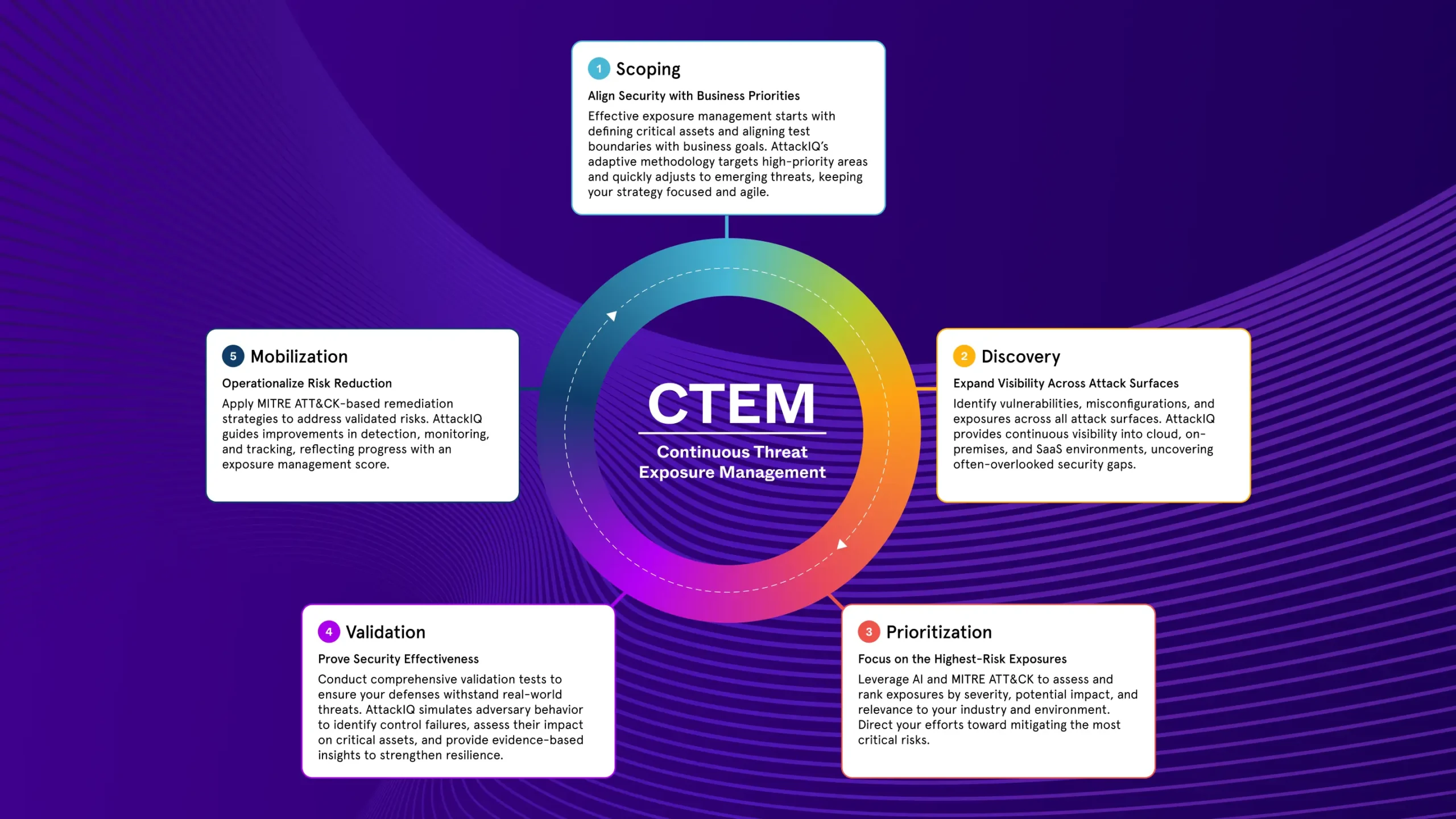
Rather than treating discovery, testing, and remediation as isolated activities, CTEM establishes an ongoing operational cycle built around five stages:
Scoping – Identify what truly matters: crown-jewel systems, critical business processes, and assets tied to material risk.
Discovery – Surface vulnerabilities, misconfigurations, and exposures across the environment.
Prioritization – Focus effort on exposures that are both exploitable and impactful, rather than chasing raw volume.
Validation – Confirm whether defenses actually prevent or detect real-world attack behaviors.
Mobilization – Drive accountable remediation and feed lessons learned back into the cycle.
Validation Powers Decision Support
The most important shift CTEM introduces is the elevation of validation. Discovery identifies what might be wrong. Validation determines what actually matters.
When validation becomes continuous, security teams stop relying on assumptions and start managing risk with evidence. This shift drives defense efficiency and effectiveness. Teams focus resources on the validated exposures that matter most and stop chasing overwhelming vulnerability lists that have little impact on overall risk.
How MITRE INFORM Enables Threat-Informed Defense Maturity
If CTEM defines how organizations manage exposure operationally, INFORM defines how defenses are designed, aligned, and improved based on real adversary behavior.
INFORM is a threat-informed defense maturity model built around frameworks such as MITRE ATT&CK®, which provide a common language for describing how attacks actually unfold. The goal is to ensure that intelligence, defensive controls, and testing evolve together—rather than in silos.
At its core, INFORM emphasizes alignment over accumulation. Instead of deploying more tools or controls, organizations focus on ensuring that what they already have is relevant, effective, and validated against real threats.
INFORM provides a roadmap to threat-informed defense maturity, enabling organizations to think strategically about their current capability and where to invest next.
The Core Elements of INFORM
INFORM turns threat-informed defense into a measurable framework with three dimensions that look across people, processes, and technology.
Cyber Threat Intelligence (CTI)
Threat intelligence provides context. Mature programs move beyond passively consuming reports and feeds and instead focus on understanding which adversary behaviors are most relevant to their organization.
The value of CTI lies in its ability to inform action—turning observed attacker behavior into concrete hypotheses that can be tested and validated.
Defensive Measures (DM)
Defensive measures include the technical and procedural controls designed to prevent, detect, or limit attacks. INFORM encourages organizations to align these measures directly to adversary techniques, creating clarity around what is covered and where gaps remain.
This approach frequently exposes a hard truth in large enterprises: the presence of a control does not guarantee its effectiveness.
Testing and Evaluation (T&E)
Testing is where confidence is earned. INFORM treats testing not as an annual event, but as a continuous capability.
By regularly evaluating defenses against known adversary behaviors, organizations replace assumption with evidence and establish a learning loop that drives real improvement over time.
CTEM + INFORM = Threat-Informed Exposure Management
CTEM and INFORM are complementary by design.
CTEM provides the operational rhythm—what to test, when to test it, and how to act on the results.
Threat-informed defense provides the adversary-centric foundation for CTEM, ensuring that security programs are aligned to real-world adversary behaviors and focused on the threats that matter most.
INFORM provides the strategic roadmap to threat-informed defense maturity—ensuring intelligence, defenses, and testing remain aligned to real threats.
Together, they create a system in which exposure is identified and prioritized continuously, defenses are aligned to adversary behavior, effectiveness is validated rather than assumed, and results inform governance, investment, and strategic decisions.
From Metrics to Meaningful Assurance
One of the most significant outcomes of adopting CTEM and INFORM is the change in executive-level communication.
Instead of abstract risk scores or activity-based metrics, security leaders can speak in terms of validated exposure reduction, defensive coverage against real attack techniques, detection and response effectiveness, and demonstrated improvement over time.
The conversation evolves from asking “Are we secure?” to “Here is what we can defend against today, how that capability is changing, and where we are investing next.”
Final Thoughts
Modern cybersecurity is no longer about deploying more tools or generating more alerts. It is about measuring what matters, validating what works, and improving continuously with intent.
CTEM provides the operational discipline to manage exposure in real time. INFORM provides the threat-informed structure to ensure defenses remain relevant and effective as adversaries evolve.
Together, they deliver what security leaders have long needed: credible, defensible assurance in an environment of constant change.
For organizations facing expanding attack surfaces and rising expectations from boards, regulators, and customers, that assurance is no longer optional—it is strategic.
Jon Baker
Jon brings over 20 years of experience leading innovation in cybersecurity with a focus on making security more efficient and effective at scale. He is the former Director and Co-Founder of MITRE’s Center for Threat-Informed Defense (CTID), where he united sophisticated security teams to advance the state of the art and the practice in threat-informed defense globally. Prior to launching the CTID, Jon led MITRE’s Cyber Threat Intelligence and Adversary Emulation Department where he advanced those critical capabilities across MITRE, and managed the CALDERA and MITRE ATT&CK® teams. Jon led teams developing open standards including STIX and TAXII for threat intelligence sharing, and was the co-creator of OVAL while managing MITRE’s security automation program.
*** This is a Security Bloggers Network syndicated blog from AttackIQ authored by Jon Baker. Read the original post at: https://www.attackiq.com/2026/02/24/from-exposure-to-assurance-how-ctem-and-mitre-inform-enable-modern-cyber-defense/
About Author