The AI Exchange: Innovators in Payment Security Featuring Flywire
Welcome to the PCI Security Standards Council’s blog series, The AI Exchange: Innovators in Payment Security. This special, ongoing feature of our PCI Perspectives blog offers a resource for payment security industry stakeholders to exchange information about how they are adopting and implementing artificial intelligence (AI) into their organizations.
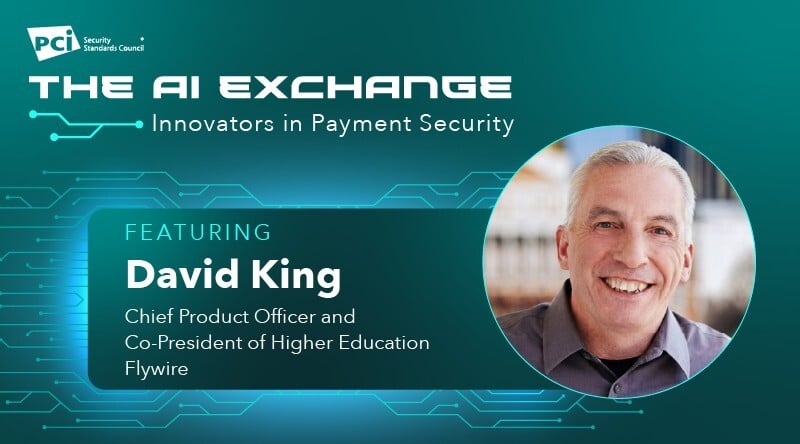
In this edition of The AI Exchange, Flywire’s Chief Product Officer and Co-President of Higher Education, David King, offers insight into how his company is using AI, and how this rapidly growing technology is shaping the future of payment security.
How have you most recently incorporated artificial intelligence within your organization?
At Flywire, we’ve been intentionally moving toward an AI-first mindset across both our technology platform and our internal operations. Given that we operate a global payments network across highly regulated industries like education, healthcare, and travel, our focus has been on applying AI in ways that improve security, efficiency, and customer experience.
On the payments and platform side, we are incorporating AI to strengthen areas such as fraud detection, anomaly monitoring, and operational intelligence across our global payment flows. AI allows us to analyze patterns across a very large and complex payments dataset spanning many currencies, geographies, and payment methods. This helps us detect unusual activity faster and improve risk signals while maintaining a smooth payment experience for our clients and payers.
Internally, we’re also leveraging AI to improve engineering productivity and operational workflows. Our development teams use AI-assisted tooling to accelerate software development, automate routine tasks, and improve code quality. We’ve also begun introducing AI into support and operational processes to help triage issues faster and surface insights from large volumes of operational data.
What is the most significant change you’ve seen in your organization since AI-use has become so much more prevalent?
The most significant change has been the speed at which teams can move from idea to execution. AI has fundamentally shifted the productivity curve for many roles, particularly in engineering, product development, and operational analysis.
We’ve also seen a meaningful shift in how teams approach problem solving. AI has become a powerful collaborator. Engineers, product managers, and operations teams increasingly use AI to explore design options, analyze complex datasets, and test ideas quickly. That changes the way innovation happens inside the organization because experimentation becomes faster and less constrained.
At the same time, the rise of AI has reinforced the importance of strong governance, security, and responsible use, particularly in a regulated industry like payments. As organizations adopt these technologies, it’s critical that they implement them in ways that align with security frameworks and compliance requirements, including those that underpin the payment ecosystem.
How do you see AI evolving or impacting payment security in the future?
AI will have a profound impact on payment security in the coming years, both in terms of strengthening defenses and changing the nature of the threat landscape.
On the defensive side, AI has the potential to significantly improve how organizations detect and respond to risk. Payment ecosystems generate enormous amounts of transaction and behavioral data across geographies, currencies, and payment methods. AI can analyze these patterns at a scale that would be impossible for humans alone, enabling earlier detection of anomalies, faster identification of fraudulent activity, and more adaptive risk models. In many ways, AI allows security teams to move from reactive controls to much more predictive and real-time protection.
However, we also must acknowledge that attackers will use the same technologies. AI will likely enable more sophisticated fraud techniques, more convincing social engineering, and faster attempts to exploit vulnerabilities.
What potential risks should organizations consider as AI becomes more integrated into payment security?
As AI becomes more integrated into payment security, organizations need to think carefully about both the technological risks and the operational risks that come with it.
One key consideration is data governance. AI systems rely on large datasets to train and operate effectively, and in the payments ecosystem that data can include highly sensitive financial and personal information. Organizations must ensure that data used in AI models is properly protected, access is controlled, and that AI tooling operates within the same security boundaries required by frameworks such as PCI DSS.
What advice would you provide for an organization just starting their journey into using AI?
My advice for organizations beginning their AI journey is to start with clear, practical use cases rather than the technology itself. AI can be incredibly powerful, but the most successful implementations begin by identifying specific problems where AI can meaningfully improve outcomes—whether that’s improving fraud detection, automating operational tasks, or extracting insights from large datasets.
The second piece of advice is to build a strong governance and security foundation from the start. In industries like payments, where data protection and trust are paramount, AI initiatives should be implemented within existing security, compliance, and risk frameworks. That includes understanding how data is used, controlling access to models and tools, and ensuring that AI solutions align with standards such as PCI DSS and other regulatory requirements.
It’s also important to invest in education across the organization. AI is not just a technology initiative—it’s a capability that will influence how product, engineering, operations, and security teams work.
Finally, organizations should approach AI as a long-term capability rather than a single project. The technology is evolving rapidly, and companies that build internal expertise, experiment thoughtfully, and continuously refine their approach will be best positioned to benefit from it.
What AI trend (not limited to payments) are you most excited about?
The trend I find most exciting right now is the emergence of AI systems that can collaborate and operate as coordinated agents to solve complex problems. Instead of AI being used for a single narrow task, we are starting to see models that can break down problems, coordinate with other AI systems, and execute multi-step workflows in ways that begin to resemble how teams of people work together.


About Author