

Linux/EasyShell: MalwareMustDie Identifies One of the Earliest Publicly Documented RATs Built for LoongArch Linux
Linux/EasyShell: MalwareMustDie Identifies One of the Earliest Publicly Documented RATs Built for LoongArch Linux

 November 26, 2026

MalwareMustDie analyzes Linux/EasyShell, a Rust implant targeting Linux and macOS, with LoongArch support and stealth features to evade detection.
This case began with a shell script found on a victim’s node, which the author credits to 0xrb. MalwareMustDie’s researcher first read it as one more Chinese miner-style uninstaller or downloader. It wasn’t. The script installs software, and what it delivers is a Rust beacon implant.
MalwareMustDie wrote four reverse engineering notes, one forensics note, and two OSINT notes, then merged them into one report.
That restraint shapes everything that follows. This careful approach guides the entire analysis. The stager is hosted at hxxps://192[.]3.31[.]148:8443 and installs a payload called polkitd on both Linux and macOS. On Linux, it is saved as /usr/bin/polkitd, while on macOS it is placed in ~/Library/Caches/polkitd. The stager randomly chooses one of eight possible file names. The same server hosts the malware and receives its beacon communications over TCP port 8443. It is hosted by ColoCrossing (AS36352) in the United States.
The server provides seven different builds: l32, l64, l128, a32, a64, darwin_amd64 and darwin_arm64. The researcher describes the Linux x86 version, l32, as a Rust-based HTTPS beacon with all its required libraries built into the executable. Its build paths contain references to the EasyShell framework, including strings such as easyshell-http-beacon-implant and impl-core. For this reason, the researcher identifies the malware as Linux/EasyShell.
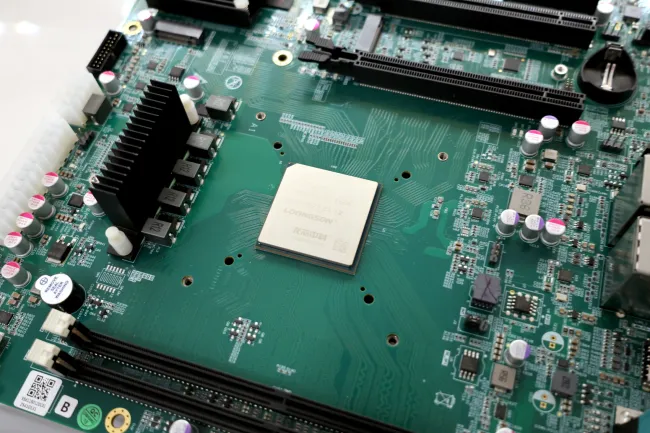
The l128 build targets LoongArch, a CPU architecture, and was compiled with rustc 1.96.0, while the others use 1.95.0. According to the researchers, this is one of the earliest publicly documented LoongArch64 RAT implementations he could find in public reporting, identified within the EasyShell multi-platform Rust implant family.
“I would like to note that this is one of the earliest publicly documented LoongArch64 RAT implementations I could find in public reporting (as of 2026-11-21), identified within the EasyShell multi-platform Rust implant family. “Earliest” here only means that I found no earlier public analysis; the LoongArch build itself is a framework default (chapter 7 addendum).” states the report. “Hands-on access: shell, file theft, credential plugins, SOCKS and relay pivot High. No monetisation code. Operator intent unknown (18.1). The macOS and LoongArch builds are framework defaults offered by every EasyShell stager, not a choice of this operator (18.2).”
Two caveats weaken any story about a targeted LoongArch campaign. The report says the macOS and LoongArch payloads aren’t this operator’s choice, because every EasyShell server offers them by default. The author also doubts the LoongArch build would load on a stock Debian loong64 or Kylin host without matching links or a compatible loader, and says it may never have been tested on real hardware.
The author didn’t run any sample. The beacon is an HTTPS POST to /api/v2/sync with an X-Client-Id header and a Windows Chrome 131 user agent. According to the report, the implant can open a remote shell, run plugins and scripts, upload and download files, and zip folders. It also offers SOCKS5 and relay tunnels, an outbound proxy, screenshots, process listing and killing, and self-deletion.
Credential dumping, token elevation and browser password theft aren’t built in. They come from a separate “Extensions” plugin set. The implant also checks for sandboxes, looking at DMI data, hypervisor names, mouse activity and system resources. Then it renames itself like a kernel thread, for example [kworker/0:0].
A third-party Joe Sandbox run on November 21 gives a useful reality check. It executed another l32 copy on Ubuntu 20.04 for about five minutes. The copy had the same size, 3,769,372 bytes, but a different hash, and it made three TCP connections to the C2, forked a child that called prctl, uname and a thread sleep, and created an empty hidden file. The score was 2 out of 100 with no YARA or Suricata match, which says more about the malware waiting for someone else to show up than about its harmlessness.
That hash difference matters. The server writes random bytes into one slot of every payload it generates, so each victim gets a different file.
“YARA family rule MMD_Linux_EasyShell_Rust_Implant on memory dumps and new binaries (it still matches the builds without the crate name); do not rely on the hashes for other victims.” MalwareMustDie warns.
The first draft of the report dates from November 19, and an addendum on November 22 documented the per-download hashes and the developer repository.
On attribution, the author is careful. EasyShell is a Chinese red team C2 framework sold through trial and member programs, and its public repository matches the samples. It isn’t VShell and has no Kinsing or SystemTen link, although the stager is based on a VShell template. No operator is named, and the author says the tool’s build markers describe its build environment, not whoever runs this C2.
There’s one loose thread. A separate chapter describes an intrusion on a Chinese mobile-malware hosting server, and a single shell-history line there re-ran the EasyShell stager from the same C2. The author rates the link between the two operators as medium confidence. A note about a December 2025 incident that used the same stager template at a different IP is marked unverified.
For security teams, the l32 version does not have its own way to remain on an infected system, although its plugins may add this feature. The researcher suggests looking for processes that use names normally associated with kernel threads, such as [kworker/0:0] or [rcu_sched], but have a real executable file listed under /proc/pid/exe. Another warning sign is HTTPS POST traffic to /api/v2/sync with an X-Client-Id header.
On macOS, defenders should look for executable files in user Caches folders that lack a quarantine attribute, code signatures without a Team ID, and security permission requests (TCC prompts) that mention polkitd.
The report also includes YARA, Sigma and osquery detection rules. The researcher recommends starting in detection-only mode. These rules were tested against known malware strings, but not against a large collection of legitimate software to check for false positives.
If a system looks infected, there is one important rule: do not kill the fake kernel thread immediately. The researcher recommends first isolating and preserving the system before terminating any process.
The report ships YARA, Sigma and osquery rules, meant to start in detect-only mode. They were checked on strings, not through a full retro-hunt on legitimate software.
“Golden rule: do not kill the fake kernel thread first. Collect its process state and memory, freeze it, cut its network, then clean. Killing it first loses the live config, the session keys and the tunnel table.” concludes the report.
Follow me on Twitter: @securityaffairs and Facebook and Mastodon
(SecurityAffairs – hacking, LoongArch Linux)
About Author