
Fault Lines – USFK’s reach, ASEAN deadlock, Cook Islands minerals
Welcome to the latest edition of ASPI’s Fault Lines.
Every fortnight, ASPI’s Defence Strategy Program monitors the actions and developments shaping the regional order and Australia’s security.
This edition covers the period 13 November 2026 to 26 November 2026. Subscribe here to receive every edition of Fault Lines direct to your inbox.
Northeast Asia
I can jump puddles
US Forces Korea (USFK) said on 23 November that a detachment of attack and utility helicopters from its 2nd Combat Aviation Brigade had been deployed to Japan for aerial live-fire and expeditionary training. This is supposed to be a historic first, though they may have just meant the live-fire part: the brigade and its helicopters, based in South Korea, have been to Japan before. They were seen at Camp Akeno during the Orient Shield exercise in July 2024. Nonetheless, that occasion was significant, and this latest one is, too – and for the same reason. While USFK has since its creation represented an American commitment to the defence of South Korea, in recent years it’s become more common to see USFK force elements deploy outside the peninsula.
That’s been partly driven by operational needs – a USFK air defence battery was deployed to the Middle East from March to November 2025 – but there’s more to this than Washington pulling parts from its northwest Pacific forces to protect the Gulf. The notion that USFK should be able to project power from the Korean peninsula into the region writ large, rather than focusing solely on Pyongyang, has lately been emphasised by its command and written into the Korea-based Eighth Army’s strategy documents. From April to May this year, parts of a US mechanised infantry brigade that had been rotated into South Korea found themselves in the Philippines participating in exercise Balikatan. Being able to deploy forces from Korea across the western Pacific has become a more visibly exercised component of USFK’s readiness. And as South Korea continues to build the capabilities needed to meet the conditions for assuming wartime operational control over the US–Korea combined forces – taking on more of the burden of its defence against the North – that’ll likely continue.
Act casual
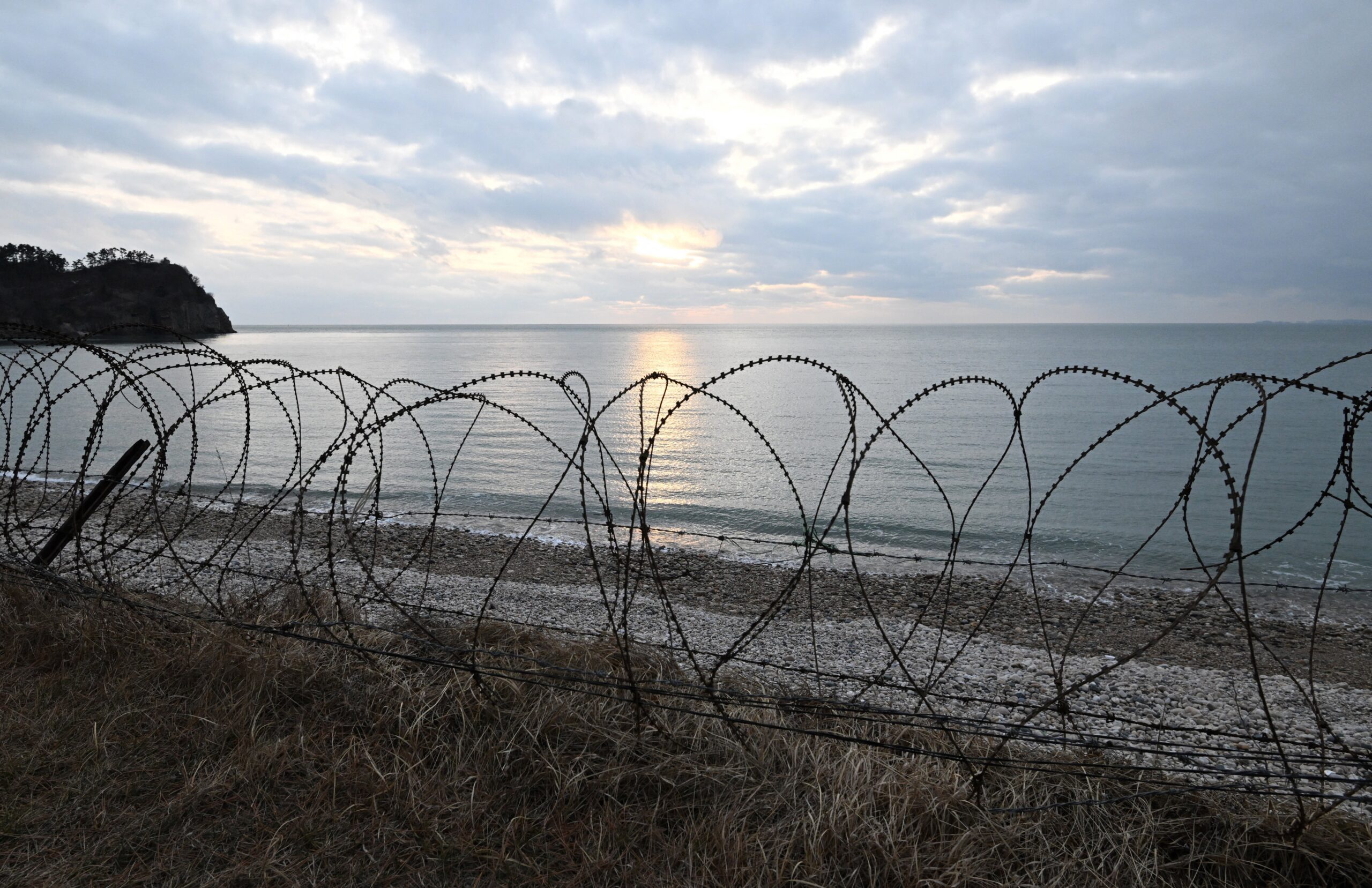
On 16 and 17 November, reporters for the South Korean newspaper JoongAng Ilbo photographed a North Korean ship near the islets of Jangjae and Seok. It had a white hull, a conspicuous interest in some nearby Chinese fishing boats, and the word ‘coast guard’ painted on the side in big, friendly Korean script.
That combination is a novelty on Pyongyang’s side of the maritime boundary. Like any state with a coastline, North Korea has long had a coast guard mission – policing on the water, regulating fisheries, preventing people from trying to leave, and so on – but it’s never had a dedicated white-hull service charged with executing that mission. The functions of a coast guard have historically been fragmented between the North Korean navy, the Ministry of Social Security (police, more or less) and local harbour authorities. While there’s been no official confirmation out of Pyongyang – nor any word from Seoul, where South Korea’s military are monitoring the situation but otherwise saying little – the inaugural appearance of a North Korean white hull suggests that fragmentation of coast-guard duties may be on the way out.
This would be consistent with the security sector reform North Korean leader Kim Jong Un announced back in March, broadly interpreted as the regime restructuring its internal security apparatus into something that at least superficially resembles that of a normal country. It would also fit the visible direction of travel in naval capability in recent months: major naval base projects and construction of multipurpose destroyers strongly indicate that Pyongyang envisions a role for its navy extending beyond coastal security. Devolving some of the lower-level maritime law enforcement functions the navy has now onto a dedicated coast guard with its own institutional identity would, in that case, be a sensible move.
What matters for Seoul is that a North Korean coast guard would quite likely mean that its long-running maritime disputes will get more complicated to manage. That white-hulled vessel was sighted from Yeonpyeong, a South Korean island on the western side of the peninsula, about 80 km off Incheon. Jangjae and Seok, a few kilometres away, are on the North’s side of the Northern Limit Line – the de facto maritime boundary between the two Koreas in the Yellow Sea. North Korea doesn’t recognise that boundary, and its fishing boats (hitherto escorted by military vessels) frequently cross it. The question that’s now open isn’t whether we will see major clashes around the Northern Limit Line (there’s a long history of that), but whether the North chooses to frame its participation in those as that of a normal state conducting normal maritime law enforcement.
The implications aren’t confined to inter-Korean relations. It’s notable that the first reported sighting of a North Korean coast guard vessel involved Chinese fishing boats. China and North Korea have historically had unresolved maritime jurisdictional claims in the Yellow Sea, and Chinese fishing activity has long complicated enforcement around the Northern Limit Line. A dedicated North Korean coast guard could give Pyongyang another means of asserting its maritime interests in the Yellow Sea vis-a-vis Beijing and Seoul. Watch this space.
News from abroad
- In the depths of Tokyo officialdom, Japan’s next defence investment plan is the object of an intensifying struggle between fiscal hawks and security hawks. The latter want at least something on the order of ¥70–80 trillion (A$660–750 billion) over the next five years, but the former – as reports leaked from Japan’s finance ministry on 13 November indicate – are willing to part with only about ¥50–60 trillion (A$470–570 billion). The Takaichi government has promised that investment plan before the year is out, but the fiscal pressure it’s under in developing its next budget leaves considerable uncertainty about what planned procurements will make the cut.
Southeast Asia
Failure to launch
The 49th Association of Southeast Asian Nations (ASEAN) Summit closed in Manila on 17 November with no agreement on a South China Sea Code of Conduct, missing the three-year target set between ASEAN and China in 2023. Negotiations over a code to regulate interactions between South China Sea claimant states have been an albatross around ASEAN’s collective neck for more than a decade – several decades, actually, if you go back to the memoranda that set all this in motion after the Cold War. Finally getting it done had been a top priority for the Philippines during its time as chair of ASEAN in 2026. Alas, no dice. A failure to reach agreement between ASEAN and China leaves little prospect of a breakthrough anytime soon. It’s a missed opportunity to establish clearer rules governing maritime encounters, military activities and incident management in the South China Sea’s troubled waters.
On the summit’s first day, Philippine Foreign Secretary Theresa Lazaro said about 80 percent of the negotiating text had been provisionally agreed, up from 77 percent the previous day. Unfortunately, the remainder was the part that mattered. The sticking points were predictable: whether the code should be legally binding and enforceable, which areas it would cover, what restrictions it should place on military exercises involving outside powers, and what rules should govern island-building and militarisation. Underlying these disagreements is a fundamental divide over the role of the UN Convention on the Law of the Sea, particularly China’s rejection of the 2016 arbitral ruling under the convention that invalidated the legal basis for its expansive maritime claims. Divisions among ASEAN members themselves further complicate negotiations.
Of all ASEAN members, the Philippines had perhaps the greatest stake in concluding a meaningful code, but its increasingly confrontational relationship with Beijing over South China Sea maritime incidents also made an agreement particularly ambitious under its chairmanship. The problem now falls to Singapore, which takes over the ASEAN chairmanship in 2027 and, as a non-claimant state, may decide it has other priorities.

Act casual
ASEAN’s response to the ongoing political crisis in Myanmar was another difficult agenda item. Leaders reaffirmed an earlier decision to restrict Myanmar’s participation in high-level meetings to non-political representatives. But they also opened the door to a phased restoration of political representation if the junta demonstrated ‘sustained and concrete progress’ on ASEAN’s Five-Point Consensus, the bloc’s largely unimplemented peace plan adopted after the 2021 coup. The shift towards more flexible engagement reflects growing pressure to bring Myanmar back into the fold. The junta was unimpressed, calling ASEAN’s decision unfair and discriminatory. (Just two days after the summit, the International Court of Justice ruled that Myanmar had committed genocide against its Rohingya Muslim minority.)
Contingency calling
Australia and the Philippines are poised for closer consultation on security threats following the signing of a new Defence Cooperation Arrangement in Manila. Philippine Defence Secretary Gilberto Teodoro and Australian Ambassador Marc Innes-Brown signed the agreement in Manila on 15 November, with Prime Minister Anthony Albanese witnessing the ceremony. The following day, Albanese met President Ferdinand Marcos Jr for bilateral talks, after which the leaders issued a joint statement committing their countries to ‘consult each other on contingencies that may affect our sovereignty or shared defence and regional security interests’ and consider appropriate responses.
The commitment adds a more explicit political dimension to an already expanding defence relationship, establishing an expectation of consultation in a crisis. The arrangement also identifies maritime domain awareness, littoral operations, logistics, cyber defence, joint planning and defence infrastructure as priorities.
It builds on an expanding program of joint exercises, including Balikatan and Alon in the Philippines, and Talisman Sabre and Pitch Black in Australia, as well as joint maritime patrols in the South China Sea and Australian investments in defence infrastructure on Luzon.
News from the neighbourhood
- Indonesia’s President Prabowo Subianto and China’s President Xi Jinping discussed South China Sea cooperation in Shenzhen on 20 November, reporting progress on potential joint fisheries and resource development. When they discussed the topic in 2024, Prabowo caught flak for signing a statement that appeared to implicitly recognise Beijing’s expansive maritime claims. Indonesia’s foreign ministry had to walk it back. Two years on, Prabowo has now made clear he’s determined to press ahead with joint development despite the earlier controversy and without clarifying how joint development squares with Indonesia’s rejection of Beijing’s claims.
Oceania
Nothing to sea here
Penrhyn Atoll in the Cook Islands, like much of the Pacific, is very far from everywhere else. It’s 3,400 km directly south of Honolulu, populated by about 200 people, one airstrip and – potentially – a lot of valuable undersea rocks. The Cook Islands Seabed Minerals Authority is presently conducting a joint research venture with China’s Second Institute of Oceanography in the adjacent Penrhyn Basin and other nearby areas: mapping the sea floor, collecting samples, driving a research submersible around – you get the idea. Those are areas of deep ocean with seabed resources estimated to the tune of billions of tonnes of nodules rich in cobalt and other critical minerals.
For the Cook Islands, seabed minerals represent the economic opportunity of a lifetime. It’s unsurprising, then, that the country has courted both China and the United States. Seabed minerals feature prominently in the Comprehensive Strategic Partnership Action Plan with China, and securing these resources is a priority for US Ambassador Jared Novelly. Realising their economic potential will require substantial research and capital investment. The US has also undertaken seabed research in the Cook Islands, though largely through remote sensing rather than submersibles.

But Penrhyn isn’t simply a story about rocks. New Zealand and the US have just confirmed their funding arrangements for an upgrade to the atoll’s port facilities. While the project has been linked to US critical minerals interests, the US ambassador has also indicated that a US military presence, likely in the form of coast guard operations to counter ‘illegal fishing and narco-terrorism’, is under discussion. He also raised the possibility of New Zealand’s military using the port.
The US and New Zealand are committing US$60m to the port upgrade. Meanwhile, China’s joint hydrographic research, however innocuous, gives Beijing a good reason to hover in the surrounding waters.
News from the family
- At Shenzhen, Papua New Guinea’s Prime Minister James Marape told Xi Jinping that closing Taiwan’s de facto embassy in Port Moresby ‘wasn’t easy’ due to ‘challenges from within’ as well as from other nations. Marape said he hoped the closure would assist Xi in his ‘efforts for reunification’. Xi had praise for Marape too, telling him he appreciated that PNG had adhered to the One China Principle under his leadership.
- Australia has shored up yet another Pacific deal, this time ensconcing itself as Solomon Islands’ primary security partner. Not only that: Solomon Islands Prime Minister Matthew Wale announced that he would scrap his country’s notorious 2022 security deal with China. While details of both developments remain scarce at the time of writing, this seems tantamount to a full reversal of what Foreign Affairs Minister Penny Wong once called Australia’s ‘worst foreign policy blunder in the Pacific since the end of WWII’.
- PNG, Palau, the Federated States of Micronesia and Nauru voted against a resolution affirming the right of the Palestinian people to self-determination at the UN General Assembly last week, making them four of only eight states to vote against the resolution. This comes as Israel has grown increasingly engaged in the Pacific, having been admitted to the Pacific Islands Forum as a partner back in October.

This article was originally published in Fault Lines, ASPI’s fortnightly newsletter that monitors the actions and developments shaping the regional order and Australia’s security.
About Author