Smashing Security podcast #466: Meta sees everything, Copy Fail, and a deepfake gets hired
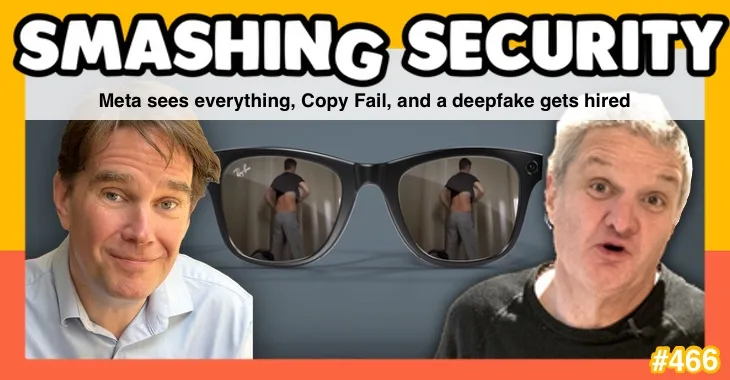
Meta’s smart glasses promise privacy “designed for you” – but everything they record was being beamed off to workers in Nairobi to label by hand. When those workers blew the whistle, Meta sacked all 1,108 of them.
Meanwhile, the IT press is in a frenzy over a new Linux bug called “Copy Fail” – complete with logo, dedicated website, and a marketing-friendly name. But is it really the disaster everyone’s making it out to be?
And in our featured interview, Jake Moore of ESET explains how he tricked a company into offering his deepfake clone a job – after a perfectly normal-looking video interview.
All this and more in episode 466 of the “Smashing Security” podcast with cybersecurity expert and keynote speaker Graham Cluley, joined this week by special guest Paul Ducklin.

0:00
0:00
Show full transcript
▼
 This transcript was generated automatically, probably contains mistakes, and has not been manually verified.
And yeah, but this, this is the reality. This trillion-dollar industry of AI, the actual truth is there’s an awful lot of people who are having to do this.
Smashing Security, Episode 466. Meta sees everything, copy fail, and a deepfake gets hired with Graham Cluley and special guest Paul Ducklin.
Hello, hello, and welcome to Smashing Security, Episode 466. My name’s Graham Cluley.
This whole cybersecurity business seems to be shutting down. Maybe we’ll have to find ourselves a new job.”
This week on Smashing Security, we’re not going to be talking about how a Brazilian firm that protects businesses from DDoS attacks was found to be helping a botnet that launched massive DDoS attacks.
You’ll hear no discussion of how Microsoft Defender started mistakenly detecting DigiCert root certificates as a Windows Trojan horse.
And we won’t even mention how hackers managed to steal source code from cybersecurity giant Trellix. So, Duck, what are you going to be talking about this week?
And if you’ve been looking at the IT media at all in the last week or two, you will probably have seen the words “copy fail.” And I’m going to be talking about another reason why you should probably steer well clear of Meta’s smart glasses.
All this and much more coming up in this episode of Smashing Security. Well, we’ve got time now to chat about one of the sponsors of this week’s show, Action1.
Now then, if you are a systems administrator managing endpoints every day, you’ve probably postponed patching at least once, not because you forgot, but because you didn’t feel like gambling with uptime.
And thanks to Action 1 for supporting the show. So, Duck, I need to make an apology. Not specifically to you, to the listeners, I think.
Back in February, I had a bit of a rant with James Ball about the smart glasses made by Meta, and I explained how Mark Zuckerberg’s company was planning to turn on facial recognition within the glasses and how it had been reported that there was this secret internal memo inside the company that said—
You know, people who care about privacy and stuff are going to object.” And so they said, “The best thing that we can do is time this to be when there’s some other political chaotic event going on, distracting all those civil liberties people.”
No one will notice.
So there’s another reason, as if that weren’t bad enough, 11 episodes ago, we are back with another alarming story emerging about how these AI smart glasses that are being sold on the high street, and I was in an airport recently, it was in a duty-free store.
They’ve been sold all around the world.
People are going around with these Buddy Holly-style glasses, and of course, these are geeky kind of glasses, but with cameras and a microphone and an AI voice assistant tucked into the frames.
And if you hear what Meta are saying about them, one of the central messages they push out and they want you to remember, and this is the quote they give people, is they are “designed for privacy controlled by you.”
These are spectacles that you wear that record the entire world around you, upload stuff to the cloud even when you forget that this is happening, and that somehow improves your privacy and everybody else’s.
I’m loving to hear how that works, Graham. Do tell.
So two Swedish newspapers, Svenska Dagbladet and Göteborgs-Posten — apologies to anyone Swedish for the mangling I’ve done of your beautiful language — they were working with a freelance journalist in Kenya.
It tells you, right? And you may well ask yourself, who actually sees that footage that you’ve just taken? Who analyzes it?
And the answer is that it’s 1,000-odd people sitting in front of computer screens in Nairobi. In Kenya, there is a firm called— Duck, do you want to fill in the blank?
So, they are the same Sama that Meta hired previously to moderate Facebook posts.
Now, as was well documented, that earlier contract ended in lawsuits and former employees of Sama describing frankly the horror and the psychological trauma that they had to endure from being made to watch what is uploaded to the internet by Facebook users in their Facebook posts.
And they were doing this 10 hours odd a day, not very much money. And Sama later said that they regretted, you know, taking on that work for Facebook.
Their new job was to look at the videos coming out of their smart glasses and label up what was in them so that Meta’s AI could learn the difference between a flowerpot and a traffic cone.
I think normally you have to say, “Hey, Meta,” a bit like, “Hey, Google,” or, “Hey, Siri.” You have to ask them to do something, but maybe there’s an option to have them permanently on.
So they don’t do a sort of biometric nose print to know that they are balanced upon your nozzle. Nothing that.
So you got them recording, you take them off, you put them down somewhere in a coffee shop, and then you wander off to the toilet or to the counter or whatever, they just carry on recording surreptitiously while they’re on the table?
So these employees, as I said, they’re drawing little boxes around things to say, this is a flowerpot, this is a traffic cone, this is a coffee tender, whatever it may be.
And, you know, but this is the reality. Duck, this is the reality. This trillion-dollar industry of AI.
The actual truth is there’s this unglamorous manual labor which is critical to the foundations of it.
You know, there’s an awful lot of people who are having to do this to train the AI, if AI even exists at all, to do these things.
But it pretended to be AI and its behavior was surprisingly AI. So maybe that website had more going for it than you might think.
Because these people had signed NDAs, they were terrified of losing their jobs. And what it turned out was that they weren’t labelling flowerpots and chihuahuas.
As one of them said, they said, “We see everything from living rooms to naked bodies. We see everything.” And what does everything mean? It means everything.
So they said, “We see footage of people on the loo.” Footage of people undressing, footage of people’s bank cards, footage of people watching pornography while wearing the glasses.
But what I hadn’t thought of, which is really obvious when you think about it, is when you get out your credit card to pay for something online.
Yes, you will unavoidably look straight at it. And modern credit cards have the numbers writ large so you can’t get them wrong.
And you say, well, show me what the password is then. Then that password is being beamed through as well, isn’t it? Absolutely.
You’ve just given away all the data that somebody would need to read out the NFC chip.
Shortly afterwards, his wife walked in, started getting changed, and the glasses were still recording. She had no idea. But it’s not just the video footage.
There’s also transcripts of what is being said by people wearing the glasses.
Workers reviewing these conversations, they said they heard chats about crimes and all kinds of what was ominously described as dark things.
Meanwhile, it’s going into the cloud so that some system can record what they said, and someone in Kenya gets to listen to it in case it got the words wrong.
It’s all very above board, says Meta. So the reporters looked at that one by one to see if that was true, and they found that the blurring fails.
According to workers at Sama and former employees at Meta, faces which are meant to be obscured aren’t, particularly in low light, like for instance, a bedroom, or when the camera’s moving quickly, which of course, if you have glasses on your face and you turn your head, your camera is moving quickly.
So the blurring is not reliable. Also, Meta says that it’s only when you choose to share your data.
So these reporters in Sweden, they bought a pair of glasses themselves and they went through the setup and the app asked, would you like to share extra data with Meta to help improve the products?
And they said no. Oh, extra data. Yes, I wondered if that extra data was carrying quite a lot.
And there’s nothing you can do about that now. You can stop using the AI features going forward, but that’s about it.
But worse still, and I’m sure this is the sort of thing that upsets you as well as me, Doug, is that if you see somebody else wearing them, someone you didn’t agree to be filmed by, you’re probably right to be paranoid that maybe your picture or what you’re doing is being uploaded there as well.
People are allowed to film in public places if they want to take photos.
This is a little bit different where somebody is recording their point of view and the things that are going on in their vicinity essentially continuously, and then possibly even without realizing it themselves, are kind of sharing that information with someone else.
It’s not even enough to trust the person who’s wearing the glasses and go, well, they’re a good friend, they wouldn’t do me down, ’cause they might be doing you down without even knowing.
And now a word from our sponsor.
Now, there’s no shortage of cybersecurity vendors claiming to be the best, of course, but ESET is one of the few that’s been proven it for 30 years.
Research has always been at the core of what ESET does.
Their threat intelligence teams are actively tracking APT groups and ransomware affiliates and publishing findings that the security community actually reads and references.
That’s not a marketing line. That’s 30 years of doing the work. And here’s what makes it interesting.
3 decades of research means that ESET has built up global telemetry that most vendors simply don’t have access to.
They combine that telemetry with AI-native technology and human expertise, and that’s what powers both their products and their MDR service.
Real intelligence behind the protection, not just pattern matching. 110 million users worldwide trust ESET with their endpoints, cloud, email, and mobile devices.
That number doesn’t happen by accident. So why don’t you check them out right now? Go to smashingsecurity.com/ESET. That’s smashingsecurity.com/ESET.
And thanks to ESET for supporting the show. Duck, what have you got for us this week?
Listeners will probably remember things like Heartbleed and Lucky 13 and Poodle and amazing bug names that stick in the mind because somebody decided, hey, I’m so proud of myself for finding this bug and disclosing it that I don’t just want to be a name in someone’s bug report 3 months later.
I want a website, a special domain, a logo. And even in one famous case, there’s a theme tune.
And so some bugs maybe get a notoriety or a degree of coverage that’s perhaps bigger than they really deserve. Not that it’s bad to know about bugs.
The problem is that if you’re focusing on something which is important but not critical, what are you losing sight of? Because there’s one that’s caught the media’s attention.
And the one I want to talk about right now is called Copy Fail.
And it is all over the IT media and it’s getting posted and reposted and copy-pasted all over social networks, I guess, because clicks.
It is a feature in the Linux kernel that aims to speed up some particular process by actually avoiding copying memory in and out between the kernel and a program and back from the program to the kernel to save time.
And in fact, the whole reason for this bug is trying to avoid copying things between blocks of memory as much as possible. And fail just means it didn’t work.
So that’s the researchers’ justification for choosing the name.
My suspicion is that the nice thing about that name rather than any other is that firstly, there is a top-level domain,.fail. Is there? And yes.
And the domain name copy was not taken. And as you say, copy, people might think, hey, there’s a clipboard involved, all of that stuff.
So I suspect that they chose the name because it’s not unreasonable, but they were able to get the domain.
So I think it’s a bit like, you know how US lawmakers love to give their laws fancy names that you can remember. And you think, hey, what’s the chance of that?
So, you know, they have a law and say, oh, this is the Fandango Act. And then you think, Fandango, what on earth is that?
And then when you hear it, it’s some weird concoction like, I don’t know, I’m trying to make one up as I go along, Federal Arrangement Never to Disparage Aerospace Navigation by Geographic Obstinacy or something.
And you think—
So I think in this case, they maybe figured, hey, we can get the domain name, we can get the website, we can promote this because for better or for worse, the reason they want to talk up this particular bug, Copyfail, is that the principle of the bug was uncovered by a human researcher who then used this company’s AI bug hunting tool to go looking for code examples in the kernel where this very kind of bug might have happened.
Okay. And they found several, and this was the worst of them.
So clearly, if not their primary goal, at least their major secondary goal is to talk up their bug hunting statistical analysis tool.
in and you can ransomware someone’s computer or servers without having root access because usually you, the user, have access to all your files and that’s all you care about.
However, it’s much more devastating if they can get admin-level access first. So you do often get remote code execution bugs chained with EOPs, elevation of privilege.
So I don’t want to underplay this bug, but it doesn’t mean that someone can break into your computer.
And as you say, because it’s Linux-specific, it relies on you running the Linux kernel. It’s not directly going to affect anybody who’s got a Mac or who is running Windows.
Even if you’re saying it’s not the end of the world as we know it, there’ll be many people who will think, well, I still don’t want this problem residing on my systems.
So maybe someone’s got a server and they say, “Hey, Graham, would you like a login on it?” You go, “Yeah, that would be very handy.
I might run a web server.” And they said to Duck, “Would you like a login?” And I said, “Oh yes, I’d love to use it for my backups.” Now, what if either of us could promote ourselves to root access and therefore read each other’s files?
That would not be good. So you definitely want to stop this. Now, this bug has been patched. So it’s a great reminder to everybody who runs Linux systems: patch early, patch often.
The new fixed kernel that no longer has this buffer leak is immune to this particular exploit.
But you know how most companies have to prove they’re secure to customers or auditors and regulators, and the whole thing involves chasing down evidence, filling in questionnaires and forms, updating the same spreadsheet cells over and over again.
It pulls everything into one place and keeps you audit ready around the clock.
So no more staring at the ceiling at 2 AM wondering whether you’ve got the right controls in place or whether one of your suppliers has been breached.
But this Vanta solution uses AI as well, and it’s the useful kind, flagging risks, collecting evidence, slotting into the tools your team already uses so you move faster, scale without the headaches, and perhaps actually get some sleep.
Go to vanta.com/smashing to find out more.
Could be a funny story, a book that they’ve read, a TV show, a movie, a record, a podcast, a website, or an app, whatever they wish.
It doesn’t have to be security related necessarily. Well, my pick of the week this week is not security related.
My pick of the week this week is a radio program which I heard, a lovely little radio documentary.
You can go and find it on BBC Sounds, and it’s just 20 minutes long, and it’s about a man called Arthur Haley who came from Luton in Bedfordshire.
And do you know what Arthur Haley’s claim to fame is?
Because Arthur Hailey, he was on an aeroplane back in the 1950s, and he was on this plane, and he wondered to himself on this rather long journey, because he lived in Canada at the time, although he’d been born in Luton, and he wondered, “I wonder what would happen if the pilots became ill?
Would I be able to land this plane?” he thought to himself. So, this got him thinking, and so he wrote a little play.
And in 1956, it was shown on CBC, which is the Canadian Broadcasting Channel, a TV drama called Flight Into Danger about exactly that, about what happens when there’s a plane and the pilots become sick from food poisoning or whatever, and one of the passengers has to land the plane, guided down by someone on the ground in air traffic control.
“Surely, you’re joking,” or something. Anyway, but yes.
Apparently, it was an absolute sensation on Canadian television. They didn’t have to have very many sets. It could be done cheaply.
And at the time, these were all broadcast live, right?
They would just act in front of the cameras, and all you needed was a set of the man down in air traffic control and over on the other side of the studio, the cockpit.
And apparently, people went crazy for this. And the BBC, they decided to do their own version, and then they got hold of the Canadian version. They said, “You know what?
This Canadian version is so good. We’re going to show the Canadian version instead on BBC.” And again, it was a sensation. People have said they’d never seen anything like it.
What I listened to was a documentary all about Flight Into Danger. And even though I’ve never seen it, I was absolutely fascinated. A lovely little documentary.
Lovely documentary.
It also helped the career of people Sidney Newman, who came to the British Isles and launched TV shows The Avengers and Doctor Who after the success of this Canadian programme as well.
I’d recommend it. Go and check it out. I’ll put links in the show notes. Lovely 20-minute-long documentary. I just thought, this is really great, and I wanted to share it with people.
So, there you are. That was the origin of the movie Airplane!, and it sounds it’s really good. Maybe someone recorded it. Maybe there is a version online which I can go and check out.
I know the BBC used to just reuse the videotapes because they were so expensive. Just record over a programme they’d made, no matter what a hit it had been.
And that’s why I love things the Internet Archive, which has been preserving old websites, keeping all this stuff because it is our culture.
You know, we don’t want that to have all been erased as well.
Because apparently several years are just missing. And they desperately try and reconstruct the history of Eurovision from the very first one.
They’re probably in an attic somewhere, but how would you ever know?
So when you started talking about the Meta Glasses fiasco, the reason I knew about Sama, was because of an excellent book that I read quite some time ago that my wife bought for me, which is called Code Dependent, with the subtitle How AI is Changing Our Lives, by a British journalist who’s originally from India called Madhumita Murgia.
I think she’s a journalist with the FT.
And she actually went to Nairobi and met with several of the people who worked on various parts of Sama, people who’d seen the terrible stuff people who’d sat there for hours looking for traffic cones and everyone in between.
And that’s just one of the many chapters that she digs into. It’s a very well-recommended book.
But the one that I actually declared in advance to you that I was going to mention, I will now mention. I just happened to reread this.
It’s a book that came out towards the end of last century, so it’s very slightly dated by now. But it’s interesting to see how much of it has not dated.
And it is a book called The Code Book, subtitled The Secret History of Codes and Codebreaking, by a well-known British science popularizer journalist called Simon Singh.
And it’s an excellent review of some key stuff in cryptography, the strengths and the weaknesses.
It’s entirely coincidental that I was reading this book when the whole copy fail thing came out, and it turned out that ironically, a bug in some cryptographic code that was supposed to make the world a safer place ended up potentially opening up your computer to anybody who could log in as root.
That was a coincidence. But the book is full of reminders.
In fact, there’s even a chapter called Le Chiffre Indéchiffrable, the Undecipherable Cipher, which is a cipher called the Vigenère cipher, which was thought to be unbeatable because it was just so clever.
And eventually, actually, Charles Babbage, I think, was the first person who came up with a way to defeat it.
But he’s not remembered for that because he came up with his way to solve it very reliably, even though the cipher’s quite hard to crack.
He came up with a trick for breaking into it, and he discovered this just before the Crimean War with Russia back in the mid-19th century.
So the theory is that he was told to keep quiet about it, and he never got any credit for cracking it.
The credit went to someone else several years later, and his cracking it was kept quiet because I suppose the British were afraid that the Russians might stop using it if they knew that it had been cracked.
So it’s a fascinating book full of those stories about how what seems impenetrable at first sight can either be cracked by a bit of cleverness or sidestepped completely by a bit of manipulation, bribery, corruption, social engineering, or what have you.
Well, I can recommend the book as well.
ing in the police force and now with ESET looking into what criminals are using. So I’m just so fascinated with it.
It’s something that was never on anyone’s radar, but yet if anyone is to infiltrate a company, why not get straight into the company itself and penetrate it from within?
If they’re able to be sent a laptop, there are lots of remote jobs out there.
I speak to big businesses who genuinely have this problem, who say, well, we’ve got contractors all around the world.
We’ve got to send out these laptops to them and once they are on their laptop, they can do so much more than their remote attacks.
So it is a huge worry, but on the flip side, there are these big companies saying, well, what can we do about it?
We can’t interview them all in the UK or wherever we might have a base because they might be anywhere in the world.
Or are there any practical tells which they can see if they are on a call and they think it’s suspicious?
There’ve been some great videos like that, but it’s difficult to say, come up with one simple thing like, oh, get the interviewee to cover their face with their hand or look like they’re waving in front of it, because it’ll only be a year or so before that can be circumnavigated.
Actually, the software that I use, as soon as it sees a hand near the face, it goes back a couple of seconds and freezes to when it was just your mugshot, and it looks like you’ve got connection issues.
Last year when I did that, the software would fall apart and it would show the true face. So I don’t like to say that that’s the way of preparing for it.
So it’s adding other verification methods, speaking to someone in their country as, say, like a third party to come and actually meet them.
Meeting people in real life is still so, so vital. But I know we’ve got HR having their own problems because it’s so busy out there. They need to cut those corners where they can.
And unfortunately, that’s where cybercriminals like to take advantage.
That have just signed a deal with Zoom and Tinder to try and help verify people. I think it’s far better to go down the verification route.
This might be through a process of verifying through your phones of who you both are on the call.
I would say that’s better than actually using deepfake technology in real time, because as the technology improves, we’ve got this major problem where we might be able to detect something now, and then just a few months later, it’ll actually come back and say, no, that’s a genuine video.
We don’t see this as showing any evidence of AI. And so we really need to use more of those verification tools. There are a few others that are also trying to do it.
There’s nothing that I’ve seen for Teams at the moment, but hopefully there will be something that we can all use. But I think it’s that testing phase at the moment.
But as the technology improves, we do just see this issue probably expanding.
Because the way in which this works, right, is you’ve got a webcam in front of you looking at you.
You would then have a piece of software which munges that video of you to look like the deepfaked version, which is what it then sends to the video platform, right?
If they were able to spot that their input was actually a virtual camera rather than an actual camera— again, I know this could possibly be subverted, maybe that would cut out some of this.
But we ended up chatting about how that can probably be circumnavigated because it’s just one of those extras.
It’s really difficult to say, use just this one method at the moment, because if you sing too loud about one detection or security method, everyone then says, well, that must be it.
And before you know it, it’s been bypassed, and then that’s given the advantage to the criminals again.
Is there a piece of security advice that’s suddenly relevant again because of all of this, like meeting people in person or making a phone call to a number you already trust?
What is it?
Yeah, it’s sad that we are having to go back to older methods of verifying because I’m a big lover of technology as most of the listeners are going to be as well.
And we all want to use AI for efficiency and speeding up our processes.
But every time we add another tool to our wonderful technology toolkit, it can also be a way that criminals can take advantage of as well.
So I really do see it’s so powerful to use those extra platforms to verify who people are.
A good old-fashioned phone call, meeting people in real life, never hiring someone just remotely.
If you really can try and even get a third party, it’ll cost you a lot less to hire that third party to go and meet up with whoever they are in whichever country they might be as well.
But really being able to spot something, having those spider senses of just knowing that something might be up.
The more people we can give that special tool to, then actually we do become safer. And we’ve got so many people that still don’t know about the technology.
And I think we have got a lot of the basics right, but we still haven’t made a lot of people aware that the technology is rapidly moving on.
We end up rejecting legitimate candidates for jobs, you know, people who have unusual accents you’re not familiar with, or poor lighting, or cheap webcams.
Because you may begin to think, oh, that, well, they could be a deepfake, therefore we’re not gonna take them forward.
Ironically, in one of the interviews that I went with, the very first introductory call was actually an AI avatar that I was having to speak to.
They knew this was gonna be happening. But no, it was really interesting.
So their whole process was, can someone sit through an introductory call where they get to learn about the company?
At the end, I had a questionnaire to fill out and I had to answer the questions that had I been listening through the first half an hour call.
I passed them ’cause I had been, and then get to go to the next interview to meet a real person.
It’s such a fantastic vulnerability finder in itself. Of course, it’s going to use the latest technology. Effectively, it’s firefighting fire. We’ve now got AI fighting AI.
And we’ll continually use that AI technology, particularly in our ESET products, to find that greater good and stop those very, say, clear attacks and even those very sophisticated ones before they go and harm those devices.
I’d be terrified. If people want to find out more about ESET, they can go and check out your products and services at smashingsecurity.com/ESet.
And thanks very much, Jake, for joining us on the show.
I’m sure lots of our listeners would love to find out what you’re up to and follow you online. What’s the best way for them to do that?
So if you would like a great presenter, a great writer, a great webinar creator, a podcast editor, please get hold of me. I kind of feel I need to be on those places.
You can find me, Graham Cluley, on LinkedIn and all the other usual places. Or follow Smashing Security on Reddit and Blue Sky on Mastodon.
And don’t forget to ensure you never miss another episode. Follow Smashing Security in your favorite podcast apps such as Apple Podcasts, Spotify, and Pocket Casts.
For episode show notes, sponsorship info, guest lists, and the entire back catalog of 466-odd episodes, check out smashingsecurity.com. Until next time, cheerio, bye-bye.
Bye everyone.
You’ve been listening to Smashing Security with me, Graham Cluley, and huge thanks, of course, to Duck for joining us this week and this episode’s sponsors, ESET, Vanta, and Action One, and also to the following fine folks who we are raising a glass to who include Chumbucket.
That’s a name gloriously unhinged, but no further comment to make on that. Mikkel Goldschmidt sounds like a Scandinavian jeweler.
Chris Pestle, Ashley Woodhall, Johan V, keeping his surname strictly classified. MJ Erasmus, maybe they kill mice for a living. James S, another initial-only last name.
This podcast is practically a witness protection program. Someone here called Satan’s Burgers, who we’ve got lots of questions for, starting with, can we see the menu please?
Alwin, Brian Jansen. Thank you all.
Everybody who’s actually signed up for our Patreon, we really appreciate it from the bottom of our hearts and also from the bottom of our chum bucket, whatever that is.
So those are all just a few members of Smashing Security Plus, which means that they get episodes ad-free earlier than the general public, and they can have their names pulled out at random to be mocked at the end of the show.
If you’d like to join Smashing Security Plus, just head over to smashingsecurity.com/plus for all of the details. And you can become a patron.
But you can also support the show in plenty of other ways which don’t cost a penny. You can like and subscribe. You can leave us a 5-star review wherever you listen as well.
You can tell your friends about the show. That’s a really good one, actually. I like that. Go and tell people, go and spread the word because every little bit helps.
It makes all the effort worthwhile. Well, I hope you have enjoyed this week’s show and you will be with us again for next week’s show. Until then, cheerio, bye-bye.