What Should Ordinary Users Do if They Receive IDS Alerts from Network Equipment?

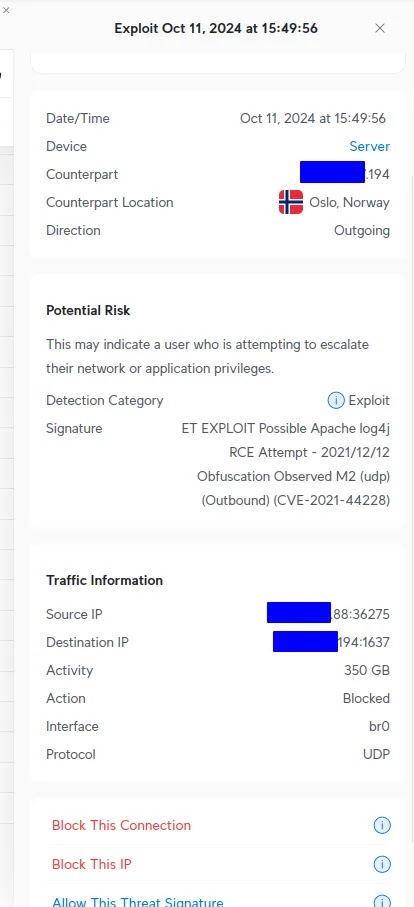
The crucial part is seeking to comprehend what MIGHT have triggered the alert. CVEs, etc., are not pertinent at this moment.
One approach to grasp some insight into the situation is as follows.
Visit
https://rules.emergingthreats.net/open/suricata-7.0.3/rules/
Obtain the file that corresponds to the initial segment of the alert. In this case, that would be EXPLOIT.
https://rules.emergingthreats.net/open/suricata-7.0.3/rules/emerging-exploit.rules
Identify the rule that was triggered. This might require some investigation. This is the process I followed.
grep -i possible emerging-exploit.rules | grep -i log4j | grep -i obfuscation | grep -i udp | grep -i outbound
Here is the output.
alert udp $HOME_NET any -> any any (msg:”ET EXPLOIT Possible Apache log4j RCE Attempt – 2021/12/12 Obfuscation Observed M2 (udp) (Outbound) (CVE-2021-44228)”; content:”|24 7b|”; content:”|24 7b 3a 3a|”; within:100; fast_pattern; reference:cve,2021-44228; classtype:attempted-admin; sid:2034805; rev:3; metadata:attack_target Server, created_at 2021_12_18, cve CVE_2021_44228, deployment Perimeter, deployment Internal, signature_severity Major, tag Exploit, updated_at 2023_06_05, mitre_tactic_id TA0001, mitre_tactic_name Initial_Access, mitre_technique_id T1190, mitre_technique_name Exploit_Public_Facing_Application;)
You can disregard 90% of this content. The crucial parts are:
content:”|24 7b|”; content:”|24 7b 3a 3a|”; within:100
and here:
udp $HOME_NET any -> any any
Now, you need to speculate how probable it is that there might be ANY UDP traffic originating from your home network to any destination, on any port, containing this particular string
24 7b
followed by this string
24 7b 3a 3a
within the next 100 bytes?
I believe there is a reasonable chance that such a scenario could occur in random, ordinary traffic.
Therefore, without any additional evidence, I suggest disregarding this alert.
If you wish to enhance your understanding in the future, feel free to explore any content I have written regarding network security monitoring. Best of luck!
About Author