To make good decisions on AI, stop reducing it to Big Tech

AI is more a discovery than a product – more like electricity or the wheel than social media or a search engine. Australia will make better decisions, including for our national security, if we grasp this.
Once made, a discovery becomes an irresistible force of progress, not something any country can afford to sniff at. The Australian government evidently gets it. As Prime Minister Anthony Albanese said on Tuesday as he announced his new AI safety and security proposals: ‘You can’t turn it off and pretend it hasn’t happened.’
But the politics of AI are ugly as hell, as the US midterms showed. Many opponents of building AI infrastructure in Australia reduce it to a synonym for US Big Tech and the unloved data centres that epitomise their record growth.
If we treat AI as just the latest shiny toy from corporate behemoths, we risk missing its economic value while doing nothing to make ourselves safer. Take for instance the first two national security measures the government announced this week. They would force frontier AI companies to ‘maintain security controls across all stages of development and deployment’ and ‘identify and manage serious risks associated with their models’.
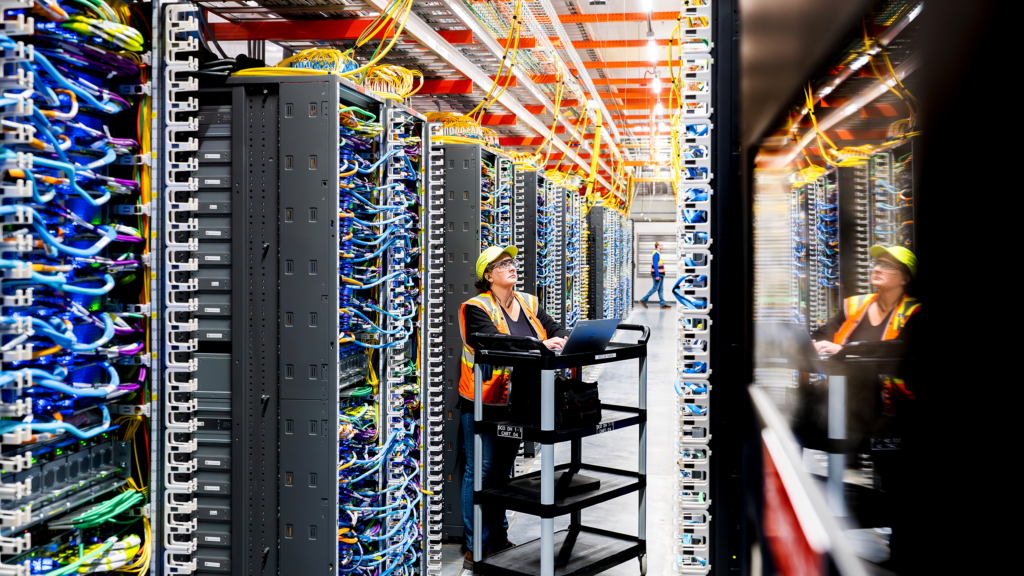
They’re commendable goals, but the problem is that Australia isn’t currently involved in the development of frontier AI. That’s all happening in the United States and China. If we’re to ‘shape AI rather than AI shape us’, as Albanese said, we need research, training, development and testing to happen here. That means attracting part of the US industry, which in turn means playing to our natural strength: hosting the infrastructure.
Yes, that investment will largely come from US Big Tech – cloud computing giants like Microsoft and Amazon, and AI companies like Anthropic and OpenAI. But those companies are just the current vehicles through which AI is travelling. The technology itself is so much more fundamental than half a dozen firms, however prominent they are today.
History is helpful. Modern AI might have been scaled by Silicon Valley but much of the founding work was done by computer scientists in university labs. Yoshua Bengio, one of the godfathers of AI who between the 1990s and the 2010s made breakthroughs in neural networks, is the most cited living scientist in any field. Another, Geoffrey Hinton, is the second most cited, and is also a Nobel Prize winner.
Like all great discoveries, AI tells us something fundamental about the universe. Intelligence, roughly defined as the ability to achieve goals based on information perceived, can exist on different substrates. Matter can be organised in a way that enables it to process information, make decisions and take actions. Once we’ve discovered how to free intelligence from animal brain cells, remarkable things become possible.
Contrast that with social media. Facebook was conceived not in the classroom but in the dorm room. It tells us many things about ourselves – most of them unflattering – but next to nothing about the nature of the universe.
It is not enough to say that we’re pro-AI adoption while spurning a role in AI creation. Adoption should be a vital part of any national AI strategy, but as AI automates more and more human tasks, our economy has a much better chance of creating valuable jobs for our kids if we own some of the key inputs to AI itself.
Nor should we shelter behind the argument that investor nervousness about the debt-driven infrastructure spending by tech giants shows AI is overhyped. It’s possible – indeed likely – that a financial bubble will burst and some people will lose money that they put in the wrong place at the wrong time. That doesn’t mean the technology itself is a bubble.
Besides, the government can hardly be accused of a track record of kowtowing to Big Tech. Australians should regard the government as having some credit in the bank here.
Australia can learn from the US voter backlash by applying sensible, predictable and consistent regulation to manage impacts to local communities, national resources and hip pockets. And we can use the US investment to strengthen Australian start-ups and research and diffuse the power of this discovery beyond its present concentration in the US and China.
The worst pathway is that democracies like Australia sit back and leave the discovery in the hands of tech bros and autocrats.
AI is happening with or without Australia. Nobody is asking that we surrender our sovereignty to Big Tech. But if we don’t establish a place for ourselves in global AI creation, we’ll cede sovereignty to more ambitious and voracious countries and companies.
By playing a part, Australia can secure its economic future, help steer the technology away from the most serious safety and national security risks, and position itself to manage the inevitable disruption AI will bring. Future generations of Australians will thank us for it.
About Author