The Language of the Cybersecurity Leaders
In cybersecurity, we like to believe that leaders are created by better products, stronger execution, and higher revenue. That belief is incomplete.
The companies that dominate categories don’t just build differently, they also speak differently.
The Language of the Cybersecurity Leaders
In cybersecurity, we like to believe that leaders are created by better products, stronger execution, and higher revenue. That belief is incomplete.
The companies that dominate categories don’t just build differently, they also speak differently. They use a different language when they communicate who they are and what they do.
Language is not just a communication tool in cybersecurity. It does even more: it reduces perceived risk, signals inevitability and frames trust before proof is complete. Buyers are choosing long-term partners under uncertainty, and language becomes the base for stability, ambition and survivability.
They don’t just ask if a product will work, but they also need to reflect on the possibility that the company might not be alive in the near future or if it is a safe bet to build upon. In many cases, language is the first, even the strongest, signal they receive.
If you analyze how cybersecurity leaders use language, there is a sense of inevitability. They broadcast a distinct combination of attributes that others rarely match at the same time.
Confidence, boldness, proof, specificity, urgency without panic, clarity on “who this is for” and a strong position against their competitors.
The question that arises, though, is what came first: Actual market success in terms of revenue or an aspirational messaging that already made them sound, look and act like the leaders they would become.
Moreover, when we focus on those that have achieved a recognized market position, are there differences across regions?
Having worked for more than 20 years with non-American cybersecurity companies, I’ve always noticed something that felt intuitive but hard to quantify. They rarely communicate like leaders, even when their technology is cutting-edge.
The language of those coming from outside the United States is often more cautious, more precise and technically accurate, and more reluctant to claim authority. And in my experience, this difference in language is an early indicator of future outcomes, not just a reflection of current ones.
That experience and intuition is what led me to test this more systematically, and below we will see what the results said about the language of the cybersecurity leaders.
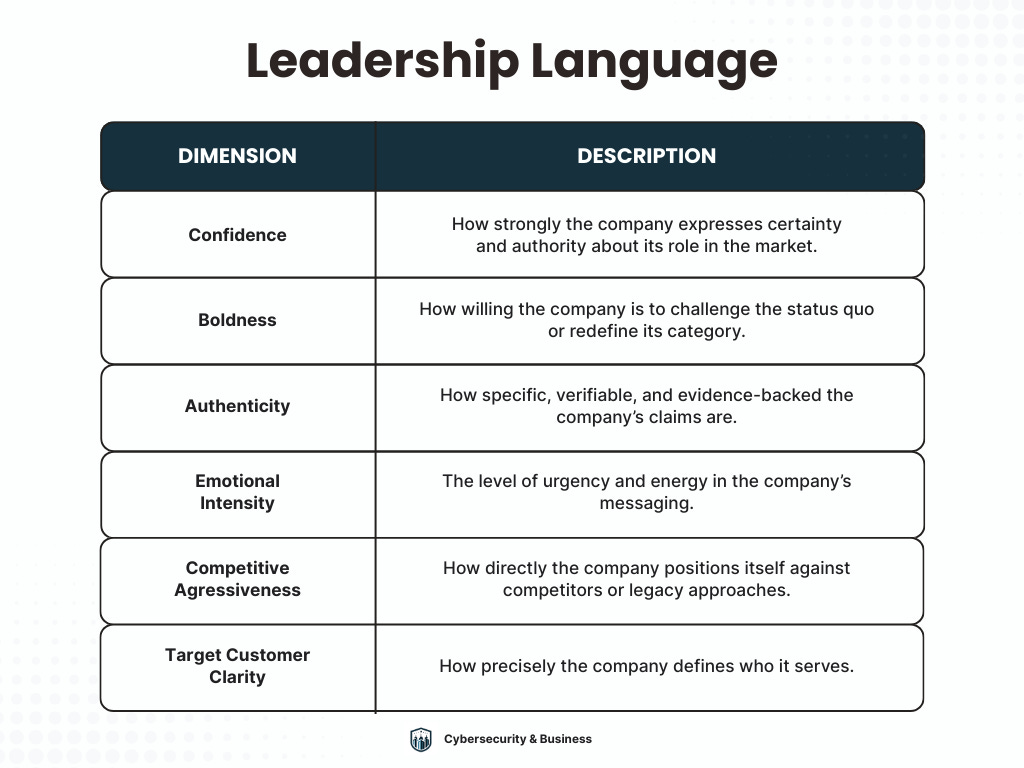
The first step was to decide what to measure. After reviewing positioning language across dozens of vendors in two sectors (Endpoint Security & Access Management), I decided to choose the following attributes:
Together, these dimensions describe not just what a company says, but how it assumes its role in the market.
In order to execute this analysis successfully, I needed to eliminate my personal bias. Considering how good LLMs are when it comes to language analysis, I designed a reusable prompt that could be applied consistently across groups of vendors.
The goal was not absolute truth, but relative comparison: how different companies speak in relation to each other.
Two LLMs were used (ChatGPT and Claude) in order to detect if there would be any large deviations.
Obviously, the same criteria was applied to all vendors. I also run the prompts three times in each one of the LLMs to account for potential differences.
Lastly, I defined the universe of vendors to be evaluated. For the purpose of this analysis, I focused on the vendors that were part of the latest Gartner Magic Quadrants for Endpoint Protection Platforms and Privileged Access Management.
Why the Gartner MQ? Those researchers already have a categorized list of vendors (Leaders, Challengers, Visionaries and Niche Players) that accounts for market penetration and positioning.
Before running the analysis, I had certain assumptions about the potential results:
Market Leaders would have a stronger language score
Immediate challengers would have a more aggressive approach
Legacy vendors would score lower than leaders growing rapidly
Non-american companies would show a lower score in the majority of the dimensions
I did exclude some vendors: Microsoft and PaloAlto Networks. The first one because of how much different of a company it is compared to the rest of the vendors, and PaloAlto as it is not naturally, in my opinion, an Endpoint Protection company.
The output didn’t vary significantly between ChatGPT & Claude, nor across the different runs of the prompts. This was a great first indication for me that the way the dimensions were defined could produce repeatable results.
You can see the results for yourselves below:
Across both markets, the same signals appeared again and again:
Market Leaders clustered at the top in pretty much every dimension
American vendors showed higher scores in almost every category
Non-American vendors had higher scores on authenticity, but lower on the rest
American vendors showed a stronger target clarity than Non-American vendors
There were two interesting outliers: BitDefender & Keeper Security. The first one, a Romanian endpoint-centric cybersecurity vendor showed a stronger authenticity and target clarity than I’d have expected.
The second one, a growing PAM solution, had the second highest average scores in its group, above leaders in the sector in several attributes.
Did the results surprise me? Not at all. It did, though, extend to more dimensions the theory I already had that leadership is not just built by execution, but it is announced through language, reinforced through consistency, and validated later by the market.
The language that Crowdstrike, SentinelOne or CyberArk are using today is not different from the one they were using when they started in this market. They did not wait for market validation to speak like leaders. They spoke like leaders first, and then built the execution to match.
Keeper Security is an early example of that. They are growing rapidly, taking advantage of a momentum created by their laser-focused targeting (MSPs) and using the language of an aspirational leader that knows where the market is going.
These companies don’t wait for permission. They speak with authority early, they frame the market on their own terms and they earn their right to keep speaking that way.
It could be argued that the analysis is biased toward leaders. It is a fair thought but that’s also the point. The goal was not to pick winners, but to understand why some companies sound like leaders while others don’t, even when they might want to become one or have the right mix of market presence, product and services that anyone else would consider the bases for leadership.
The more interesting question for me is not why leaders speak this way, but why don’t others. Why do so many capable vendors avoid assertive language or do they hesitate to define the market, name the problem strongly and claim authority?
That doubt, that lack of strength costs them over time.
Some may argue that positioning through features or technical details is what works in their culture, country or region. And they might be right. But that is not the language that the market leaders use.
The uncomfortable takeaway is that you cannot become a global category leader without first sounding like one. It is not about hype, exaggeration or lying. It means embracing strength.
The leaders speak in outcomes, not just features. They don’t request relevance, they assume it. They define their target customers sharply, even at the cost of exclusion. And, not least important, they treat the competition as something beneath them, not to coexist with.
Leaders shape the playing field (redefining it or reinventing it, as they like to say), using language that reflects a claim on their inevitability. This influences procurement committees, analysts and partner ecosystems to perceive them as leaders, which then becomes a reinforcing cycle.
This prepares the market before the product fully arrives. While others use more precise words, which is excellent for technical accuracy yet signals lower urgency, the leaders become a market-shaping force by the way they speak and talk about it. They talk like leaders before they become leaders.
That confidence enables a clearer target customer narrative, defining who they are for and making it easier for buyers to know where they fit. This strong clarity is not just vanity, it drives their positioning, sales efficiency, partner alignments and customer trust.
The consistent embrace of a leadership identity, shown regularly by their language, is a key pillar of what produces category leaders. Companies that speak like leaders recruit differently, set higher expectations, and normalize ambition.
Leadership language does not just influence buyers. It influences the company itself.
Of course, bold language alone does not create leadership. Many companies have spoken loudly and disappeared quietly. Leadership language is not a silver bullet, yet appears to be necessary.
Those that want to build a cybersecurity company that changes their market category need to understand that what they do today is tied to how you talk about their vision, their strengths, their customers and about tomorrow.
How a cybersecurity vendor speaks (its tone, audacity and narrative ambition) isn’t window dressing. It’s a foundation on their path to leadership.
Companies that embrace the language of leaders, with confidence, boldness, audacity and clear positioning will get noticed earlier and shape the market they want to end up as leaders.
American vendors dominate the market for many reasons, and this is one of them. European vendors often excel in accuracy and precision yet don’t talk about it enough in a way that will position them as leaders.
I will give you two examples of non-American vendors that are breaking this pattern: BforeAI and Aikido. Both of them founded in Europe, they embraced the leadership identity and language from a very early stage, and while in different categories, the scores on the dimensions above would put them in the same group of the market leaders we analyse.
BforeAI is leading the talk about preemptive cybersecurity and Aikido recently became a unicorn.
In cybersecurity, technology earns credibility. Execution earns trust. And language earns attention, and that is where leadership begins. If you don’t speak like a leader, don’t be surprised when the market never lets you become one.
*** This is a Security Bloggers Network syndicated blog from Cybersecurity & Business authored by Ignacio Sbampato. Read the original post at: https://cybersecandbiz.substack.com/p/the-language-of-the-cybersecurity
About Author