

New FBI Warning: Chinese Apps Could Expose User Data

The FBI is urging Americans to think twice before downloading foreign apps, warning that some could quietly expose sensitive user data.
The alert comes just days after China banned Jack Dorsey’s Bitchat over regulatory concerns, underscoring the growing digital standoff between the two countries. Years of escalating data privacy tensions have already pushed the US to restrict several foreign platforms, citing Chinese laws that can compel companies to hand over user data to government authorities.
Now, the bureau is raising fresh concerns about widely used apps developed by foreign firms, particularly in China, cautioning that millions of users could be at risk. And given the global reach of these platforms, the warning extends far beyond the US.
What’s behind the concerns over Chinese-developed apps
In recent years, several Chinese-developed apps, including CapCut and Temu, have become widely used in the US. With millions of US users, the FBI says “these apps are subject to China’s extensive national security laws.”
Although the bureau did not explicitly issue an instruction to stop downloading Chinese-developed apps, it did leave three clues that it says allow “the Chinese government to potentially access mobile app users’ data.”
- Data storage and privacy policies: App stores require app developers to indicate where they store users’ data and for how long. The FBI advises Americans to always check this before downloading any app, as some software companies often store user data on servers in China, sometimes indefinitely.
- The invite friends option: Certain apps often request contact permissions to allow users to invite their friends and family. While harmless, this can give apps access to the contact information of people who don’t even use them. Forbes notes that in the wrong hands, such data can be used to map social relationships, a key element in social engineering attacks such as phishing. For companies based in China, that data can be accessed by the government.
- Malware: On the user side, it is often hard to detect, but the bureau recommends downloading only from official stores. Doing this reduces the risk of apps using hidden malware to collect user data beyond what users agreed to share or exploit software vulnerabilities. iOS users face a lower risk due to stricter controls, and even Android, which permits side-loading apps, has recently begun tightening that area.
The tale of TikTok and Bitchat
Early this year, TikTok moved part of its operations involving US users to American servers, led by Oracle. The decision was made after the US threatened to ban the company from the country. Under the hood, this represents a more serious battle for data supremacy, and the FBI’s recent warning may have confirmed it.
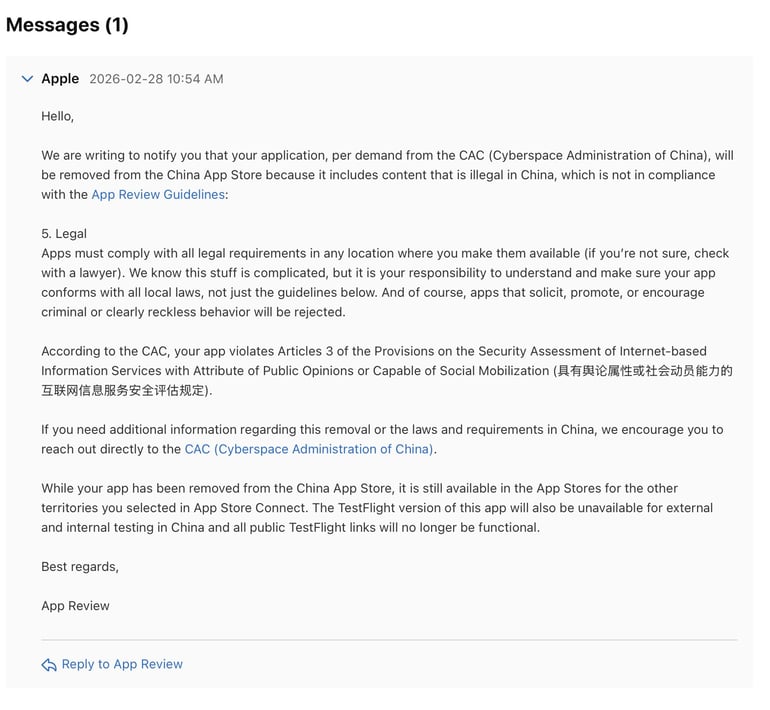
China, on the other hand, has continued banning US-developed apps over censorship concerns. While many Meta- and Google-related apps are on the list, several others are highly regulated. Jack Dorsey’s Bitchat has become the latest app to be banned in the country.
In a post on X, Dorsey shared a screenshot of the removal notice and wrote that Bitchat had been “pulled from the china app store.”
The FBI’s recommendation
The bureau’s recommendations to users are basically normal safety guidelines that every user should know.
It recommends turning off unnecessary data sharing, enabling regular software updates, requiring frequent password changes, and downloading apps from official stores. It also recommends that users read the terms of service of apps they wish to download. However, that is one thing many users don’t do.
The PSA also includes links to useful resources for staying safe online. Additionally, the PSA instructs US users to report suspected data compromise and provides a list of relevant information to include.
Also read: A China-linked breach of an FBI surveillance system, which the bureau classified as a “major incident,” adds to broader US security concerns about sensitive data exposure.
About Author







![[un]prompted 2026 – When Passports Execute: Exploiting AI Driven KYC Pipelines](https://securityboulevard.com/wp-content/uploads/2018/01/TwitterLogo-002.jpg)