How Cyber Risk Management Builds Resilience | Kovrr
TL;DR
Cyber risk management supports resilience by enabling timely, informed decisions that reduce disruption and align with enterprise performance goals.

Tech layoffs: A 2026 timeline
TL;DR
Cyber risk management supports resilience by enabling timely, informed decisions that reduce disruption and align with enterprise performance goals.
Integrating cyber into ERM frameworks ensures risks are prioritized and governed like other core business exposures.
Frameworks like NIST CSF provide structure for aligning cyber activities with business impact, enabling consistency across teams and risk domains.
Regulations in the US, EU, and globally now demand executive-level oversight and measurable integration of cyber risk into enterprise risk strategies.
Cyber risk quantification (CRQ) translates technical threats into financial insights, helping leaders invest strategically and strengthen operational continuity.
Cyber Risk Requires Enterprise-Level Accountability and Action
Cyber risk management plays a foundational role in enabling business resilience. As organizations today rely more heavily on digital infrastructure than ever before, the world’s cyber threats have direct implications for operational continuity and revenue stability. The ability to manage these risks proactively, therefore, determines how well a company can absorb disruption and maintain performance under pressure. In short, cyber risk management supports broader business resilience when it is integrated into enterprise risk frameworks and decision-making.
In its role to support broader business resilience, cyber risk management can no longer be confined to IT or security teams. Key issues must be prioritized and governed by high-level stakeholders as a fundamental component of the enterprise’s overall risk strategy. While such a shift may at first seem difficult, it can be more easily approached by leveraging the same metrics for cyber risk that are used in the broader enterprise risk management (ERM) framework. When cyber risks are assessed and communicated in financial and operational terms, for instance, leaders can quickly make high-level decisions that balance protection and performance.
Cyber risk quantification (CRQ) is central to this integration and ensuring that cyber risk management programs can support the business at large. CRQ platforms specifically translate complex cyber risk data into measurable financial and operational exposure, helping decision-makers compare cyber risks alongside other enterprise risks. With a full understanding of the tradeoffs they’re potentially making, these executives are then empowered to direct resources where they deliver the most value. Ultimately, with CRQ, organizations can use cyber to build resilience not only through protection but through insight and preparedness.
Request a Free Demo Today
The Role of Frameworks: Turning Complexity Into Structure
Operationalizing cyber risk and integrating it into the broader ERM strategy begins with harnessing a structure. Organizations in this day and age know that cyber threats impact business resilience, but without a solid methodology to connect the two, efforts remain fragmented and, in the worst cases, never make it out of the cybersecurity department. This common challenge is why cybersecurity standards such as the NIST Cybersecurity Framework (CSF) were established. These cyber risk management blueprints provide teams with a shared foundation to assess risks and align cyber initiatives with enterprise objectives.
Among other frameworks, such as CIS Controls and ISO 27001, the NIST CSF is particularly useful for resilience-focused programs because of its practical design. NIST 2.0, released in 2024, is composed of six functions: Identify, Protect, Detect, Respond, Recover, and Govern, all of which map directly to the lifecycle of cyber disruption. By organizing cyber risk management activities into these domains, teams can more easily blend NIST CSF cyber risk assessments with higher-level operational goals and support decision-making across business departments.
Most importantly, frameworks like the NIST CSF provide a solid measure of consistency. They ensure that cybersecurity teams can move beyond ad hoc and spreadsheet-based assessments and establish repeatable practices that fit within the structure of the broader ERM program. With this consistency and alignment, a common language between cybersecurity, GRC, and executive leadership emerges. This language, based on actionable, tangible terms, supports long-term resilience planning, regulatory readiness, and smart investments.
NIST CSF and ERM Alignment
When organizations map their NIST CSF assessment results to their higher-level ERM frameworks, they’re ultimately creating a unified structure for understanding and managing cyber risk. The Identify and Recovery functions are especially valuable in this regard, as they drive asset visibility, help define critical dependencies, and support recovery time objectives. These capabilities align directly with ERM goals, allowing cyber risks to be evaluated directly alongside financial and operational exposures using consistent and scalable methods.
A Baseline for Maturity and Continuous Improvement
While frameworks such as NIST CSF offer organizations a risk management structure and shared vocabulary, they also directly enable growth. By benchmarking current cyber capabilities against a recognized standard, organizations can more easily identify safeguard gaps, define maturity targets, and measure their progress. These goal-setting and improvement processes are essential and ensure that assessments are not one-off exercises but full-on resilience programs. With a robust framework, security and risk managers (SRMs) can demonstrate value to stakeholders in a manner that builds trust and credibility.
What Regulators Are Really Asking for in 2026
Regulatory bodies around the world have sharpened their expectations regarding cyber risk management’s integration into the broader ERM strategy, and will only continue to do so. These entities no longer view cybersecurity as a narrow compliance issue, but rather a core element of business resilience and risk governance. In 2026, both domestic and international mandates will push organizations even further to move far beyond basic control checklists and to demonstrate integrated, enterprise-level oversight of cyber risk.
Indeed, cyber risk is now widely recognized by governments across the US, Europe, and other digital-forward nations as a material business exposure. As seen with past cyber incidents, these threats have the potential to disrupt operations and compromise financial stability. Consequently, regulators no longer ask whether risks are being identified but whether structured board-level processes are governing them. Compliance has become a matter of how well cyber risk management supports the organization’s ability to maintain continuity through evolving threats.
Key Regulations Shaping the Conversation
In the US, the SEC requires public companies to disclose cyber governance practices and board-level oversight on an annual basis. In Europe, the Digital Operational Resilience Act (DORA) mandates that financial entities manage ICT-related risks as part of overall resilience, requiring scenario testing and board accountability. Meanwhile, the NIS2 Directive expands cyber governance obligations across sectors, emphasizing continuous risk assessment and executive responsibility. Globally, regulators are converging on the same core expectations of quantification, transparency, integration, and readiness.
From Compliance Reporting to Resilience Strategy
Organizations must be able to show in no uncertain terms how cyber risks are being assessed in the same terms as financial and operational risks. Both structured methodologies and measurable metrics must support their approaches if they are going to adhere to the stream of updated regulations. CRQ solutions, such as the one offered by Kovrr, facilitate this shift by quantifying exposure and modeling loss scenarios, ensuring insights can be integrated into enterprise decisions.
Request a Free Demo Today
Unified Risk Intelligence: How to Operationalize Integration
Accepting that cyber risk and, subsequently, its management impacts business resilience is an essential business baseline to thrive in today’s market. The real challenge, though, is execution. In practice, many organizations are still managing cyber separately from enterprise risk, using different metrics and reporting cycles. This fragmentation significantly limits visibility and prevents leaders from seeing the full risk picture. Integration is not just a matter of collaboration and a few shared meetings. It requires shared systems intelligence.
Building unified risk intelligence starts with governance. Teams need clearly defined roles and responsibilities that bring cyber into the same decision-making process as financial and operational risks. Cyber risk must be represented in the same forums, reported in the same terms, and reviewed against the same strategic objectives. When cyber oversight is siloed, gaps emerge between what the business values and what security teams prioritize. Closing those gaps requires governance structures that promote informed, cross-functional decision-making.
Operationalizing integration also requires a consistent and repeatable mindset. Organizations must go much further beyond qualitative ratings and translate technical exposure into measurable impact, such as the likelihood and potential cost of cyber events. They must also map risks to critical business processes and align mitigation strategies to organizational goals. Embedding these insights into ERM dashboards and executive reviews ensures that cyber is treated as a core driver of enterprise risk and resilience planning.
How Cyber Risk Quantification (CRQ) Unlocks Resilience Building
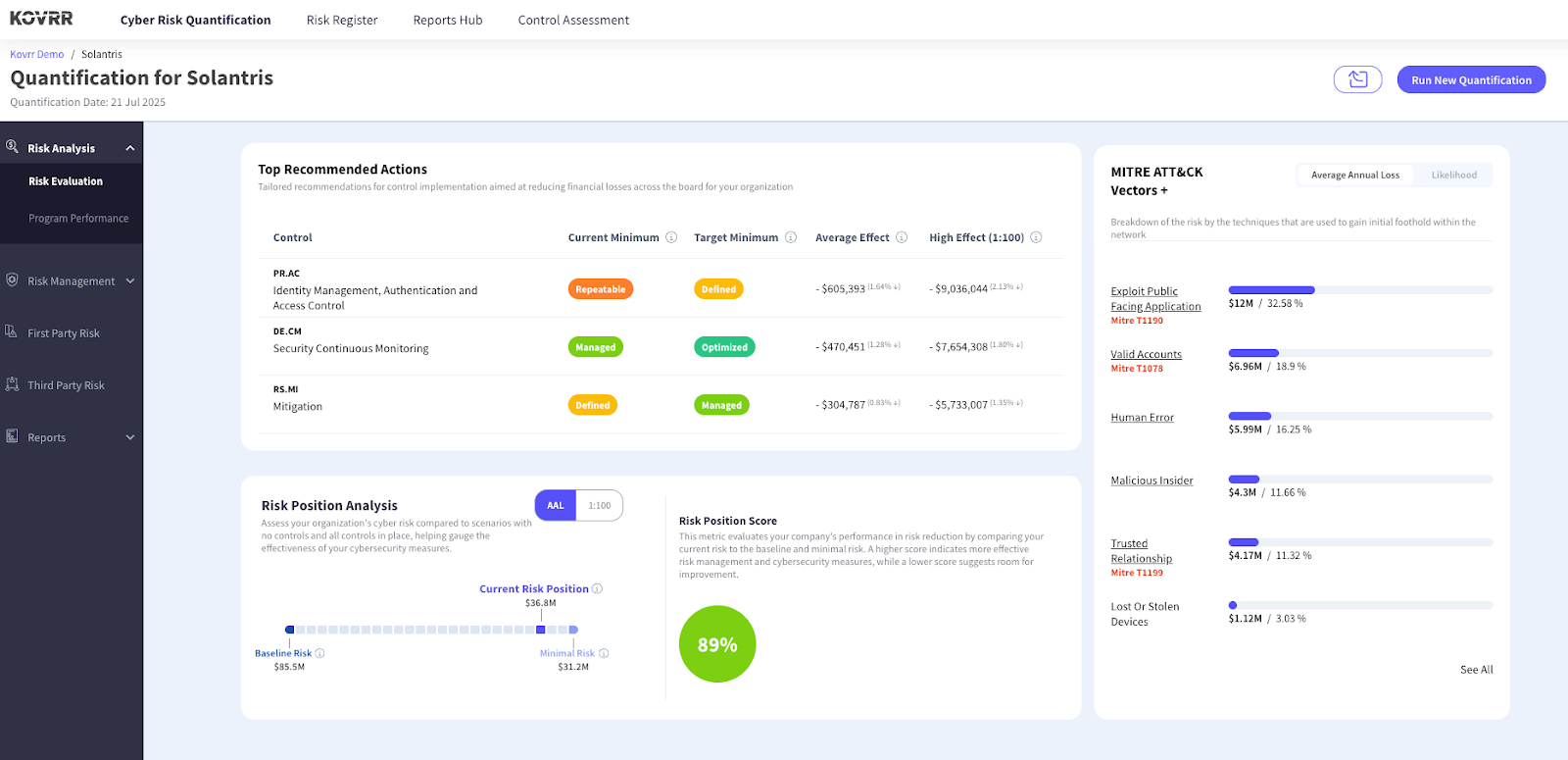
Cyber risk quantification (CRQ) platforms like the one from Kovrr highlight the mitigation initiatives that yield the highest ROI.
Qualitative cyber assessments can raise awareness, but they rarely provide the clarity that decision-makers need to make mission-critical decisions. Without a way to objectively measure potential losses or compare cyber exposure to other risks, organizations struggle to prioritize or justify investments. With CRQ, however, technical inputs are transformed into financial insights that inform enterprise risk decisions and resilience planning. This translation helps organizations move from reactive security postures to proactive, evidence-based strategies.
Quantification brings cyber into alignment with the language of enterprise risk, enabling teams to calculate potential financial losses from specific cyber scenarios and forecast how risk exposure evolves, such as when a new control is implemented. This perspective allows organizations to make more informed tradeoffs and demonstrate the return on security investments to boards, regulators, and shareholders. It also builds internal credibility by making cybersecurity decisions traceable and tied to business outcomes.
CRQ platforms, such as the one offered by Kovrr, are purpose-built for this shift and integration, delivering insurance-grade intelligence and data-driven modeling that connects cyber events to business impact in measurable terms. By integrating real-world threat data with company-specific inputs, CRQ supports risk-based planning and capital allocation decisions that reflect actual exposure, not assumptions or averages, ensuring cyber programs are acting as strategic levers for resilience.
The Tradeoffs: What to Know Before Integrating Cyber Into the ERM
There is no single path to integrating cyber risk into enterprise frameworks. Every organization faces unique tradeoffs depending on its structure, maturity, and regulatory obligations. Moreover, every organization has a different idea of what they want to prioritize according to that year’s strategic objectives. No matter the preference, though, what matters most is choosing an approach that delivers accountability and defensibility without creating bottlenecks or blind spots. Building resilience requires explicit intention and not only fragmented activity.
Qualitative assessments and control checklists can offer a fast starting point, but often lack the necessary depth. These more subjective approaches tend to flatten nuance and can create a false sense of coverage. Custom-built internal models may feel tailored, but are difficult to maintain. If there’s no presence of strong external data or validation, even well-constructed models can quickly become outdated. These methods may work in narrow contexts but rarely provide the consistency needed for enterprise-wide confidence.
The most resilient organizations find the balance between structure and agility. They use methods that scale, metrics that matter to decision-makers, and tooling that supports repeatable analysis over time. Such programs do not rely on isolated insights but build an integrated view of risk that can inform capital planning, control investments, and regulatory reporting. Regardless of the specific solution or approach, what sets leading programs apart is their ability to align cyber risk insight with business strategy and act on it decisively.
Resilience Requires Cyber Risk to Be Measurable and Embedded
Cyber risk management supports broader business resilience by enabling organizations to make informed, timely decisions in the face of uncertainty. When cyber risk is quantified and integrated into ERM frameworks, it becomes a strategic input and not a mere technical consideration. Embedding cyber risk into enterprise risk management also creates consistency across how risks are reported and governed. Using structured frameworks such as NIST CSF ensures cyber exposures are mapped to core business functions.
Regulatory guidance continues to reinforce the need for executive accountability and measurable impact. This pressure has elevated cyber from a departmental issue to a board-level concern that directly influences resilience strategy. Organizations that approach cyber risk with the same discipline applied to financial or operational risk gain an advantage. The ability to quantify potential losses and model scenarios creates transparency at the exact moment leadership needs clarity. By transforming fragmented signals into enterprise-wide intelligence, cyber risk management contributes directly to resilience.
Start harnessing quantified metrics to embed cyber risk into your enterprise risk management strategy and build long-term resilience. Schedule a free demo of Kovrr’s CRQ platform today.
*** This is a Security Bloggers Network syndicated blog from Cyber Risk Quantification authored by Cyber Risk Quantification. Read the original post at: https://www.kovrr.com/blog-post/integrating-cyber-risk-into-enterprise-risk-frameworks
About Author