
GitGuardian Introduces One-Click Secret Revocation to Accelerate Incident Response
The application security landscape in 2025 is defined by growing complexity and speed.
GitGuardian Introduces One-Click Secret Revocation to Accelerate Incident Response
The application security landscape in 2025 is defined by growing complexity and speed. With 77% of organizations managing over 100 developers and 57% handling more than 50 external applications annually, security teams are drowning in alerts while attackers exploit exposed secrets faster than ever. The gap between detection and remediation has become a fatal flaw of modern AppSec programs.
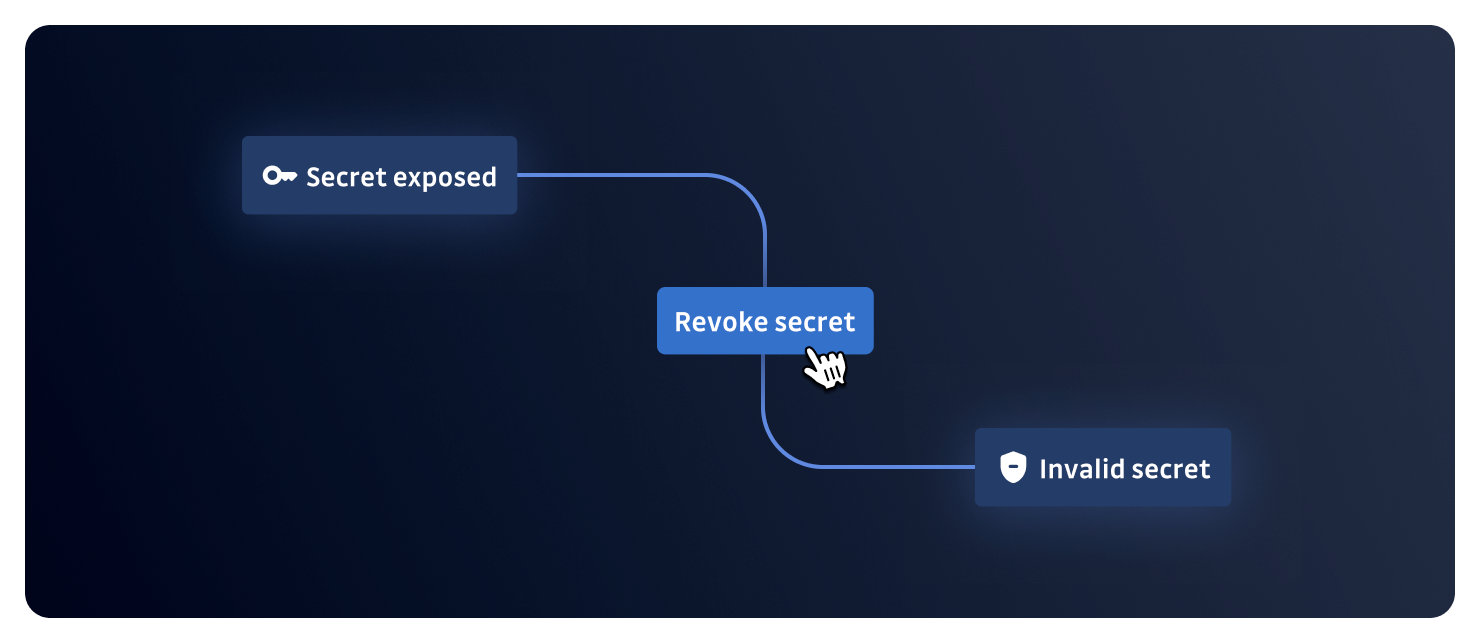
Today, we’re excited to announce a powerful capability in the platform that directly addresses this critical gap: one-click secret revocation. GitGuardian users can now revoke valid secrets directly from incident pages in under 10 seconds, fundamentally transforming how security teams respond to secret exposure incidents.
The Risk of Unaddressed Secret Exposures
The urgency around secret revocation is backed by alarming reality. Exposed AWS credentials are probed by attackers in under 17 minutes on average, and sometimes as fast as 9 minutes. This narrow attack window makes traditional manual revocation processes not just inefficient, but dangerously inadequate.
Secret sprawl has reached epidemic proportions. Our State of Secrets Sprawl 2025 report revealed that 23.8 million secrets were leaked on public GitHub repositories in 2024—a 25% year-over-year increase. More alarmingly, 70% of secrets leaked in 2022 remain active today, dramatically expanding the attack surface for threat actors. But here’s the thing: it’s not just about finding these secrets. It’s about how quickly you can neutralize the threat.
The Manual Revocation Crisis
The current state of secret lifecycle management reveals a troubling disconnect between the speed of attacks and organizational response capabilities. 40% of organizations take weeks or more to revoke API keys, and only 20% have formal processes for API key revocation.
Traditional secret remediation workflows are painfully manual and fragmented:
Security team detects exposed secret
Create a ticket and notify the development team
Developer locates secret owner
Navigate to the provider platform (GitHub, AWS, etc.)
Revoke the secret manually
Update incident status
This process can take hours or even days, during which the exposed secret remains a constant threat. In an era where Time to Automation (TTA) has become the most critical security metric, manual processes simply can’t keep pace with modern threats.
Introducing One-Click Secret Revocation
Our new secret revocation capability eliminates the context switching and manual overhead that plague traditional incident response workflows. Here’s what changes:
Immediate Action: Security teams can now revoke valid secrets with a single click directly from the incident detail view, without leaving the GitGuardian platform. This instant revocation capability is designed to close the critical attack window.
Built-in Safeguards: Every revocation includes a confirmation step to prevent accidental actions, ensuring teams maintain control while moving fast.
Complete Audit Trail: All revocation actions are automatically logged in the incident timeline, providing full visibility for compliance and post-incident analysis. This is critical for meeting regulatory standards like PCI DSS 4.0, which mandate secret rotation/revocation upon suspicion or confirmation of compromise.
Smart Filtering: Teams can easily identify revocable incidents with dedicated filtering, streamlining triage and prioritization efforts.
Understanding Revocation Impact Before You Act
Revoking a secret may have dramatic side effects on your systems, applications, or workflows.
Therefore, you should always consider checking what the revocation will impact before proceeding. GitGuardian provides you with extensive context and insights to assess the impact of the exposure, but more importantly, measure the impact of the revocation, thanks to the identification of the workloads using these credentials. The platform’s incident detail view shows:
Source repositories where the secret was found
Consumer applications that may be using the credential
Accessed resources, the secret can reach
Connected workloads in your infrastructure map
Usage patterns from our NHI Governance features
This contextual information helps teams make informed decisions about immediate revocation versus coordinated response.
The revocation feature gives teams flexibility to match responses to risk level:
Immediate revocation scenarios:
Developer testing locally leaks GitHub OAuth key during early project development
Non-production API keys exposed in feature branches
Personal access tokens found in public repositories
Secrets in development or staging environments with minimal business impact
As one customer noted: “Sometimes you are building locally, early on a project, and leak your GitHub OAuth key—being able to immediately invalidate this on GitHub is a great relief.”
Coordinated response scenarios:
Production API keys with unknown downstream dependencies
Historical secrets discovered during security audits
High-privilege service account credentials
Keys are integrated across multiple production systems
Another customer explained: “We would definitely love for the tool to have that capability and then decide if we want to do it remotely if it’s a low impact. Or if it’s a very high impact, we would definitely coordinate with the app team and schedule that revocation.”
Critical warning for production secrets: Use extreme caution for keys found in production, especially from historical scans. Investigate what could break before implementing your own “scream test” on your company’s production applications.
During our alpha testing with core alerting scenarios, 40% of users who received email alerts immediately used the revocation feature. This demonstrates a clear demand for this integrated approach. As one customer noted: “If you find a bad [secret], send it to GitHub and ask it to revoke it… that would be very nice if we just know, like, hey, this is a valid AWS secret. Let’s just revoke it.”
This feedback aligns perfectly with broader industry trends. According to recent research, organizations that embrace automation can reduce incident response times by up to 99.999%, while inefficient vulnerability management remains the top pain point for 32% of security teams.
Starting with Strategic Partnerships
We’re launching with support for three critical providers—GitHub, GitLab, and OpenAI—chosen for their open revocation endpoints and widespread enterprise adoption. But this is just the beginning. We’re actively working with additional vendors to expand this capability, recognizing that comprehensive secret management requires ecosystem-wide collaboration.
This launch represents more than just a new feature. It’s a critical piece in completing GitGuardian’s end-to-end remediation workflow. Combined with our upcoming automated code fix generation, security teams will now:
Detect exposed secrets across the entire software development lifecycle
Prioritize based on their validity and business context
Push the secret to a secure vault for proper management
Click the Revoke button immediately to invalidate the exposed secret
Generate an automatic pull request with suggestions for developers to fix the code
Change the value of the secret within the vault
Prevent future secret exposures with policy enforcement
Our goal is simple: make secret revocation as easy as clicking a button, regardless of where the secret lives or which provider issued it. This requires close collaboration with vendors across the ecosystem, and we’re excited to lead this charge in building rapid, automated revocation and remediation capabilities that match the speed of modern attacks.
Getting Started
The one-click secret revocation feature is available now for all GitGuardian users with appropriate permissions. To get started:
Navigate to any valid secret incident from a supported provider
Look for the revocation button in the incident detail view
Follow the confirmation prompts to complete the action
Monitor the incident timeline for confirmation of successful revocation
For organizations evaluating their secret management strategy, this capability represents a fundamental shift toward proactive, automated incident response. The days of manual, time-consuming secret revocation are numbered.
*** This is a Security Bloggers Network syndicated blog from GitGuardian Blog – Take Control of Your Secrets Security authored by Soujanya Ain. Read the original post at: https://blog.gitguardian.com/gitguardian-introduces-one-click-secret-revocation-to-accelerate-incident-response/
About Author




