Fault Lines – Putin’s Kurils trip, US’s carrier gap, China’s NZ espionage
Welcome to the latest edition of ASPI’s Fault Lines.
Every fortnight, ASPI’s Defence Strategy Program monitors the actions and developments shaping the regional order and Australia’s security.
This edition covers the period from 7 August to 20 August 2026. Subscribe here to receive every edition of Fault Lines direct to your inbox.
Northeast Asia
I can see your house from here
On 13 August, Vladimir Putin visited the Southern Kuril island of Iturup – a picturesque, windswept, Russia-held disputed territory about 100 km or so off Japan’s northeastern tip. This was Putin’s first visit, the first by any senior Russian official since the war on Ukraine began, but not the first of its kind. Since 2010, Russian leaders show up in the Southern Kurils every couple of years to poke Japan in the eye.
We’ll spare you the hundred-page legal argument. Call it a difference of opinion. Iturup, Kunashir and a few smaller nearby islands have been claimed and controlled by Moscow since the end of World War II. Tokyo disputes that claim. Since February 2022, both sides have dug in their heels. Russia has withdrawn from existing dialogues over the dispute and terminated visiting arrangements for former Japanese residents, while Japan has officially designated the Southern Kurils as ‘illegally occupied territories’. Putin’s visit unsurprisingly drew a sharp rebuke from Tokyo: Japanese Foreign Minister Toshimitsu Motegi called in Russia’s ambassador for a frank exchange of views, while Prime Minister Sanae Takaichi called it ‘absolutely unacceptable’.
Behind this war of words – as with many land disputes, really – there’s a lot of woundable national pride, but that’s not all. The quality of local caviar cannot entirely explain Moscow’s late efforts to consolidate its footprint on the Kuril arc, chiefly through economic development. Putin’s prior movements show you the big picture: Russia’s navy was out on a major exercise across the Sea of Japan, Sea of Okhotsk and northwestern Pacific from 4 to 12 August, and Putin was present to observe the wrap-up.
Sixty surface ships, submarines and support vessels, 30 aircraft and uncrewed systems and 13,000 personnel – roughly half the Pacific Fleet – made that exercise a substantial undertaking. It appears to have been Russia’s largest maritime activity so far this year and closely resembled exercises conducted in June of 2024 and 2025: a theatre-level defence of the Kuril arc against a simulated enemy task group.
The rationale isn’t too mysterious. The Pacific Fleet has shrunk considerably since the late Cold War when it was the largest component of the Soviet fleet. Today, it accounts for barely a quarter of the much-diminished Russian navy. Yet its contribution to Russia’s nuclear posture has not declined to the same extent. The Pacific is increasingly the destination of choice for Russia’s modernised nuclear-armed ballistic-missile submarines (SSBNs): the five Borei-class SSBNs stationed at Vilyuchinsk on the Kamchatka peninsula are 40 percent of the SSBN fleet, and its newest 40 percent. In the event of a major war with the United States and its allies, protecting those SSBNs will be among the Pacific Fleet’s high-priority missions.
It’s not an enviable one. For a combination of historical and geographical reasons, the SSBN base at Vilyuchinsk is on the less convenient side of Kamchatka: it faces the (dangerous, US Navy-infested) Pacific, not the (warm, welcoming) Sea of Okhotsk. That was manageable when the Soviet Union was willing to devote enormous resources to the Pacific Fleet, but budget cuts have hit hard. Getting those very expensive and strategically valuable submarines to a safer place in a tense moment now means not only establishing a defensive perimeter along the Kuril Islands and getting the SSBNs out of base and through it in a timely and stealthy manner; it also means doing it on the cheap. Meanwhile, the Japanese military – which alone outmasses the Pacific Fleet’s conventional component – and the US Navy together hold considerable advantages in anti-submarine warfare in both quality and quantity. And in a conflict, they’d very much like to use them to stop you.
News from abroad
- The major annual US-Korean civil-military exercise Ulchi Freedom Shield began on 17 August under something of a cloud. Mere hours before kickoff, US President Donald Trump issued a directive to reduce the exercise’s scope on the basis that it’s not only ‘costly’ but also sends a signal ‘that is totally inappropriate and hostile, to a Country that, as long as Donald J. Trump has been President, has been unthreatening and respectful.’ That means North Korea, believe it or not. It’s not yet clear what de-scoping Ulchi Freedom Shield will mean in practice, but one can only imagine what choice words were had in Seoul when this message came down the pipe. Set against the president’s complaints about South Korea not chipping in for the Iran war, the more charitable interpretation is that the decision is intended as an olive branch to Pyongyang. Compare Lee Jae-myung’s recent proposal to restart talks on an inter-Korean peace treaty. The White House claims that Kim Jong Un has responded positively; at present, there’s no public confirmation of that.
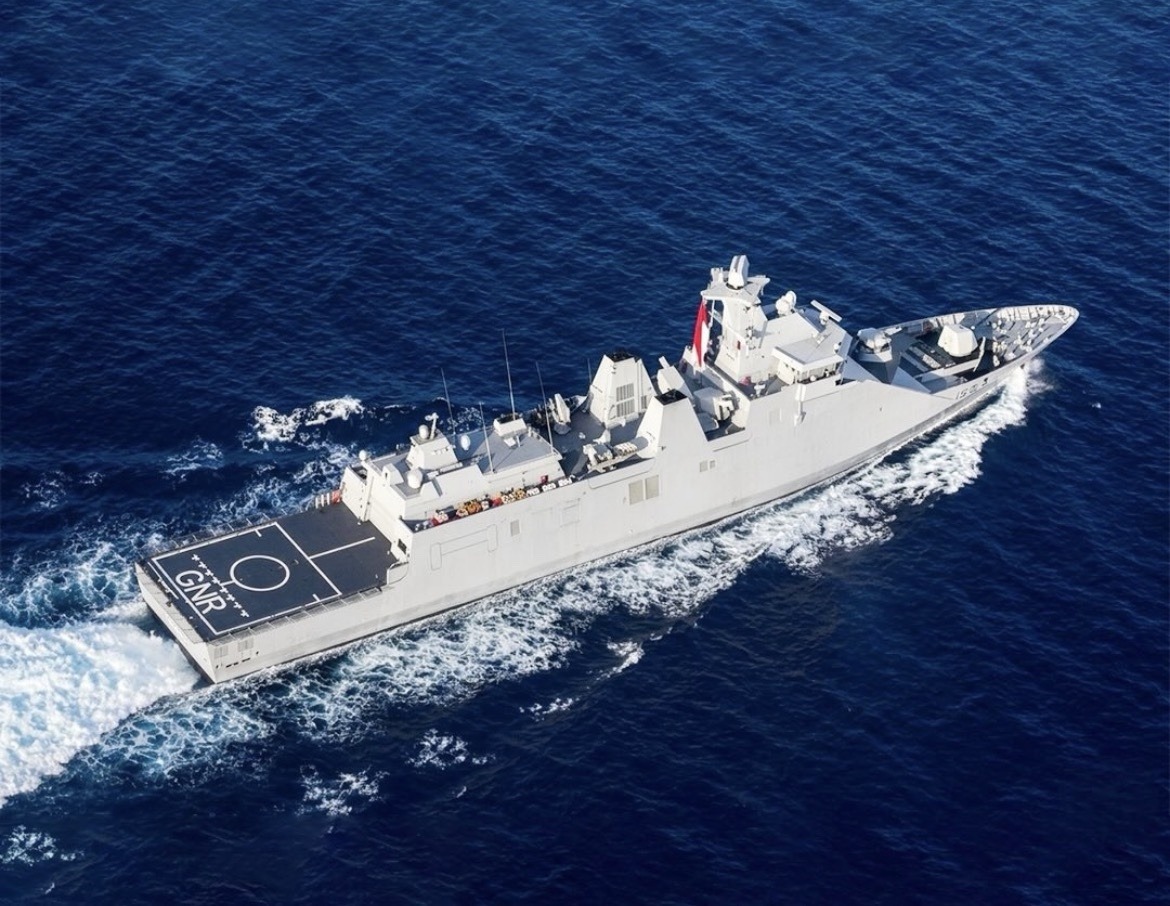
- On 12 August, the Indonesian frigate KRI I Gusti Ngurah Rai conducted a passage exercise with the Chinese frigate Honghe in waters east of Taiwan, where China has maintained coastguard patrols since June. It was the first time a foreign military had exercised with China in those waters. Although the two-ship exercise involved routine formation, communications and replenishment drills, Taipei viewed it as reinforcing Beijing’s efforts to normalise a Chinese presence and assert authority in the area. China called it a ‘navigation exercise’, while Indonesia described it as ‘routine’ and stressed that it was not geared towards warfighting.
Southeast Asia
Exit stage left
If by chance you were piloting a container ship through the Strait of Malacca on 12 or 13 August, you’d have seen a beacon pop up on your automatic identification system tracker displaying a nondescript, though unquestionably correct, name: ‘US GOVT VESSEL’. You might then have looked out the window and seen the USS George Washington carrier strike group – nuclear-powered supercarrier, destroyer and cruiser escorts, support vessels and all – floating serenely past. Last fortnight, you’ll recall, George Washington was in the South China Sea. It’s now heading for the Arabian Sea, where it’s expected to relieve USS Abraham Lincoln, currently deployed in support of US operations in the Persian Gulf.

This has left the US’s carrier footprint in the Western Pacific unusually thin. Non-existent, actually, unless you take a very generous view of amphibious assault ship USS Tripoli, in port at Sasebo, Japan. Sure, you can launch an F-35B off Tripoli if you really want to, but with half the displacement of a carrier, a third of George Washington’s embarked air wing and no organic airborne early-warning and anti-submarine warfare screen, it just isn’t the same. (Don’t tell the Marines.) The US Seventh Fleet has kept a carrier strike group forward-deployed at Yokosuka, near Tokyo, since October 1973; it’s the only one permanently stationed outside the US, and you’ll generally find it patrolling the region between June and December each year. For those in the ‘carrying big sticks’ business, there are few more conspicuous pieces of timber, and absences are no less conspicuous. They’ve happened in the recent past, notably between August and November 2024 after USS Ronald Reagan rotated out of Yokosuka and George Washington hadn’t yet replaced it. This absence is also a little awkward, coming only days after US Under Secretary of Defense for Policy Elbridge Colby spoke in Manila to the effect that Southeast Asian states should judge security frameworks by whether they actually result in ‘more ships in the water’.
Still, a ship in the water isn’t necessarily useful. On forward deployment, a carrier such as George Washington spends at least four months of the year in heavy maintenance, during which its ability to project sea power is seriously restricted. But it’s precisely that that makes a carrier strike group’s limited time on deployment so valuable and makes quite the juggling act out of keeping a persistent carrier presence anywhere at all. As the Iran war has sputtered and guttered along since February, Abraham Lincoln’s deployment has stretched considerably beyond what was planned. It’s been a record-breaking 250 consecutive days at sea, with no port calls since December. Supplies are strained and crew morale is in a parlous state. The official line is that George Washington is subbing in for Abraham Lincoln as part of its regular deployment schedule, which in theory means it’ll be home by Christmas. In practice, how long the Western Pacific goes without its most visible US security presence is now in pertinent part a question about when the Iran war will end. Your guess is as good as ours.
News from the neighbourhood
- Another stop on Colby’s Southeast Asia itinerary: Cambodia, on 14 August. The key outcome there was a public commitment from Prime Minister Hun Manet to restart Angkor Sentinel – formerly a major US-Cambodian joint military exercise, suspended in early 2017 at a time when Cambodia was perceived to be drawing much closer to China militarily. In many ways, it still is: Beijing is still Phnom Penh’s biggest defence supplier, and last year’s combined Golden Dragon exercises with the Chinese military were the biggest yet. That Thailand – a country that has been on-again off-again at war with Cambodia for the past 18 months or so – is a US treaty ally makes the situation more delicate still.
Oceania
The final frontier
On 13 August, the New Zealand Security Intelligence Service (NZSIS) issued its annual threat assessment. The report identified China as the only state conducting espionage against New Zealand ‘at scale’ and highlighted methods of coercion being used.
The report highlights that Beijing’s national security laws can compel private Chinese businesses based in China to cooperate with intelligence services – creating potential risks for New Zealand firms that engage with them – and draws attention to China’s attempts to recruit New Zealanders who have inside access to government information. More concretely, the assessment outlines an incident involving Chinese government-linked entity Purple Mountain Observatory, which sought to install ground-based space infrastructure, used for tracking satellites and orbital debris, in New Zealand through cooperation with an unsuspecting local company.
The attention given to space is notable. The sector receives substantially more attention in this year’s report than in previous iterations, when it earned, at best, a passing mention. New Zealand is a prime location for both launches and satellite tracking, giving rise to a sizable space industry that includes the world’s only private orbital launch range, on North Island’s Mahia Peninsula. The range is operated by New Zealand-founded, now US-headquartered Rocket Lab.
NZSIS says this industry has become a regular target of espionage, and it’s not difficult to see why. Rocket Lab has launched satellites for customers such as the US Department of Defense, National Reconnaissance Office, Space Force and NASA from its New Zealand and US launch sites. It also has close partnerships with telecommunications giants such as Globalstar. As NZSIS says, New Zealand is a good place to ‘track satellites passing over the Asia–Pacific in a variety of orbits, with minimal radio frequency interference and visual impediments.’ Convenient for New Zealand and its allies; enticing for ‘foreign states seeking to advance military capabilities and intelligence operations’.

China has denied New Zealand’s allegations. According to the Chinese embassy in Wellington, the report is the work of ‘anti-China forces’ coordinating an international campaign of ‘slander and vilification against China’. The embassy further claimed the report ‘may well itself be a product of foreign interference’.
The report ultimately highlights a broader problem for New Zealand: its geography and strategic assets are generating security demands disproportionate to the size of the organisations responsible for managing them. Alongside protecting New Zealand’s growing space industry, NZSIS must also counter efforts to ‘undermine Pacific regionalism, sovereignty and the national interest of a range of countries’. NZSIS reports that New Zealand’s proximity to Antarctica has also made the country, particularly its key gateway city of Christchurch, a target. This is all in addition to NZSIS’s growing counterterrorism responsibilities. Combined, these factors indeed present a significant remit for a smaller nation such as New Zealand to manage.
Other Pacific countries face similar pressures. As NZSIS itself puts it, ‘our relatively small economies and government systems’ can become ‘overwhelmed by the growing number of security challenges we collectively face’. Perhaps, for New Zealand’s adversaries, that is part of the point.
News from the family
- The Pacific Islands Forum Foreign Ministers’ Meeting on 7 August failed to reach consensus on a joint statement condemning last month’s Chinese SLBM test in the region. Nauru and Kiribati objected to the proposed statement’s wording. New Zealand Foreign Minister Winston Peters took issue with what he saw as the inappropriate use of the forum’s consensus requirement as a de facto veto, and accused the two countries of ‘gaming the system’ to appease an unnamed external partner. Be that as it may, Australia, New Zealand, Marshall Islands and Palau shortly afterward signed on to a US statement condemning the launch.

This article was originally published in Fault Lines, ASPI’s fortnightly newsletter that monitors the actions and developments shaping the regional order and Australia’s security.
About Author