AWS Billion-Dollar Software Bug Explained
A runaway cloud bill can trigger instant panic. For some Amazon Web Services (AWS) customers, that panic arrived in the form of estimated charges reaching billions—and, in at least one reported case, more than $1 trillion.
Amazon said the incident was caused by a bug in AWS’ estimated billing computation subsystem. The problem affected billing estimates displayed in the AWS Cost Management Console, not customers’ actual usage or final invoices, meaning no one will be charged the erroneous amounts.
The incident was temporary, but it exposed how quickly unreliable cost data can disrupt engineering, finance, and security teams trying to distinguish a dashboard failure from a compromised account or an uncontrolled workload.
“I just saw $1.5tn on my AWS bill and my soul left my body,” one user wrote on X.
How the AWS billing estimate bug worked
According to AWS status page, the issue began after the company implemented a software change to its estimated billing computation subsystem. That change introduced a bug that caused the system to use incorrect unit pricing when calculating projected cloud costs, resulting in some AWS customers worldwide seeing incorrect estimated bills.
Users across X and Reddit reported estimated bills ranging from millions to billions—and, in one case reported by The Guardian, trillions—of dollars.
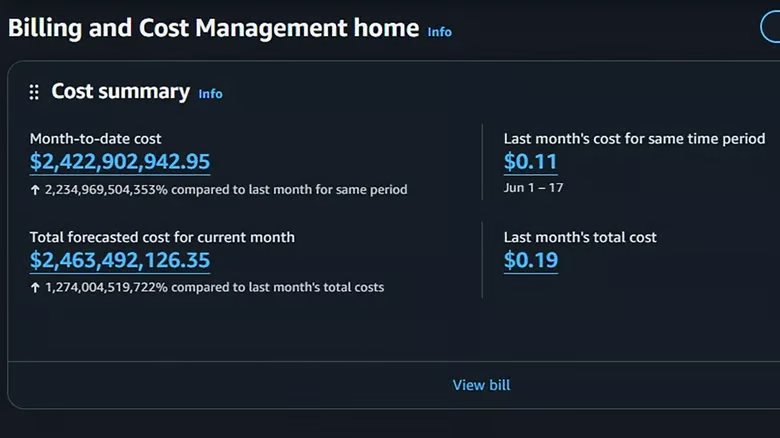
To put it simply, estimated cloud charges can be represented as:
Estimated Cost = Resource Usage x Unit Price
For example, imagine you only use 100 GB of storage, and the correct price is $0.023 per GB. Normally, your estimated bill would be $2.30.
According to AWS, the bug caused the estimator to use incorrect unit pricing when calculating projected costs. If it mistakenly treated the price as $10 million per GB, that same 100 GB of storage would appear to cost $1 billion. Your actual usage never changed; the billing estimator simply multiplied it by an incorrect price, resulting in an impossible estimate.
The example is hypothetical, but it illustrates how an incorrect pricing input can produce an otherwise impossible total.
Importantly, the bug only affected estimated billing, not customers’ actual cloud usage or final invoices. AWS said the underlying usage data remained accurate and that customers would not be charged inflated amounts.
Advertisement
AWS initially tried rolling back the change, but that didn’t fix the issue, so the company disabled the estimator, found the error hours later, and began deploying the fix. The company also noted that the rollout would be gradual.
Must-read security coverage
Why unreliable cloud cost data matters
On the surface, bugs often look like minor errors, but these technical errors have not just disrupted services; they have, on many occasions, enabled cybersecurity attacks and, in rare but tragic cases, contributed to fatalities.
The uncomfortable reality is that society increasingly trusts software to make decisions we rarely question. Whether it’s calculating medical doses, keeping infrastructure functional, processing financial transactions, or estimating cloud costs, we assume the numbers on our screens are correct. Incidents like this challenge that assumption, reminding us that every system remains vulnerable to flaws.
Businesses face an equally important lesson.
In this age of rapid software releases and continuous deployment, resilience isn’t just about preventing cyberattacks. It’s also about detecting mistakes before they spread in production software. That means treating every code change as a potential business risk, backed by rigorous testing, gradual rollouts, automated monitoring, and the ability to reverse faulty updates quickly.
The episode highlights the risks associated with frequent software changes. Automated testing, staged deployments, anomaly detection, and reliable rollback procedures are not only engineering safeguards; they are financial controls when software calculates costs that businesses use to make decisions.
AWS’s billing glitch ended with confused customers rather than financial damage. But it served as a reminder that organizations increasingly rely on software-generated data to make operational and financial decisions. When that data becomes unreliable, even briefly, the business impact can extend well beyond a faulty dashboard.
Advertisement
Other News: Discord’s automated moderation system mistakenly banned more than 8,000 users over harmless images, exposing how software bugs can turn AI-powered safety tools into widespread account lockouts.
About Author