OpenAI introduced its video creator by the name of Sora to specific levels of ChatGPT users on December 9 during the series of announcements leading up to the holiday season.
In February 2024, the organization showcased the capabilities of Sora. Since then, they have developed a faster version and explored responsible ways to unveil AI video generators.
Nowadays, OpenAI’s focus on security around Sora is commonplace in the world of generative AI. However, it also highlights the necessity of precautions when dealing with AI that could potentially create deceptive images. These fabricated images could, for example, harm the reputation of an organization.
By December 10, the registration for Sora was closed due to the overwhelming demand.
What Sora Entails
Sora serves as a generative AI diffusion model. It has the ability to produce a variety of characters, intricate backgrounds, and lifelike movements in videos up to one minute long. Additionally, it can craft multiple shots within a single video, ensuring consistency in characters and visual style, making Sora an effective tool for storytelling.
Sora can be utilized to create videos that can complement content, advertise products or content on social platforms, or elucidate key points in business presentations. Although it should not substitute the creativity of professional video producers, Sora can expedite the creation of certain content.
“Media and entertainment are expected to be the primary industries that might embrace models like these early,” stated Gartner Analyst and Distinguished VP Arun Chandrasekaran in an email to TechRepublic in February. “Business sectors such as marketing and design within tech firms and corporations could also be early adopters.”
Countries currently excluded from Sora access
As of now, Sora is accessible in all regions where ChatGPT can be accessed except the United Kingdom, Switzerland, and the European Economic Area. The Guardian highlighted that Sora still needs to adhere to the European Union’s GDPR and Digital Services Act, as well as the UK’s Online Safety Act. OpenAI announced in December its plans to expand access in the upcoming months.
Accessing Sora
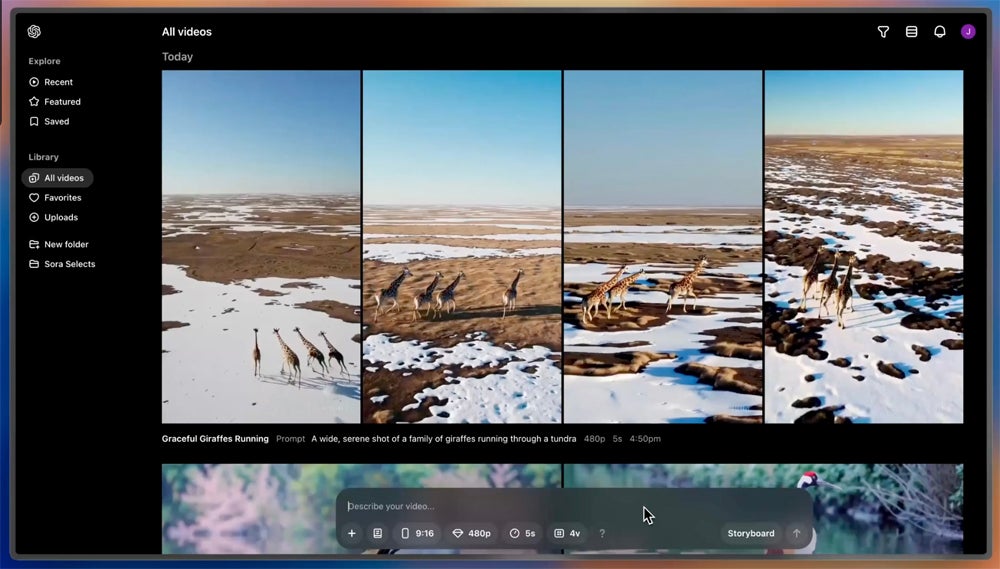
Starting from December, users of ChatGPT Plus and Pro can utilize Sora on sora.com.
Sora videos can be created in 1080p resolution, up to 20 seconds in duration, and in widescreen, vertical, or square aspect ratios. The interface enables users to incorporate their own content, with the “storyboard” feature aiding in organizing prompts sequentially.
The Mechanism Behind Sora
Sora operates as a diffusion model, refining an insensible image into a clear one based on the prompt and employing a transformer architecture. The research conducted by OpenAI to create models such as DALL-E and GPT, especially the recapturing technique from DALL-E, acted as stepping stones for the birth of Sora.
DISCOVER: Chief AI officers could play a pivotal role in the APAC region in 2025.
The Realism of Sora Videos
Sora encounters challenges in distinguishing left from right or comprehending intricate event descriptions progressing over time, such as prompts involving specific camera movements. Errors in causality can be noticeable in videos generated by Sora, as highlighted by OpenAI in February, like an individual biting into a cookie without leaving a mark.
Interactions among characters may exhibit blurriness (especially near limbs) or ambiguity related to quantities (for instance, the fluctuating count of wolves in the video below).
OpenAI’s Measures for Sora’s Safety
By providing proper prompts and adjustments, videos produced by Sora can easily be mistaken for live-action films. OpenAI is cognizant of potential defamation or misinformation challenges resulting from this technology. In December, the company stated it has implemented safeguards to prevent “child sexual abuse materials and sexual deepfakes.” General uploads of individuals are restricted.
If Sora is made available to the public, OpenAI intends to incorporate C2PA metadata in Sora-generated content. The metadata can be viewed by selecting the image and opting for the File Info or Properties menu. Despite this, those producing AI-generated images can still purposely or inadvertently remove the metadata.
Presently, OpenAI lacks mechanisms to prevent users of its image generator, DALL-E 3, from erasing metadata.
“OpenAI’s decision to delay the public launch of Sora, despite having the opportunity to introduce it sooner, is definitely commendable,” commented Nana Nwachukwu, AI ethics and governance consultant at Saidot, in an email to TechRepublic.
However, she added that it is too premature to assess the effectiveness of OpenAI’s mitigation strategies or whether it will be available in the EU.
“Governance needs to evolve in tandem with technology to oversee and address these risks,” Nwachukwu remarked. “Without continuous monitoring and robust industry standards, the allure of innovation could be overshadowed by potential misinformation and harm.”
“It is already [challenging] and will increasingly become implausible for human beings to discern AI-generated content,” highlighted Chandrasekaran in February. “Venture capitalists are investing in startups developing deepfake detection tools, which could serve as a defense for enterprises. Nonetheless, there will be a need for public-private partnerships to identify machine-generated content, particularly at its inception.”
Alternatives to Sora
Sora’s lifelike videos are distinctive, but there are analogous services available. Notable among them are Google’s Veo, currently in a private testing phase, and Amazon’s upcoming Nova Reels.
Runway offers text-to-video AI generation suitable for business settings. Fliki specializes in crafting concise videos with synchronized audio for social media narration. Generative AI can now seamlessly add or modify content in traditionally captured videos.
On February 8, Apple researchers unveiled a publication discussing Keyframer, a proposed large language model capable of producing stylized animated images.
Editor’s note: This article was originally published in February and updated in December.
About Author