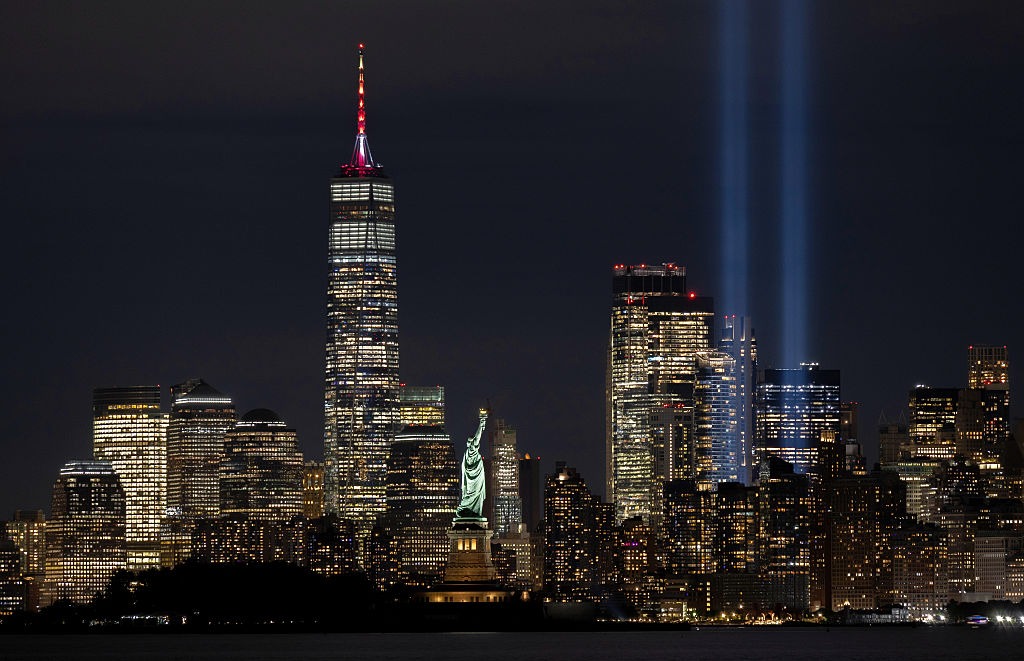
After 9/11, we came together. After Bondi, we didn’t
Twenty-five years later, it’s easy to remember the images of September 11 but harder to reconstruct how that morning felt. The strongest memory is of people simply stopping and watching something almost incomprehensible unfold. The shock was enormous, but it was the uncertainty that was most unsettling. From moment to moment, the questions would change from ‘How could such a crash happen?’, to ‘Is the United States under attack?’, to ‘Are the terrorist attacks finished?’
Immediately it felt existential – for the US of course, but also for all of America’s allies. The attack was on the US homeland but also on democratic freedom. Australian prime minister John Howard, in Washington as the attacks were unfolding, said on 12 September 2001, ‘yesterday marked the end of an era of a degree of innocence following the end of the Cold War and a decade in which it seemed as though things which posed a continuous threat were put behind us.’
And while the initial uncertainty of the attack froze us, we did not divide. The US alliance network stood strong, and the national resilience of democracies held together.
A few days later, president George W Bush said, ‘These terrorists kill not merely to end lives, but to disrupt and end a way of life …. This is not, however, just America’s fight. And what is at stake is not just America’s freedom. This is the world’s fight. This is civilisation’s fight. This is the fight of all who believe in progress and pluralism, tolerance and freedom. We ask every nation to join us.’
Australia already had. On returning to Australia, Howard invoked the ANZUS treaty for the first and still only time and set about explaining the action to the public. Opposition leader Kim Beazley gave it immediate and full-throated support. That helped with national unity.
It was an era before social media. There was less information, but in many ways that gave extra time for authorities to collect, establish and explain facts. Yes, the internet was already popular, but we read newspapers, watched television and listened to radio. We waited for information. We trusted the information.
We might not have known what was happening at every moment, but that initial uncertainty turned into a largely shared long-term pursuit for safety, justice and repair.
No such national cohesion is visible today, and indeed none has been since the largest terrorist attack on Australian soil, at Bondi Beach in December 2025. This is because we are well into the era of social media and its exploitation by those who want to divide us, whether terrorists and their supporters or foreign adversaries and their proxies.
The public has more access to information than ever before but less ability to verify it. Fewer people trust in government, and more give credit to extreme social media activists – so-called content creators, whose content is unverified, inaccurate and unsourced. They feed each other, deepen each other’s extremism and, depending on their ideological alignment, may themselves be highly exposed to manipulation.
Governments, democratic institutions, security agencies, the mainstream media and the public grapple with the output of people untrained in and unbound by journalistic ethics. Instead of careful information collection, analysis and updates, we get uninformed guesswork and rage-baiting.
Just weeks after the Hamas attacks on Israel in October 2023, a letter titled ‘Letter to the American People’, written by Osama bin Laden in 2002 to justify 9/11, went viral on TikTok. A new generation, many of whom had not even been born in 2001, transitioned in days from ordinary disagreement with US and Israeli Middle East policy to extraordinary agreement with bin Laden’s defence of hijacking and ramming planes into civilian buildings.
Hindsight has imposed an order on the hours after 9/11 that didn’t exist at the time. We know what followed: Afghanistan, Bali, wars and interventions, al-Qaeda’s evolution, Jemaah Islamiyah, sweeping changes to intelligence and policing, the rise and territorial defeat of Islamic State – and its exploitation of social media for recruitment. None of that was apparent on the morning of 9/11. Nor, indeed, did we see that fighting terrorism in Afghanistan and the Middle East over the coming decade and more would distract us from a revival of Russian aggression and the rise of a powerful and bellicose China.
After 9/11, Australia created not just a succession of new terrorism laws and additional powers for security agencies; it built an interconnected system for managing terrorist risk without promoting division. This included, for example, explaining the need for extraordinary security agency powers and promoting the idea of our looking out for each other against the common threat. The catchphrase ‘be alert, not alarmed’ made us simultaneously aware and reassured. That job of holding people together is never finished, and it needs more effort than ever. And that effort needs not just prevention but preparation to manage inevitable crises.
Australian counterterrorism did not begin on 11 September 2001. Australia already had intelligence and policing capabilities, aviation-security arrangements, and experience dealing with politically motivated violence. It had prepared well for the 2000 Olympic Games. What changed after 9/11 was the scale, priority, resourcing and integration of the effort. A larger architecture progressively encompassed intelligence collection and assessment, information sharing, federal, state and territory policing, border security, criminal law, financial intelligence, international partnerships, prevention, prosecution, protective security and crisis response. Together, these things formed Australia’s counterterrorism capability.
Then, barely a year after 9/11, came Bali. For Australians who were already adults then, it’s difficult to separate the two events when thinking about the period that followed. New York had shown us what terrorism could do. Bali showed us what it could do to us. The bombings at Paddy’s Bar and the Sari Club on 12 October 2002 killed 202 people, including 88 Australians. The victims included footballers on end-of-season trips, families and Australians simply on holiday.
Bali demonstrated a limit in counterterrorism. Australian authorities were already concerned about the terrorist environment in Indonesia. In September 2001, the Australian Security Intelligence Organisation had raised the threat to Australian interests there to ‘High’, and intelligence subsequently developed an increasingly disturbing picture of Jemaah Islamiyah’s intent and capability. But no intelligence identified those two venues as targets. The distinction is critical. Strategic warning doesn’t provide tactical prediction. Governments can know that the likelihood of terrorism is increasing without knowing who will attack, where, when or how.
Bali shocked Australia despite the warnings that preceded it. But once again there was a united national and social response. Shock, justice and recovery were shared journeys; they weren’t divisive. Terrorism seeks effects far beyond its immediate victims. It wants fear, reaction and division. A terrorist’s murder of just a few people achieves a great strategic goal if it provokes communal retaliation, destroys trust in government or turns parts of society against each other.
So social cohesion is a national security capability. Vulnerability emerges when trust in institutions and our ways of handling normal disagreements begin to break down. Our capacity to absorb a shock without fragmenting is part of national resilience.
The contrast between the unified aftermath of September 2001 and Bali and the social disorder we face in 2026 is striking. With the rise of social media in those 25 years, our ability to cope with difference, disagreement and crises has regressed. The quote often misattributed to Voltaire, ‘I disagree with what you say but I will defend to the death your right to say it’, risks becoming ‘I disagree with what you say, so we must fight to the death.’
Twenty-five years ago, the public was used to waiting for facts to be settled. Now people expose themselves to, and trust, purveyors of bogus instant certainty that often generates grievance.
Australians had been warned of the risk of a terrorist attack before Bondi. ASIO raised the national terrorism threat level from ‘Possible’ to ‘Probable’ in August 2024. It had assessed that the security environment had become more volatile, because people were radicalising more quickly, motivations for extremism were diversifying, and pathways to violence were becoming harder to detect. ‘Probable’ meant there was a greater than 50 percent chance of an onshore attack or planning for an attack in the following 12 months.
When the attack did happen, at Bondi, the first public response was familiar from 9/11 and Bali: shock, grief and ensuring the attacks were over. But this time there was no waiting for information and facts. Another phase followed quickly. Instead of the search for justice and shared repair, it was the pursuit of blame, division and, in some quarters, rationalising violence against the Jewish community, akin to support for bin Laden’s letter justifying 9/11.
The terrorist doesn’t control what happens in this second phase after an attack – but still achieves the objective of social division. Extremists, influencers, political actors, foreign states and ordinary citizens all participate in interpreting and amplifying an event, while algorithms reward content that generates engagement. Fear, outrage and identity are powerful drivers of that engagement. The attack surface of terrorism has expanded from the physical into the digital ecosystem.
Preventing violence remains the first responsibility of counterterrorism. But managing terrorist risk increasingly also means limiting the consequent fragmentation – because social cohesion, valuable in itself, is also part of the armoury against terrorism. We’d already lost much social cohesion before Bondi, after the Hamas attacks of October 2023. So the social response to Bondi started from a position of low resilience.
Whether 9/11, Bali or Bondi, all terror attacks show that, while preventing and avoiding them is our main objective, preparation is still needed for when they nonetheless occur – and that requires national unity. Where once this unity was to be maintained, it is now to be regained.
While the West failed to imagine the terrorist acts of 9/11, bin Laden failed when he imagined it would lead to democratic distrust and decline. But through means that bin Laden can’t have imagined (social media didn’t exist in 2001, and by the time he died in 2011 it was lauded as a powerful tool of democratic progression), just such distrust and decline are happening now.
We must find a way to prevent him from finally being right. There shouldn’t come a time when terrorists and their sympathisers can say, ‘Well, it was better late than never’. Democracies must be able to stand together and say, ‘Never on our watch.’
Western governments are right to judge that, more likely than not, social-media policy is crucial to questions around cohesion and unity. Social media is an international phenomenon that no single country can contain. To succeed and not suffer further social division, nations need to find the answers together.
This is a lightly edited version of an article that was first published in The Australian.
About Author