
Fake Government App Exposes Italy’s Expanding Spyware Surveillance Industry
Fake Government App Exposes Italy’s Expanding Spyware Surveillance Industry

 November 28, 2026

A fake Interior Ministry app used Morpheus spyware to target asylum seekers in Italy, raising questions about surveillance and oversight.
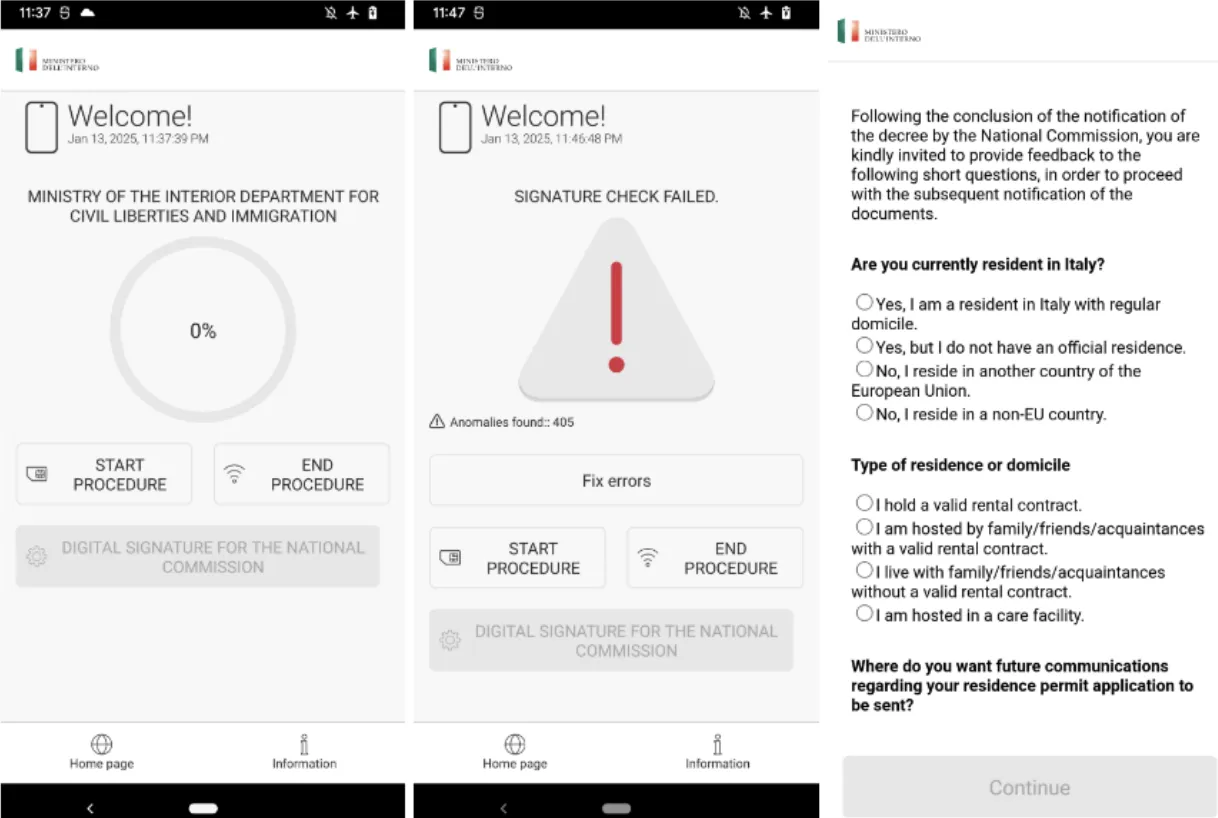
An Android app called FirmaDigitale promised asylum seekers news on their protection status, instead, it was delivering spyware.
An IrpiMedia investigation by Rosita Rijtano builds on Lookout’s 2024 discovery and attributes the malware to IPS, a Latina supplier to prosecutors, police and intelligence agencies. Nobody knows who ordered the operation or whom it hit.
Victims downloaded the app from firmadigitale.assistenza-mobile[.]it, a page mimicking the website of Italy’s primary postal service provider Poste Italiane. The app displayed the Interior Ministry logo and mentioned a protection decree. Police deny any link to it, and Poste didn’t comment.
The spyware could add components to use the microphone, intercept internet calls, record the screen and track the phone. It could also reach contacts, call logs, files and texts. The site has been unreachable since 2025, but the app could still circulate elsewhere.
Osservatorio Nessuno named the spyware Morpheus in April 2026 after finding it in a fake Fastweb app. Attackers also abused the TIM, Iliad, PosteMobile and WindTre brands, and Iliad said it knew of no such apps. Morpheus can even hijack WhatsApp through a fake biometric prompt.
“We are faced with yet another example of low-cost spyware that exploits vulnerability and suffering to strike at one of every individual’s most intimate rights: the privacy of the devices we use daily for all our activities and communications,” comments a spokesperson for Osservatorio Nessuno, a volunteer organization that studies digital surveillance technologies and provides technical assistance to journalists and activists.
“This case is particularly cruel because it leverages—from a position of supreme power—systems that are already discriminatory and hostile, specifically targeting migrants. The responsibility lies in many quarters: from the complete lack of Italian or European regulation regarding the proliferation of such companies, to a total absence of transparency and constraints—including ethical ones—on these types of operations.”
Kristina Balaam of Citizen Lab, formerly at Lookout, says social engineering makes these tools cheaper than zero-click spyware and still effective. Why burn a rare exploit when a convincing form will do?
Osservatorio Nessuno blames weak Italian and European rules, opacity and missing ethical limits. Civil liberties coalition Cild wants to know why authorities would target asylum seekers, who authorized it and what it produced.
IPS has plenty of company, including RCS, Area, SIO and Innova. Nine established firms reported €214.4 million in 2024 revenue from surveillance and intelligence tools. Italy supplied 72.8% of revenue among the five disclosing geography.
Spyware targets rose from 2,894 in 2021 to 5,611 in 2025, up about 94%. Mafia cases accounted for 2,930 last year, ordinary crimes for 2,618 and terrorism for 63. Germany authorized 91 spyware operations in 2024 and carried out 57.
Italian law permits spyware well beyond mafia and terrorism cases, including corruption and many ordinary crimes. Defence lawyer Eugenio Losco warns that a criminal association charge opens the door, even against unionists and activists. Interception spending also reached about €299 million in 2025, despite a national price list meant to cut costs.
Controls remain thin. Italy has no prior quality check, and authorities lack the skills to verify the software. In the eSurv case, a company kept intercepts on its own servers, and its trial continues.
Magistrates’ association vice president Marcello De Chiara calls spyware essential and current safeguards for its use adequate. He wants tighter rules for private vendors, including a national register and clearer ownership.
The concern extends beyond this app. A researcher says at least five activists recently received spyware links, while Sea-Watch’s Giorgia Linardi has reported zero-click surveillance in 2021. IrpiMedia doesn’t tie either case to FirmaDigitale.
Lawyer Giovanni Battista Gallus says Italy lacks a complete law limiting what spyware can do. Collected data can remain archived, and authorities needn’t notify targets when an investigation is shelved. IrpiMedia captures the result, that targets may never find out, in one sentence:
“Those who are spied upon may never even find out. In fact, there is no obligation to notify an individual that they have been subjected to surveillance once an investigation is closed.” Gallus concludes. “Furthermore, while the surveillance tools must be deactivated at the end of an operation, the material collected is not automatically deleted; instead, it may remain stored in the public prosecutor’s archives.”
Follow me on Twitter: @securityaffairs and Facebook and Mastodon
(SecurityAffairs – hacking, Morpheus spyware)
About Author