China’s ambassador tells Australia what to do, again
China is continuing its long-term efforts to dominate Australia and divide it from its ally, the United States. Yesterday’s op-ed by Chinese Ambassador Liu Jinsong, carried in The Australian, was a prime example of this strategy.
It amounted to instructions for Prime Minister Anthony Albanese and the Australian delegation on their upcoming participation in the Shenzhen Asia-Pacific Economic Cooperation (APEC) meeting and their subsequent visit to Beijing. It presented guidance for Australia’s long-term future, too.
The ambassador asked, ‘Do Australians see themselves as part of the Asia-Pacific family?’ before moving immediately to ‘Where does the future of China–Australia relations lie?’ He answered both questions with references to Australia’s engagement with APEC, repeatedly conflating APEC and a China-led ‘Asia-Pacific’. The concept of the ‘Indo-Pacific’ was studiously avoided, as was any reference to the diverse APEC members (US, Canada, Mexico, Peru and Chile) along the eastern littoral of the Pacific.
The message was crystal clear: that Australia thrives through its engagement with an economically vibrant and China-led East Asia. That the Australian government needs to bear in mind that Australians essentially care only about the economy and people’s livelihoods. That strategic engagement and collaboration with other regions threatens this prosperity and that the Australian government ignores China’s concerns and interests in this sphere only at its peril. Undergirding this rhetoric was China’s ardent and ongoing opposition to AUKUS and the Australia–US alliance.
The Global Times assisted in this endeavour by concurrently publishing an op-ed by Australian economist Peter Drysdale, ‘APEC offers major multilateral platform to take China–Australia ties to next stage’. The title gives the gist.
Efforts to divide Australia from the US have been a constant in China’s engagement with Australia over many decades. China’s long-term planners dwell on ways to gain dominance over a landmass that fronts the Pacific, Indian and Southern Oceans and has immediate access to the Antarctic and the South China Sea.
As early as the 2013 Australia–China Forum held in Canberra we heard instructions much like Liu’s yesterday. Back then, the Chinese delegation led by diplomat Li Zhaoxing vented its anger over Australian statements criticising China’s unilateral announcement of an air-defence identification zone over the East China Sea. The delegation blamed this ‘unwarranted intrusion’ into China’s affairs on Australia’s close alliance with the US. The relationship was simply ‘a product of the Cold War’ and negatively affected China’s ‘core interests, its sovereignty and its territorial interests,’ the Australians were told.
Jason Van der Schyff has recently noted in The Strategist that China ‘seeks not partners but vassals. Its military expansion has concentrated heavily on the western Pacific, where geography, trade and territorial disputes give it strong incentives to seek greater control. Its economic influence extends much further, supported by investment, infrastructure and commercial relationships across the world …. Coercion needn’t be military. When Australia said what China didn’t want to hear about the Covid-19 pandemic in 2020, it suffered Chinese trade restrictions.’
Ambassador Liu’s op-ed tells us exactly what we need to do to maintain our economic prosperity. Citing President Xi Jinping, he urges concentrating on promoting economic growth and improving people’s lives. In this, Australia should further open itself up to expanding frontier cooperation with China in artificial intelligence, biotechnology and clean energy.
Then comes the warning. ‘The relationship is at a crossroads – pressure to fall back on one side, momentum to move forward on the other.’ The pressure to ‘fall back’, it should be noted, comes from those who promote Australia’s interests through our alliance with the US and the many joint political, economic, technological and strategic plans being laid to counter China and its efforts to dominate our region.
But the ambassador urges Australia to avoid the inevitable fallout of collaborating with outsiders in countering China’s aims, by following China’s lead in upholding the multilateral trading system to ‘build an Asia-Pacific community together’. After all, ‘the Asia-Pacific is where China and Australia stand and, more important, [is] the foundation for our shared development and prosperity.’
China appears far more anxious than any other country to try to publicly influence Australia’s foreign and domestic policies. Rarely do we see an op-ed in the national press by a diplomat from a country other than China. ‘China telegraphs its punches,’ former US ambassador to China James Lilley is reported to have said. Indeed, Chinese cadres are always anxious to guide, a tradition which likely derives from the all-important role that propaganda plays under the Chinese Communist Party.
Even from his day of arrival in Australia in August, when he posed at Sydney airport with two prominent united front figures, Liu has been anxious to publicly telegraph China’s policies and intentions. He has done that again in The Australian.
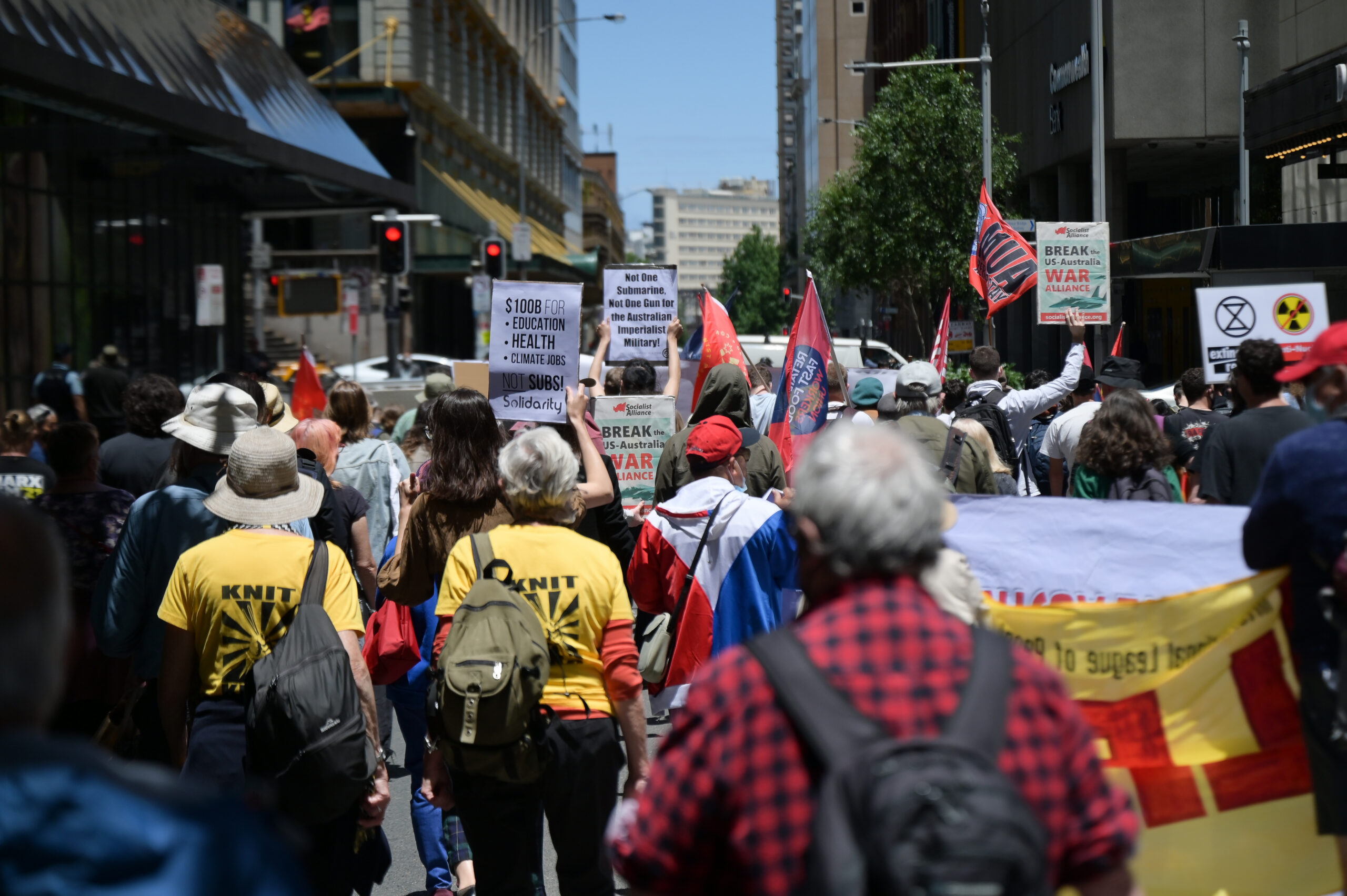
The op-ed comes on the heels of a much less subtle editorial carried in China Daily on 5 November, reporting on the publication of what its promoters call the Independent AUKUS Public Inquiry Report. The China Daily editorial writer concluded that the AUKUS agreement ‘runs counter to Australia’s national interests. Its staggering costs divert resources away from essential public needs, and it unnecessarily entangles Australia in geopolitical competition.’ On the Australia–US alliance, the editorial continues: ‘Facts suggest that blindly following an extraterritorial power in pursuit of enhanced military capability cannot deliver genuine security for Australia, and dependent military arrangements will only compromise Australia’s strategic autonomy and increase the country’s security risks.’
Liu is essentially saying the same thing in his op-ed, presented behind a facade of immediate economic interest. Australia is simply being told to proceed at the APEC meeting and in its future national and foreign policies in ways that are in accord with China’s (and therefore Australia’s) core interests.
About Author