Chinese twin-track diplomacy is building influence in the Middle East
China is seeking to exploit perceived Western missteps in the Middle East, including the Iran war, by turning societies against the United States and other western nations.
As part of this, the Chinese Communist Party’s International Department has, over the past year, established several joint bodies with Middle Eastern partners. These joint bodies overtly promote Xi Jinping’s Global Civilization Initiative, which in turn promotes the idea of a multipolar world order, and simultaneously serve as outlets for CCP influence and propaganda.
All this has been well timed to take advantage of Middle Eastern feeling against the US arising from its support for Israel in Gaza and its actions against Iran.
Three China-backed Global Civilization Initiative bodies have been established in Ankara, Erbil (the capital of the Kurdish region of Iraq) and Teheran. These are all closely linked with the CCP’s International Department, a body which we have already seen pursuing twin-track diplomacy across the Pacific.
First, let’s look at Turkey. From 18 to 19 July 2026, an international conference titled Alliance to Prevent a Great War was held in Ankara. It focused on why Turkey, Russia, China and Iran should form an alliance against the evils of the US, NATO and Israel. The Turkish Vatan (Patriotic) Party promoted it as ‘a Eurasian Summit in response to the NATO Summit convened in Ankara on 7–8 July 2026’. A range of papers was presented, but the nature of the conclave, which reportedly attracted some 200 people, can be best assessed through these extracts from its final declaration:
The threats that could lead to a Great War originate from the United States and Israel. The US-Israeli attack on Iran, the United States’ military buildup in Ukraine and its use of proxy forces against Russia, Israel’s genocide in Gaza, and its attacks on Lebanon are regional wars that carry the risk of triggering a Great War, including through the use of tactical nuclear weapons.
…
Security in the world represents a need not only for the countries and peoples placed in the crosshairs of the United States and NATO, but for all humanity, including the Atlantic countries. An alliance among Turkiye, Russia, China and Iran would also provide a solid foundation for the formation of a FRONT OF HUMANITY against a Great War.
It would be easy to dismiss these statements as simply the collective pro-Russia and anti-NATO sentiments of the Vatan Party. After all, the left-wing Vatan Party holds none of the 600 seats in Turkey’s parliament.
However, a closer examination shows that the CCP is closely tied to both the sentiments expressed and the Vatan Party itself. The CCP’s aim is to build influence and drive a wedge between Turkey and the US: electoral power is likely only a potential future and secondary objective.
The conference in Ankara was convened by the Global Civilizations Initiative Research Centre (DUNYA-MER). This was established in Ankara in April 2026, with the opening ceremony including speeches by leaders from Vatan and DUNYA-MER, and by Jin Xin, deputy head of the International Department of the CCP Central Committee. The speeches underlined how the centre was being established in line with Xi Jinping’s Global Civilization Initiative. They also stressed the congruence between Republic of Turkey founder Kemal Ataturk’s idea of a ‘social order befitting humanity’ and the CCP’s ‘community of common destiny for humanity’. The CCP’s International Department has continually met with the Vatan Party since 2018, and the establishment of this centre is part of their expanding cooperation.
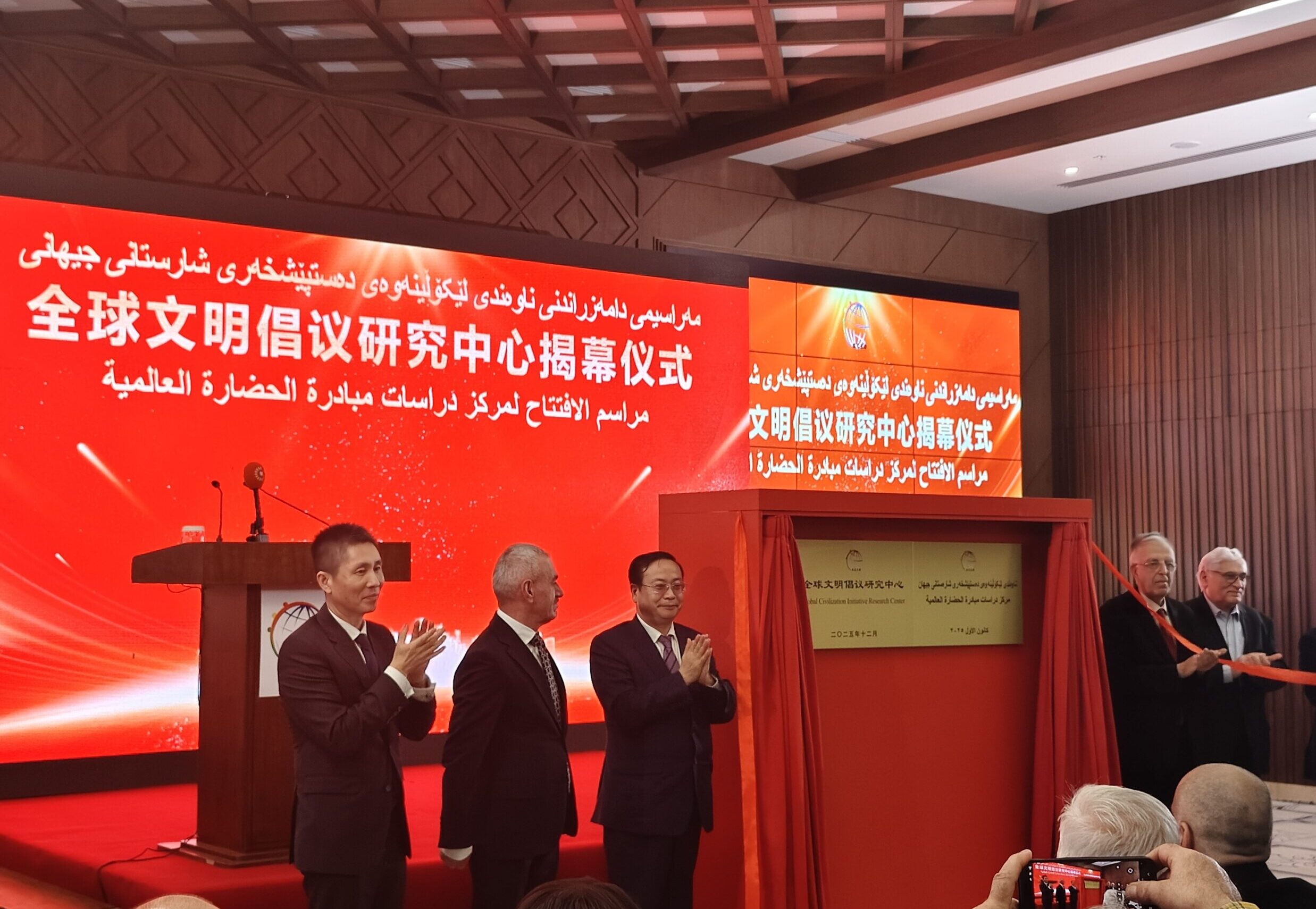
There have been parallel developments in Iraq. In December 2025, Jin Xin of the CCP’s International Department led a delegation there. During that visit, the first Global Civilization Initiative Research Centre in West Asia was established in Erbil. The launch was reportedly attended by ‘over 300 representatives from political parties and think tanks of Iraq, Türkiye, Syria, Jordan and other countries’. This centre is led by Kawa Mahmoud, former secretary-general of the Central Committee of the Kurdistan Communist Party of Iraq.
Five months later, in April 2026, Jin hosted in Beijing a delegation from the Iraq Global Civilization Initiative Research Centre. The group included political party representatives and think-tank scholars from Iraq, Palestine, Syria, Jordan and Lebanon. Reportedly, they were ‘speaking positively of the vision of building a community with a shared future for mankind and the four global initiatives proposed by General Secretary Xi Jinping.’
To coordinate these West Asian (and perhaps broader) endeavours, a Global Civilization Institute was inaugurated in Beijing under the Chinese Academy of Social Sciences in July 2026. It is tasked with acting ‘as a comprehensive academic platform aimed at advancing research on civilizations and promoting exchanges and mutual learning among civilizations’.
The third case has arisen in Iran. Last month, a delegation of the Iranian Research Institute for Islamic Culture and Thought made its first visit to the CCP International Department in Beijing (again, they were hosted by Jin). There, it was said that the Iranian institute had recently established a Global Civilization Initiative research centre in Tehran. The leader of the Iranian delegation ‘highly praised the Global Civilization Initiative proposed by General Secretary Xi Jinping’. He also said ‘the Iranian leadership attaches great importance to developing Iran–China relations, particularly in exchanging experiences in governance and promoting mutual learning among civilisations.’
While the attention of the CCP’s International Department appears currently focused on the Middle East, all regions need to watch closely how China is using these Global Civilization Initiative bodies for influence and propaganda. China’s aims in the Middle East – deepening hostility towards the US and the West – are no different from its aims in our own region.
About Author