Four Nation-State Actors Used the Same Chrome Zero-Day Exploit Kit Within 12 Days
Four Nation-State Actors Used the Same Chrome Zero-Day Exploit Kit Within 12 Days

 September 10, 2026
Four espionage groups used the BlueMoon Chrome+Windows exploit kit within 12 days. Researchers suspect AI development.
Proofpoint published a detailed analysis of a Chrome-and-Windows exploit kit it tracks as BlueMoon that four nation-state actors adopted within roughly two weeks of the first observed use. Google’s Threat Intelligence Group, Microsoft’s MSTIC, and Volexity all contributed to the investigation.
“Proofpoint identified four espionage-motivated threat actors employing a new exploit kit that chains multiple Chrome browser and Microsoft Windows vulnerabilities. Proofpoint is tracking the exploit kit used in this activity as BlueMoon.” reads the report published by Proofpoint. “The first observed cluster using the BlueMoon exploit kit was the China-aligned threat actor TA412 (JungleBamboo, Violet Typhoon, APT31, TIDE CASTLE) on 28 August 2026. Within days, several other espionage-motivated clusters began using BlueMoon, the majority of which have a suspected China nexus. However, BlueMoon may not be exclusive to China-aligned actors, as some usage remains unattributed and there are also potentially more actors using the exploit kit.”
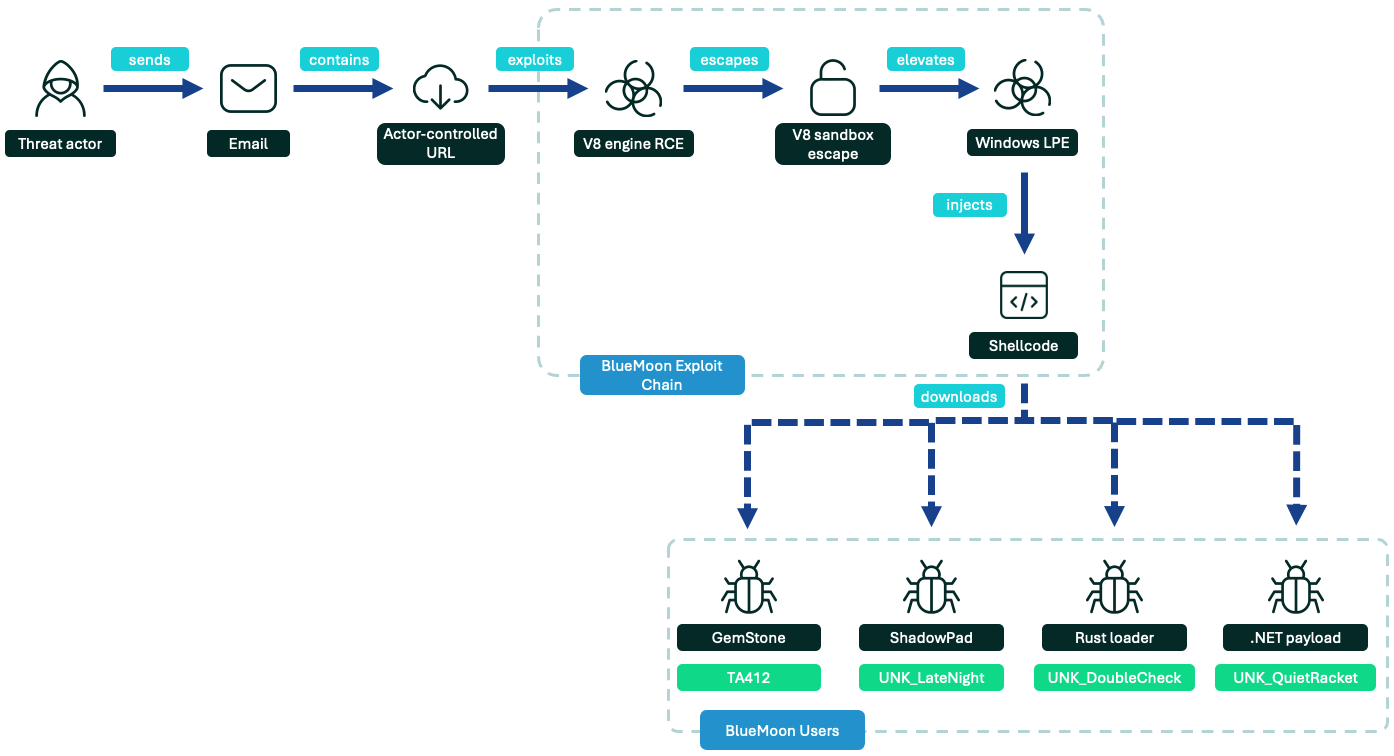
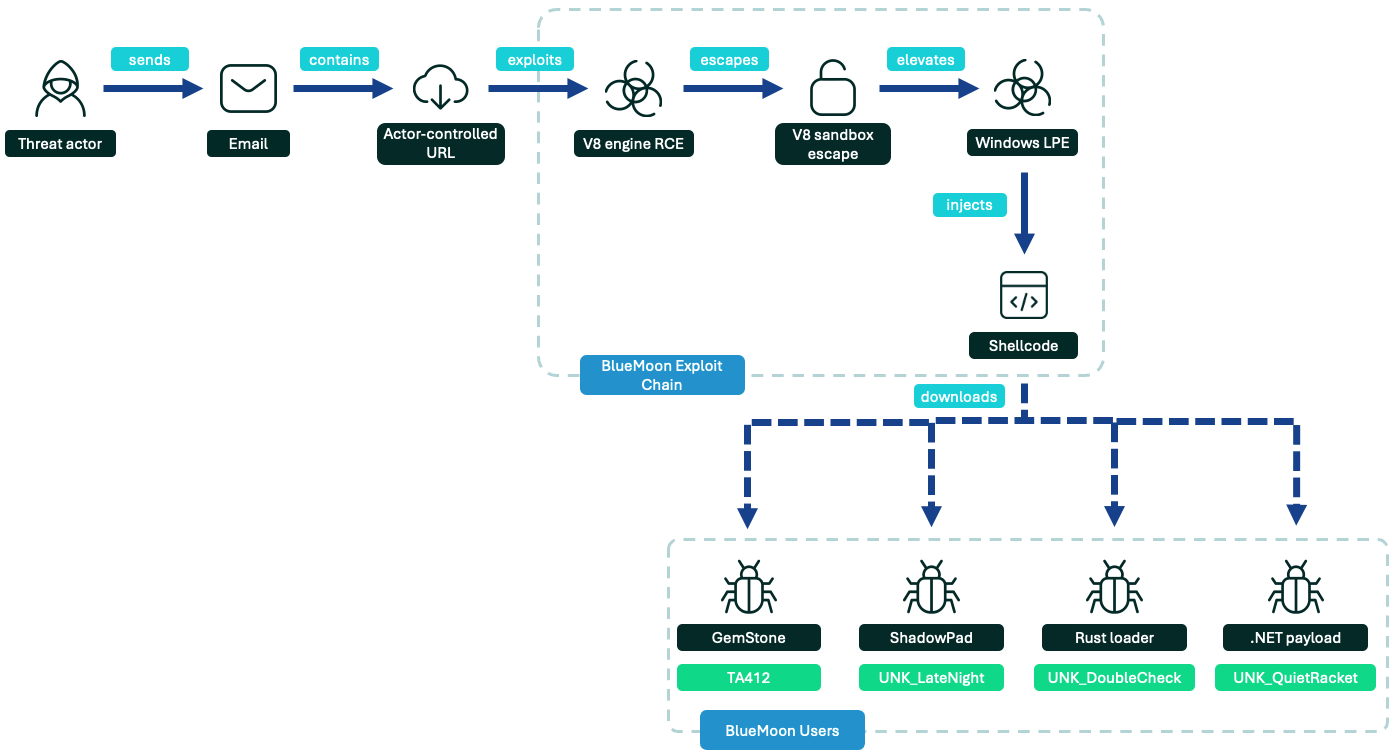
BlueMoon chains three vulnerabilities. CVE-2026-85046 is a type-confusion bug in Chrome’s V8 JavaScript engine that abuses an optimization flaw in the TurboFan JIT compiler: by mutating an array mid-sort, an attacker gets the ability to read object memory addresses and forge fake object pointers, building toward arbitrary read and write inside V8’s heap. A V8 sandbox escape (no CVE assigned, Chrome doesn’t issue CVEs for sandbox escapes) then overwrites WebAssembly compiled function bodies with attacker shellcode from memory. CVE-2026-85880, a Windows kernel local privilege escalation using ALPC and Windows Notification Facility mechanisms, completes the chain and elevates the attacker from the browser’s sandboxed renderer to a position where they can inject code into Chrome’s parent process and run arbitrary commands.
“Both V8 vulnerabilities were “patch-gap” zero-days at the time of the observed activity. In other words, while they were known vulnerabilities already fixed in public upstream Chromium source code, they remained unpatched in the latest stable releases of Chrome and Chromium-based browsers available to the public.” continues the report. “It is likely that the exploit kit developer used these publicly available Chromium patches to weaponize the browser exploit chain.”
The fix for CVE-2026-85046 was committed to the Chromium source tree on August 7, almost four weeks before it rolled into the stable Chrome release on September 3. That gap is what made rapid weaponization possible: the patch itself is a public document describing exactly what was wrong.
The kit also bears visible signs of how it was made.
“Although no single artifact conclusively confirms AI-assisted development of BlueMoon, Proofpoint identified several indicators consistent with this hypothesis, including extensive diagnostic logging capabilities, a referenced markdown handover document, and detailed comments documenting successive debugging iterations and implementation decisions.” states the report. “Furthermore, the exploit chain’s default configuration reflects a departure from the level of operational security and technical tradecraft typically associated with browser exploit chains. For example, by default, successful exploitation simply results in a curl command that downloads an actor-provided executable to disk and executes it. “
The comments in the kit ask testers to “please send the full log back.” It also refers to a markdown handover file, docs/v8-ctf-chrome-stage4-handover.md, which could be used to pass context between AI agent sessions. The kit repeatedly mentions Google’s V8CTF vulnerability bounty program. Proofpoint says this could mean the V8 bugs were developed through that program, or that the developers used the V8CTF context to get around AI safety restrictions while creating the exploit. The researchers cannot confirm which explanation is correct.
The default post-exploitation step is another important clue. The kit includes a complete Chrome exploit chain that can escape the V8 sandbox and gain higher privileges on Windows. Its default payload uses curl to download an executable into %TEMP% and run it. Endpoint security tools would likely detect this activity quickly. This suggests the developers focused on releasing the exploit before the September 3 Chrome patch rather than making it difficult to detect.
The first confirmed use was TA412 (aka APT31, Violet Typhoon, and JungleBamboo) a China-nexus APT linked to the Ministry of State Security’s Hubei State Security Department and indicted by the US government in 2024 for economic espionage. Starting August 28, TA412 targeted US NGOs, mining companies, and physical commodity trading firms using phishing emails that posed as university students seeking internships or as outreach related to the Association for Asian Studies conference. Clicking the link loaded BlueMoon silently, then redirected the browser to a legitimate site while exploitation ran in the background.
TA412’s post-exploitation payload was GemStone, a malicious browser extension that masquerades as an “AI-powered browsing companion by Google Gemini.” It installs into Chrome, Edge, Brave, and Vivaldi by bypassing the browser’s Secure Preferences protection mechanism using the same HMAC computation method the browser itself uses to validate extensions.
GemStone accepts commands to capture keystrokes, cookies, screenshots, local and session storage, and browsing history, and can inject arbitrary HTTP requests from the browser’s own context. It runs its C2 through a Cloudflare Worker domain. Proofpoint has the full command table in the report.
On September 2, UNK_LateNight, a second suspected China-aligned cluster, began targeting US aerospace and defense companies with fake RFQ and procurement inquiry emails. The payload was ShadowPad, the modular backdoor extensively used by Chinese state groups, delivered through a DLL sideloading chain that creates a scheduled task named “EdgeCore_AutoUpdate” for persistence and unhooks 20 network monitoring functions to reduce visibility. The same day, UNK_DoubleCheck targeted a Vietnamese manufacturing company from a compromised Southeast Asian government email address with a vaccination appointment lure. Its payload downloaded a Rust-based loader from Cloudflare R2 that staged a second DLL sideloading chain for C2.
Since September 3, UNK_QuietRacket has targeted government, consulting, and financial organizations in Indonesia and Singapore with conference-themed lures. Its C2 uses Google’s DNS-over-HTTPS service to resolve addresses through TXT records, then decrypts them with ChaCha20 before reaching Cloudflare Workers. DoH hides the DNS activity among normal encrypted traffic, making the C2 harder to detect.
CVE-2026-85880, the Windows LPE component of the chain, is the same vulnerability Microsoft patched as an actively exploited zero-day in September 2026 Patch Tuesday. The Windows LPE only targets older builds, including Windows 10 through 22H2, Windows Server 2019 and 2022, and Windows 11 21H2. Its compilation timestamp is from 2025, suggesting it was a pre-existing capability packaged into BlueMoon rather than written for this campaign.
Defenders running those builds who haven’t applied September patches should treat this as urgent regardless of whether they’re a BlueMoon target.
“A fully weaponized Chrome exploit chain has historically been a high-value, rare capability. BlueMoon was developed, deployed rapidly, and shared across multiple threat actors within days in a manner that had high detection signals. This may reflect a reduced cost and barrier to entry for this class of capability, as AI agents increasingly enable threat actor exploit development. This is particularly relevant for open source codebases, such as Chromium, where upstream patches are publicly accessible prior to downstream consumers of the codebase applying the patch. This creates a window for threat actors to attempt to rapidly reverse engineer patches and develop exploits ahead of downstream stable releases.” concludes the report. “The majority of observed BlueMoon usage is assessed to be China-aligned espionage-motivated activity, although there is not sufficient evidence to attribute BlueMoon usage exclusively to China-aligned threat actors at the time of writing.”
Follow me on Twitter: @securityaffairs and Facebook and Mastodon
(SecurityAffairs – hacking, BlueMoon)
About Author