
With over a million prescriptions for Ozempic and similar GLP-1 drugs being dispensed by pharmacies weekly, scammers are taking advantage of the situation. Our Threat Research Team has observed a significant increase in online scams related to Ozempic and weight loss.
Whenever there is a high demand combined with scarcity, scammers inevitably appear. This is the case with the rise of Ozempic and weight loss scams.
For nearly twenty years, doctors have been prescribing GLP-1 medications to manage diabetes. The approval of several GLP-1 drugs for weight loss by the U.S. Food and Drug Administration (FDA) has led to a surge in demand.
What was a $500 million market for this drug in 2020 is now projected to exceed $7.5 billion in 2024.[i] Consequently, these drugs have become increasingly difficult to obtain as pharmaceutical companies struggle to keep up with the demand.
Various Ozempic scams circulating on the internet, phones, and social media
The Threat Research Team at McAfee has unveiled the widespread nature of these weight-loss scams. Malicious websites, scam emails and texts, social media posts, and online marketplace listings have all contributed to the proliferation of these scams.
- Between January and April 2024, malicious phishing schemes associated with Ozempic, Wegovy, and Semaglutide saw a 183% increase compared to the period from October to December 2023.
- In their investigation, McAfee researchers identified 449 risky website URLs and uncovered 176,871 fraudulent phishing attempts related to these medications.
- Scammers on Facebook are posing as doctors based outside the U.S., offering Ozempic and other drugs without the need for a prescription.
- Other scammers are resorting to platforms like Craigslist to advertise their scams. In just one day in April, McAfee researchers detected 207 fraudulent postings for Ozempic.
Payment through Bitcoin, Zelle, Venmo, and Cash App is commonly requested in these scams. These unconventional payment methods for prescription drugs should raise immediate suspicions of fraudulent activities.
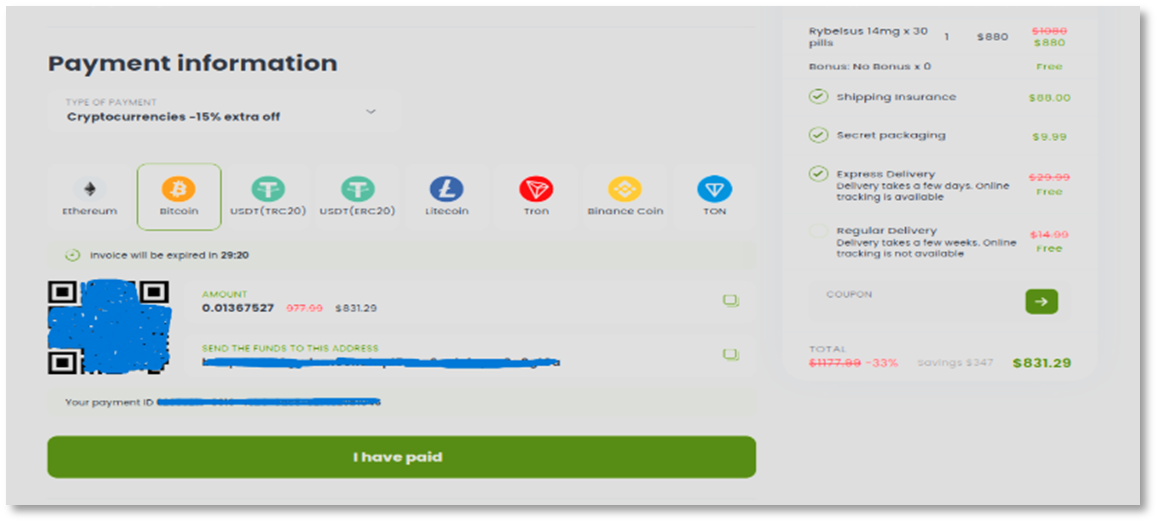
Illustrative example of a deceitful website
Another common trait seen in these scams is the offer of discounts. Several scams discovered by McAfee offered counterfeit drugs at a reduced price if individuals paid using cryptocurrency. Additionally, some were selling these drugs at significantly discounted rates far below the legitimate market value of $1,000 per dose.
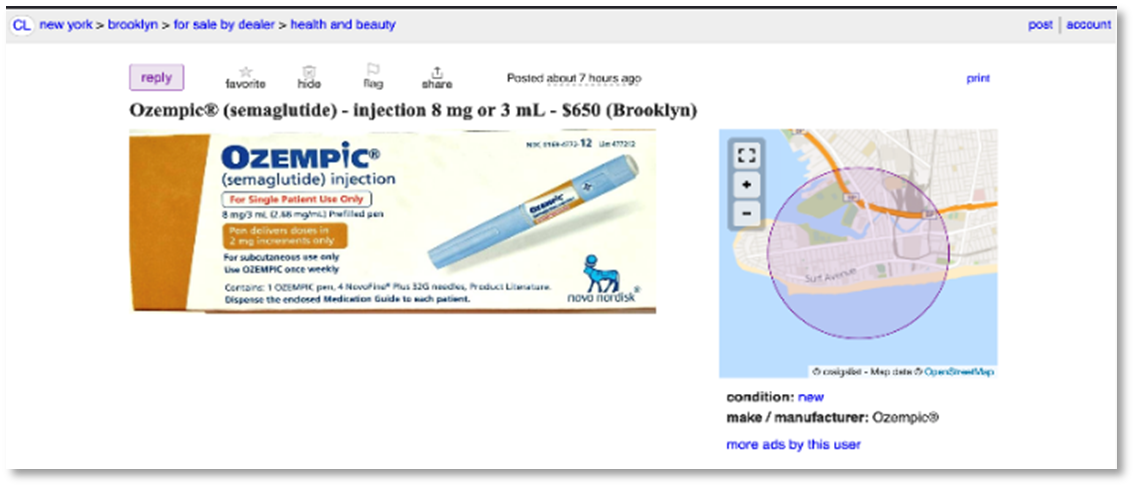
Deceptive ad on Craigslist
Similar to many fraudulent schemes, these Ozempic and weight loss scams fall under the category of “Too Good To Be True.” Unrealistically low prices and the option to purchase drugs without a legitimate prescription are clear signs of fraudulent activities. The risks associated with falling for such scams are substantial.
The Consequences of Falling Prey to Ozempic or Weight Loss Frauds
These scams can result in theft, health hazards, or a combination of both.
Many times, victims of these scams receive nothing in return. The scam operators simply abscond with the money without delivering any products. Furthermore, personal and financial information may be stolen for use in future identity theft schemes.
In instances where scammers do fulfill the order, the received product is often not what was promised. Instead of receiving the correct medication via an injection pen, victims may be sent EpiPens filled with allergy medication, insulin pens, or pens containing a saline solution.
An individual who fell victim to one of these scams shared her harrowing experience:
“I started using Ozempic in February 2023 to manage my diabetes. Initially, the drug was readily available, but as its popularity grew a few months later, the stock became scarce.
By September, it was extremely challenging to find Ozempic in stock, and for about a month and a half, my mother and I were unable to locate it at all. I mentioned this to a colleague, who mentioned that her friend was selling it. Although skeptical, I knew that her acquaintance was linked to the medical field, and the price was only slightly higher than what I had been paying. It seemed reasonable, so I decided to give it a shot. I received the product and paid her the agreed-upon amount.
Upon opening the package, it immediately felt suspicious. The packaging seemed flimsy, and the pen appeared significantly different from the one we had been using. My mother examined it closely and quickly identified that something was amiss. I took photos and videos, and with the help of my doctor, we contacted a representative [from the legitimate pharmaceutical company], who confirmed that it was a counterfeit. It wasn’t Ozempic; it was an insulin pen.
Realizing that I had almost injected myself with the wrong substance, mistakenly believing it was Ozempic, was terrifying and potentially life-threatening. The thought of what could have happened if we hadn’t thoroughly scrutinized the product is truly frightening.”
This account underscores the gravity of the situation regarding Ozempic and weight loss scams. Unlike many other online scams, these particular scams have the potential to cause physical harm, underscoring the critical need to avoid falling victim to them.
Precautions to Take to Steer Clear of Ozempic and Weight Loss Scams Online
Remember that purchasing Ozempic or similar medications without a proper prescription is against the law. Consequently, selling these drugs on social media platforms such as Facebook Marketplace or Craigslist is also illegal. Be cautious of foreign pharmacies and unfamiliar websites, as they may be selling FDA-unapproved drugs or could be fraudulent.
Only purchase medications from trustworthy pharmacies. Verify a pharmacy’s license through your state board of pharmacy (this link provided by the FDA can help you locate that information). If a pharmacy is not listed, avoid using its services. Additionally, ensure that the pharmacy has a U.S.-based phone number and physical address.
Remain vigilant against excessively low prices. Once again, if an offer appears too good to be true, it likely is. Moreover, never utilize digital wallet apps, bitcoin, prepaid debit cards, or wire transfers to pay for prescription medications.
PayPal, Apple Pay, or making a payment with a credit card are common choices available at legitimate drugstores.
Be vigilant for errors on websites and missing information about products. Untrustworthy websites often lack concrete details about their products. Pay close attention and peruse the fine print. Seek out specific product batch numbers, expiration dates, or manufacturer information to verify the authenticity of your purchase. Some websites fail to meet basic design standards and exhibit grammatical mistakes.
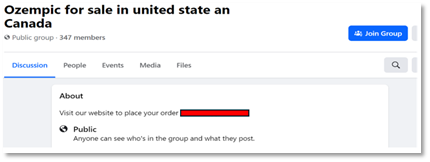
A poorly constructed scam through social platforms…
Watch out for deceptive assertions. If a medication promises instant weight loss or miraculous recoveries, be cautious. The acquisition of counterfeit Ozempic presents substantial health hazards such as exposure to hazardous substances, incorrect dosing, and absence of intended effects. On top of financial detriment, ineffective or counterfeit medications can lead to adverse reactions or exacerbate existing health conditions.
Contemplate utilizing AI-based scam defense. McAfee Scam Protection employs artificial intelligence to identify and prevent malicious links inserted by scammers into emails, texts, and social media messages. Moreover, McAfee Web Protection detects and blocks links to scam websites that emerge in searches or while browsing.
Remain alert. Scam artists establish counterfeit profiles on various social media platforms. Do not place unwavering trust in sellers on platforms like Telegram, Craigslist, Facebook, or TikTok. Many scammers leverage these platforms for their illicit activities. Also, be wary of testimonials! Fraudsters utilize fabricated recommendations to instill false trust.
The financial ramifications of Ozempic and weight loss swindles
Truly, the repercussions of these schemes can be detrimental. They can inflict damage on both your finances and well-being. The silver lining here is that you have the ability to completely sidestep them.
This serves as a poignant reminder…when something gains immense popularity and becomes scarce, it becomes a breeding ground for scams. This is exactly what we are witnessing with these highly sought-after medications. It mirrors previous scenarios seen with trending toys during holiday seasons and even rental cars during peak travel periods. In situations where urgency, necessity, and monetary transactions intersect, the likelihood of encountering a scam elevates.
[i] https://www.jpmorgan.com/insights/global-research/current-events/obesity-drugs
The article How Ozempic Scams Put People’s Finances and Health at Risk was initially published on the McAfee Blog.
About Author