The AI SOC’s L1 Automation Ceiling: Why Classification Is Not Investigation
Your “autonomous AI SOC” classifies alerts, but it stops short of investigating them. Here’s why that distinction will define the next generation of security operations.
The AI SOC Gold Rush
The AI SOC market is in a gold rush.

Wikipedia’s AI agent row likely just the beginning of the bot-ocalypse
Your “autonomous AI SOC” classifies alerts, but it stops short of investigating them. Here’s why that distinction will define the next generation of security operations.
The AI SOC Gold Rush
The AI SOC market is in a gold rush. Venture-funded startups have collectively raised hundreds of millions of dollars on a compelling promise: autonomous AI agents that replace Tier 1 analysts, eliminate alert fatigue, and revolutionize security operations.
The demos are polished. The speed metrics are impressive. And after years of drowning in alerts, security leaders are understandably eager to believe that AI will finally solve the SOC staffing crisis.
But there’s a problem that nobody in the AI SOC market wants to talk about: almost every platform on the market stops at L1 triage.
They classify alerts. They enrich them with threat intelligence. They tell you whether something is a true positive or a false positive. And then they hand the real work back to your team.
The L1 Ceiling Is Structural
L1 triage (alert classification, enrichment, and prioritization) is genuinely valuable work. Automating it addresses a real pain point. But it’s only the front door of the investigation.
Once an alert is classified as a true positive, the substantive investigation begins: tracing the attack path across multiple tools and telemetry sources. Correlating identity events with endpoint activity. Mapping lateral movement. Assessing blast radius. Determining containment and remediation actions. This is Level 2 work, and it’s precisely where today’s AI SOC platforms hit their ceiling.
We call this the L1 Automation Ceiling, and it’s a structural consequence of building on general-purpose large language models that lack a foundational understanding of how cyber attacks propagate across tools and time.
What’s Below the Marketing
Beneath the marketing language of “autonomous investigation” and “AI SOC analyst,” a consistent pattern emerges across the competitive landscape:
Generic AI foundations. Most platforms wrap general-purpose LLMs in cybersecurity prompts. They’re fast classifiers, and they lack the depth of trained investigators.
No attack path discovery. They classify alerts individually. They can’t trace lateral movement across your EDR, SIEM, identity systems, cloud logs, and network telemetry to build a unified threat narrative.
Agent maintenance overhead. Several require your team to build, configure, and maintain AI agents, trading the “SOAR architect” problem for an “agent architect” problem.
No SOAR or case management. They’re triage layers that stop short of full platforms. You still need a separate SOAR product for response orchestration and a separate case management system for incident tracking.
Silent integration failures. When vendor APIs change, their integrations break, and nobody knows until alerts start queuing.
Usage-based pricing. Many charge per alert, per investigation, or per AI credit. Scale your coverage and your costs scale with it.
What It Actually Takes to Go Beyond L1
Going beyond L1 triage requires a fundamentally different architecture: a purpose-built cybersecurity intelligence engine that understands how attacks move through enterprise environments.
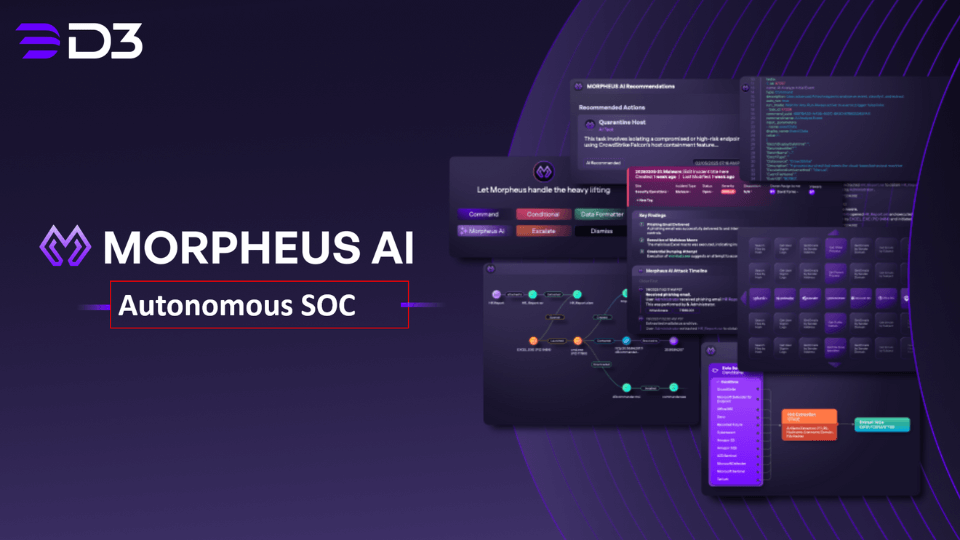
That’s what we built with D3 Morpheus.
Morpheus is powered by a cybersecurity LLM that we developed over 24 months with a team of 60 specialists: red teamers, data scientists, AI engineers, and SOC analysts. On every incoming alert, it performs multi-dimensional attack path discovery: vertical deep inspection into the origin tool’s telemetry, and horizontal correlation across the full security stack. The result is an L2-level investigation report with step-by-step reasoning, delivered in under two minutes.
L1 triage solutions tell your analyst the alert is real. Morpheus tells your analyst what happened, how far it spread, what systems are affected, and what to do about it.
The Complete SOC Platform
But investigation depth is only part of the story. The AI SOC market’s other blind spot is platform completeness.
Morpheus consolidates three products into one: AI-driven autonomous triage with attack path discovery, a full traditional SOAR engine for deterministic playbook automation, and integrated case management for incident lifecycle tracking. Organizations can start with traditional SOAR playbooks for compliance-sensitive workflows and adopt AI-driven triage progressively, running both from the same platform, migrating at their own pace.
And critically: no usage fees. No per-alert charges. No investigation quotas. No overage surprises. Your SOC can scale to 100% alert coverage without watching a meter tick.
The Question Every Security Leader Should Ask
Before you sign your next AI SOC contract, ask one question: “What happens after the alert is classified as a true positive?”
If the answer is “a human analyst picks it up from there,” you’re buying an L1 bot. A sophisticated, fast, well-funded L1 bot, but an L1 bot nonetheless.
If you want a platform that investigates, orchestrates, and manages the full incident lifecycle from a single vendor with predictable pricing, the architecture exists. It’s called Morpheus.
For a deeper read, check out our new whitepaper D3 Morpheus vs. L1 AI Triage Solutions.
Ready to see the difference? Request a personalized demo at d3security.com
The post The AI SOC’s L1 Automation Ceiling: Why Classification Is Not Investigation appeared first on D3 Security.
*** This is a Security Bloggers Network syndicated blog from D3 Security authored by Shriram Sharma. Read the original post at: https://d3security.com/blog/l1-ceiling-ai-soc-vendor/
About Author