Security by Design: Why Multi-Factor Authentication Matters More Than Ever
If you’re planning a cruise for your holidays, and cannot bear the idea of being parted from your Ray-Ban Meta smart glasses, you may want to avoid sailing with MSC Cruises.
The cruise line has updated its list of prohibited items, specifically banning smart glasses and similar wearable devices from public areas.
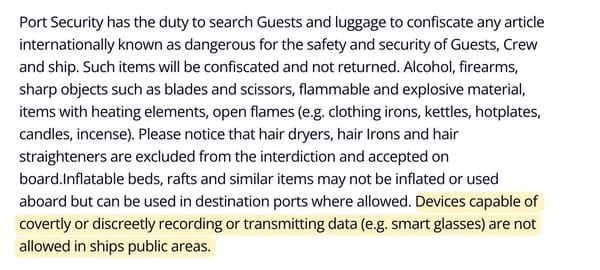
The ban means that you could find your expensive Google Glass, Meta/Ray-Ban Stories confiscated by the cruise’s security team if you break the rules.
An obvious question is why are smart glasses subject to a ban onboard, but not other recording devices such as smartphones and regular cameras?
MSC Cruise’s reasoning is likely to be that there is a significant difference between someone obviously recording what is going on around them, and covertly recording footage.
A cruise passenger can fairly easily tell when someone is pointing a smartphone camera at them, but as smart glasses sit discreetly on a wearer’s face it can be much harder to know when you are being filmed.
Furthermore, everyone understands today that phones have cameras. Smart glasses remain relatively rarely encountered (although they are becoming more mainstream), and so the typical person is unlikely to realise what is happening unless they are specifically looking out for the technology.
And, unfortunately, it’s not always obvious that someone is wearing smart glasses. For instance, a key selling point of the most recent version of Ray-Ban Meta glasses (which have a built-in camera that can capture and even stream video) is that they look just like “normal” glasses.
The companies manufacturing smart glasses are very aware of the strong opinions people have about being covertly filmed, and some have included prominent recording indicators, such as a visible LED light, to inform others when the camera is active.
Some smart glasses even have built-in technology which is supposed to block their ability to capture photos and video if the LED indicator is covered by, say, a piece of sticky tape. However, it is reported that such glasses can be “modded” to disable this safeguard and allow covert filming without individuals nearby having any indication that they are being filmed.
As CruiseHive reports, MSC Cruises is also likely to have security concerns that extend beyond the privacy of travellers, and extend to the risk that sensitive locations such as gangways, behind-the-scenes operations, and security checkpoints, might be filmed, potentially compromising safety if footage was shared online.
Opinions amongst travellers are mixed on whether MSC Cruises has taken the right approach.
While some have applauded MSC Cruises for getting ahead of what is viewed as growing problem, others on social media have said that the ban goes too far – arguing that smart glasses can be genuinely helpful as they can provide real-time translation, navigation help, and even offer assistance for those with impaired vision or hearing.
The Cruise blog, for instance, describes the verdict of one passenger:
“Won’t be sailing MSC then. I love my [Ray-Ban] smart glasses… They do so much more than photo and video. Translation, calls, music, and so much more. They don’t go? Neither do I.”
My hunch is that MSC Cruises will find itself with some grumpy passengers. After all, if you’ve gone to the expense of investing in smart glasses and purchasing a cruise ticket, you probably won’t be too happy finding out that you are not going to be allowed to use them willy-nilly on your vacation.
But then, MSC Cruises appears to have weighed that against the displeasure of aggrieved travellers who simply do not want to be filmed without their permission or knowledge.
For now, MSC appears to be sailing alone in implementing a strict policy against the usage of smart glasses. Carnival Cruise Line, for instance, does allow “Google-type glasses” in public areas, only restricting them during gangway operations when passengers are boarding or disembarking.
But fundamentally this is not a cruise ship issue at all. Smart glasses are becoming increasingly sophisticated and harder to distinguish from regular glasses.
As wearable recording technology becomes more prevalent, expect more venues – from gyms to restaurants to concert halls – to grapple with similar policy decisions.
For now, if you’re an MSC cruiser, leave the smart specs at home. Or at least keep them in your cabin.
About Author