
How to Visualize Web & API Coverage with Screenshots and Validate Attack Paths in Escape
We reworked how Escape represents dynamic security testing tool coverage across web applications and APIs, with one goal:
Make every executed action observable, verifiable, and explainable.
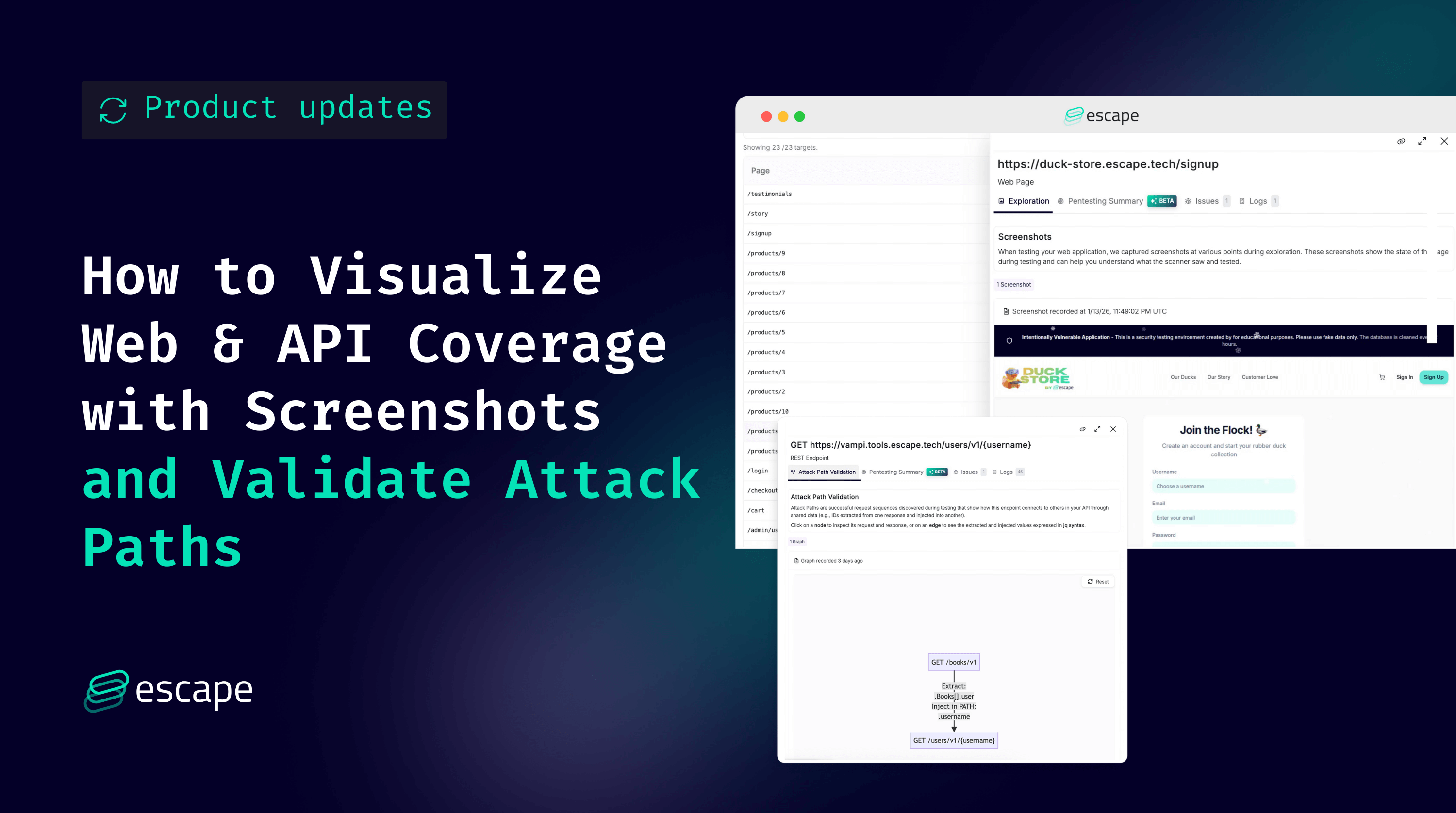
<div>How to Visualize Web & API Coverage with Screenshots and Validate Attack Paths in Escape</div>
We reworked how Escape represents dynamic security testing tool coverage across web applications and APIs, with one goal:
Make every executed action observable, verifiable, and explainable. We strongly believe every app is different, and just showing visited URLs is not enough.
.toc-smart.hidden {
opacity: 0;
pointer-events: none;
}
.toc-smart ul {
list-style: none;
margin: 0;
padding: 0;
}
.toc-smart li {
margin-bottom: 0.65rem;
}
.toc-smart a {
text-decoration: none;
color: inherit;
padding-left: 0.5rem;
display: block;
border-left: 3px solid transparent;
transition: all 0.2s ease;
}
.toc-smart a:hover,
.toc-smart a.active {
background-color: rgba(5, 226, 183, 0.15); /* ✅ 15% opacity */
border-color: #2b185d;
color: inherit;
}
@media (max-width: 1024px) {
.toc-smart {
display: none;
}
}
]]>
const tocTitle = document.createElement(‘div’);
tocTitle.classList.add(‘toc-title’);
tocTitle.textContent = ‘Jump to’;
tocBox.insertBefore(tocTitle, toc); // Insert title before the list
let lastH2 = null;
headings.forEach(heading => {
const text = heading.textContent.trim();
if (!text) return;
if (!heading.id) {
heading.id = text.toLowerCase().replace(/[^a-z0-9]+/g, ‘-‘).replace(/^-+|-+$/g, ”);
}
const li = document.createElement(‘li’);
const a = document.createElement(‘a’);
a.href = `#${heading.id}`;
a.textContent = text;
li.appendChild(a);
// If it’s an h3, indent it under the last h2
if (heading.tagName.toLowerCase() === ‘h3’ && lastH2) {
let sublist = lastH2.querySelector(‘ul’);
if (!sublist) {
sublist = document.createElement(‘ul’);
lastH2.appendChild(sublist);
}
sublist.appendChild(li);
} else {
toc.appendChild(li);
lastH2 = li; // Update lastH2 for nesting h3s
}
});
const tocLinks = document.querySelectorAll(‘#smartToc a’);
// Click scroll
tocLinks.forEach(link => {
link.addEventListener(‘click’, function(e) {
e.preventDefault();
const target = document.querySelector(this.getAttribute(‘href’));
if (target) {
const yOffset = -100;
const y = target.getBoundingClientRect().top + window.scrollY + yOffset;
window.scrollTo({ top: y, behavior: ‘smooth’ });
}
});
});
// Scroll tracking
const observerOptions = {
root: null,
rootMargin: ‘0px 0px -60% 0px’,
threshold: 0
};
const observer = new IntersectionObserver(entries => {
entries.forEach(entry => {
const id = entry.target.id;
const link = document.querySelector(`#smartToc a[href=”#${id}”]`);
if (link) {
if (entry.isIntersecting) {
tocLinks.forEach(l => l.classList.remove(‘active’));
link.classList.add(‘active’);
}
}
});
}, observerOptions);
headings.forEach(heading => observer.observe(heading));
// Hide TOC after blog
const blogEnd = document.querySelector(‘main’);
if (blogEnd && tocBox) {
window.addEventListener(‘scroll’, () => {
const rect = blogEnd.getBoundingClientRect();
const hide = rect.bottom
Why this matters
After every security scan, you might be left wondering: “Did it actually test our admin endpoints? How did it reach that nested API call? Why didn’t it find the vulnerability our pentester discovered?” When auditors, developers, or leadership ask for proof of thorough testing, you’re stuck with a vulnerability report and a shrug.
Screenshot shown to confirm exploration of a specific path
Now, we help your team to answer the following questions:
Is the scanner getting good broad coverage?
What endpoints were actually tested?
Did authentication succeed, and where did it fail?
How were inputs discovered and chained?
Which attack paths succeeded, failed, or were blocked?
This update makes Escape’s exploration and testing fully transparent, end-to-end. You can prove what was tested, troubleshoot gaps instantly, and stop defending your security tooling.
What’s Included For APIs (At a Glance)
API Coverage page showing all API endpoints actually visited during a scan
Advanced filtering by endpoint, severity, method / mutation type, and coverage status
HTTP status code visualization to quickly spot error-heavy or unreachable routes
Attack Path Validation graph that gives you visibility into Escape’s API exploration engine and helps you ensure that everything found by Escape is interpreted in the correct way and that all the input is valid.
Pentesting Summary (Beta) explaining the endpoint’s purpose and what vulnerabilities were found on that endpoint
New Logs page with a full, filterable execution trace of the scan
What’s Included For Web Applications (At Glance)
Web Application Coverage showing all tested pages and states
Screenshots captured during exploration, including dynamic SPA states
Search and filtering to validate that specific routes were tested
Dedicated Crawling view listing all discovered pages in a folder-based structure
API Coverage for web-triggered API calls, with the same attack path validation graphs and visibility as API-first scans
Unified Logs page shared across web and API testing for full end-to-end traceability
Yes, you can now get full visibility into everything executed during a scan and truly check whether Escape is testing your applications and APIs appropriately.
Find more details on each point below.
Coverage & Attack Path Validation For API Testing
API Coverage Page: Proving What Was Actually Tested
The API Coverage page shows every API endpoint visited by the crawler, allowing you to quickly confirm that sensitive routes were actually exercised.
Escape Coverage Page for API testing
You can:
Search for a specific endpoint or resolver
Confirm whether it was tested
Immediately see if testing succeeded, partially failed, or was blocked
This lets you answer, with certainty:
Was this endpoint actually exercised during the scan?
You can narrow the list of endpoints by:
Associated vulnerability severity→ focus on endpoints involved in high-impact findings
Associated HTTP method (REST) or mutation type (GraphQL)→ understand how an endpoint was interacted with
Coverage status→ OK, server error, timeout, unreachable, etc.
This is especially useful to:
Identify endpoints that consistently error out
Spot routes that were reachable but never returned valid responses
Understand where configuration issues prevented deeper testing
At the top of the page, Escape visualizes HTTP status codes (200 / 400 / 500 …) in a stacked bar chart. This gives you a fast signal for questions like “Are a large number of endpoints returning 400 or 500?”
Attack Path Validation Graphs: Verify that interpreted in the correct way
The coverage page tells you what was reached. Attack Path Validation Graphs show how it was reached, including the initial input. For each endpoint, you can open an Attack Path Validation Graph that exposes the exact execution chain used by Escape to get there.
These graphs help you to understand complete request sequence generated by Escape’s Business Logic Security Testing (BLST) algorithm, an intelligent engine built by the our research team that understands dependencies, extracts dynamic values, and chains requests like an experienced pentester.
What the Graph Shows (Precisely)
Each graph represents:
The sequence of requests and responses
Dependencies between endpoints
Data extraction and reinjection logic used to build valid requests
Extractions and reinjections between different requests are described using jq syntax.
Example (REST API): Chaining Endpoints the Way an Attacker Would
API Attack Path Validation within Escape
Imagine an API exposing:
GET /books/v1→ returns a list of books and associated user_id
GET /users/v1/{user_id}→ returns user details
During exploration:
Escape calls GET /books/v1
Extracts user_id values from the response
Reinserts those IDs into GET /users/v1/{user_id}
In the Attack Path Validation Graph, you can see:
Where the ID came from
How it was validated
Which follow-up requests succeeded or failed
Pentesting Summary (Beta)
To complement raw execution data, Escape adds AI pentesting summaries per endpoint.
Exploration Summary (Beta)
This explains the endpoint’s purpose, business logic, how it was discovered, and which execution path led to it. It is particularly useful for reviews, knowledge transfer, audits.
Pentesting Summary (Beta)
This section focuses on security impact and provides explanations:
What vulnerabilities were found
Which payloads triggered them
Why the behavior is exploitable
What an attacker could realistically do
It connects findings directly to execution evidence.
To get access to the AI pentesting summary feature, reach out to your dedicated Escape contact.
Web Application Coverage with Screenshots and Pentesting Summaries (Beta)
Escape now shows:
1. Coverage with Screenshots
Every unique application state reached during the crawl is:
Captured as a screenshot
Associated with a logical route
Searchable and filterable by severity
2. Pentesting summary (Beta)
Beyond screenshot validation, Escape delivers AI-generated summaries that break down how vulnerabilities associated with a specific page were uncovered and precisely which attack attempts led to its discovery:
3. Associated Issues
In a dedicated tab, you can view all issues linked to this specific web page, giving you immediate visibility into what was found and where.
No more guessing whether a given page was touched during scanning.
Behind the scenes: Escape’s RL-driven web crawler identifies similar page states and avoids redundant visits — now you can see exactly which unique states were tested and why.
Crawling View
A structured list of all discovered pages organized by folder and hierarchy. This makes it easy to:
Validate that important areas of the site were exercised
Cross-reference against your sitemap
Spot blind spots in discovery
API Coverage Within Web Testing
When web crawling triggers API calls (XHR/Fetch), those same coverage and attack path visualisation capabilities apply — giving you:
Unified API visibility
Integration into Attack Path Validation graphs
Proven evidence of how frontend and backend interactions were exercised
This gives you end-to-end visibility, from UI action → API call → vulnerability.
A list of API calls triggered by web crawling associated with a corresponding web app
With this release, Escape shifts dynamic testing from a black box to a glass box.
You don’t just see results of the scan, you see:
How coverage was achieved
Why authentication might have failed
And where your real attack surface lies
Whether you’re validating that a critical part of a web app was tested, debugging a failed scan, preparing for an audit, or reviewing a production incident, Escape gives you the right evidence.
Improved Scan Logs Page: Stop Debugging Scans Blind and Improve Your Scan Performance
Escape’s improved Logs page gives you a complete, chronological view of everything that happens during a scan — and, crucially, why it happens.
By making every scanner decision, skip, and failure fully visible, Logs help you quickly diagnose issues, fine-tune configurations, and continuously improve scan coverage and reliability.
The result: less guesswork, faster debugging, and better scans over time.
What you’ll see in the Logs page
The Logs page shows every event associated with a scan, including:
Configuration steps (schema download, auth detection, proxy usage)
Execution steps (requests, responses, mutations)
Issues found
Agentic LLM reasoning and decisions (when enabled)
It helps to answer the following questions like
“Why didn’t the scanner find anything?” → It was blocked by your WAF, but you didn’t know
“Why is coverage so low?” → Authentication failed during the scan
You can search and filter logs by:
Log level (debug, info, warning, error)
Scan stage (configuration, execution, agent actions)
Risk type (unauth access, sensitive data, external exposure…)
Escape severity
Scan problem codes (auth failure, WAF block, unreachable asset, timeout…)
to help you troubleshoot scan problems instantly:
Filter by “Scan Problems” → see “Authentication Failure” logged at 8:04:26 AM → fix auth config → rescan
Filter by “Blocked by WAF” → see exactly which requests triggered blocking → whitelist scanner IP
Filter by “Rate Limit Exceeded” → adjust scan before next run
Each log entry is evidence-backed:
Full request and response
Attachments (exchange, snippet, attack validation path graph – to highlight when the execution path from the Escape business logic security testing engine was generated:
or screenshots captured via Agentic crawling:
Clear explanation of why an issue was raised
You can even save filtered views to reuse during reviews or audits.
Feel free to explore!
Want to improve your current coverage? Check out our documentation.
💡 Want to get more out of Escape? Explore these guides to optimize your workflows, save time, and make your agentic pentesting or DAST tool even more efficient:
*** This is a Security Bloggers Network syndicated blog from Escape – Application Security & Offensive Security Blog authored by Alexandra Charikova. Read the original post at: https://escape.tech/blog/how-to-visualize-coverage-and-validate-attack-paths/
About Author




