Enterprise AI Agent Governance: A Layered Approach (Build, Deployment and Runtime)
Emerging Governance Challenges
As organizations implement AI agents on a large scale, they are likely to encounter governance challenges.
Enterprise AI Agent Governance: A Layered Approach (Build, Deployment and Runtime)
Emerging Governance Challenges
As organizations implement AI agents on a large scale, they are likely to encounter governance challenges.
The current focus in AI security primarily centers on several key concerns: prompt injection, model misuse, and unsafe responses. These issues reflect the immediate risks that enterprises must address as they deploy AI agents, highlighting the need for robust safeguards and monitoring practices throughout the agent lifecycle.
These are important issues, but they represent only one part of the problem.
Three Layers of Governance
In reality, governing AI agents requires three distinct layers of control across the agent lifecycle:
Build-time governance
Deployment-time governance
Runtime governance
Each layer addresses a different type of risk.
Understanding this layered approach will become essential as organizations deploy hundreds or thousands of agents across departments, applications, and workflows.
Layer 1: Build-Time Governance — Controlling How Agents Are Created
Build-time governance applies during the development phase, when engineers design and implement an agent.
This includes:
Writing agent logic
Integrating APIs and tools
Selecting models
Managing secrets
Building containers
Running CI/CD pipelines
At this stage, governance ensures the agent stack itself is constructed securely and correctly.
Typical controls include:
Code reviews
Secure coding practices
Dependency and container scanning
Model allowlists
Prompt template validation
Secrets management
CI/CD security gates
For example, imagine developers building an agent that can:
Query Salesforce
Summarize documents
Send Slack messages
Access internal billing APIs
Build-time governance ensures:
• Only approved models are used• Secrets are not embedded in prompts or code• API integrations follow security policies• prompts do not expose sensitive internal instructions• the container image is signed and scanned
Build-time governance answers the question:
Was the agent built safely?
But once an agent stack exists, the next challenge begins.
Layer 2: Deployment-Time Governance — Controlling Agent Configuration and Posture
Modern agent frameworks make it possible to deploy many specialized agents from a single agent stack.
The specialization happens through deployment configuration, not new code.
For example, the same agent stack might be deployed as:
HR assistant
Finance reporting agent
Customer support triage agent
Sales copilot
Engineering release assistant
The differences may come from configuration such as:
system prompts
enabled tools
connected data sources
vector databases
memory scope
model routing
approval policies
permissions and action limits
logging and retention rules
This means configuration itself becomes a governance surface.
Deployment-time governance ensures that each deployed agent instance is configured safely and aligned with its intended purpose.
Key governance areas include:
Ownership and accountabilityWho owns the deployed agent? Which team approved it?
Purpose bindingIs the agent restricted to its intended function?
Tool permissionsWhich APIs or systems can the agent access?
Knowledge accessWhich documents, vector stores, or databases are connected?
Action permissionsWhich actions are autonomous vs requiring approval?
Environment isolationAre tenant boundaries enforced?
Operational controlsAre cost limits, token limits, and rate limits configured?
AuditabilityAre configuration changes tracked and versioned?
Consider a finance assistant agent.
If configuration governance is weak, that agent might accidentally gain access to:
HR salary records
customer databases
external email capabilities
Even though the underlying code is secure, misconfiguration could create dangerous combinations of capabilities.
Deployment-time governance therefore answers the question:
Is this agent instance configured safely for its intended role?
This is why many organizations are beginning to think about Agent Posture Management, similar to how cloud environments introduced Cloud Security Posture Management.
But even when an agent is built correctly and deployed safely, another class of risk remains.
Layer 3: Runtime Enforcement Governance — Controlling What Agents Actually Do
The third layer governs the live operation of an agent.
Once an agent begins interacting with users, models, tools, and enterprise systems, the risk landscape changes dramatically.
At runtime, agents process:
user prompts
model responses
tool requests
tool results
file uploads and downloads
URLs and references
conversation memory
streaming outputs
Each interaction may introduce risk.
Runtime governance must evaluate these transactions in real time.
Examples of runtime enforcement include:
Prompt injection detectionJailbreak detectionSensitive data leakage detectionContent safety validationCode and intellectual property protectionURL risk detectionTool-call validationTool-Result validationFile inspection and malware detection
For example, a user might ask:
“Generate a list of delayed payments and email the vendors.”
A runtime governance system must evaluate:
Is sensitive financial data being requested?
Is the agent attempting to export restricted information?
Is the email action allowed for this user and agent?
Are attachments exposing confidential invoices?
This is where runtime enforcement platforms become essential.
They inspect agent transactions across multiple inspection points such as:
request headers
response headers
prompts
model responses
file uploads
file downloads
tool permissions
tool requests
tool actions
tool results
embedded URLs
By analyzing these signals, runtime governance systems can block, redact, alert, or log unsafe behavior.
Runtime governance answers the third question:
Is the agent behaving safely right now?
Deployment Governance and Runtime Governance Are Equally Important
It is tempting to assume that preventing misconfiguration alone is enough.
But real-world agent behavior is dynamic.
Even a perfectly configured agent can encounter:
prompt injection attacks
malicious user inputs
unsafe model responses
unexpected tool outputs
data leakage risks
chained agent interactions
Conversely, runtime enforcement alone is not enough either.
If an agent is deployed with overly broad permissions or incorrect data access, runtime enforcement will constantly be forced to correct structural problems.
The safest architecture therefore combines both layers.
Deployment-time governance ensures agents are configured safely before activation.
Runtime governance ensures agents behave safely during live operation.
These two layers reinforce each other.
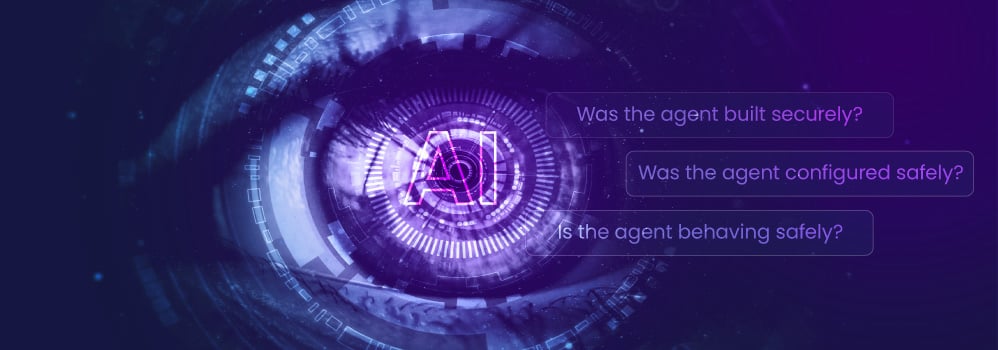
A Simple Way to Think About Agent Governance
Build-time governance asks:
Was the agent built securely?
Deployment-time governance asks:
Was the agent configured safely?
Runtime governance asks:
Is the agent behaving safely during live operation?
Enterprises that adopt this three-layer governance model will be far better positioned to scale AI agents safely.
Because as AI agents become more autonomous and interconnected, governance must extend across the entire lifecycle.
Not just development.
Not just configuration.
And not just runtime.
But all three together.
The post Enterprise AI Agent Governance: A Layered Approach (Build, Deployment and Runtime) appeared first on Aryaka.
*** This is a Security Bloggers Network syndicated blog from Aryaka authored by Srini Addepalli. Read the original post at: https://www.aryaka.com/blog/enterprise-ai-agent-governance-layered-approach/
About Author