Bitwarden and KeePass stand as two renowned freely available open-source password management solutions. Initially, determining the superior choice for your personal or professional requirements may pose a challenge. However, as I delved into testing both password managers, the prominent disparities between Bitwarden and KeePass swiftly surfaced.
Continue reading to unravel why Bitwarden arguably aligns better with your needs compared to KeePass — unless, of course, you possess expert technical skills and seek a greatly customizable password management tool.
Head-to-Head: Bitwarden vs. KeePass
Beyond the pricing aspect, various other elements come into play when selecting a password manager. Below are the primary distinctions between Bitwarden and KeePass:
| Supported Platforms | ||
| Importing Passwords | ||
| Browser Extensions | ||
| Support Services | ||
| Free Plan Availability | ||
| Initial Cost |
Bitwarden vs. KeePass: Pricing
Bitwarden’s Price Structure
Bitwarden presents two plan tiers: one tailored for personal and family use and the other exclusively designed for businesses. A trial period is accessible for Families, Teams, and Enterprise plans. The pricing breakdown for these plans is as follows:
- Bitwarden Personal
- Free: $0 indefinitely for limitless devices.
- Premium: $10 annually ($0.83 per month).
- Families: $40 annually ($3.33 per month) for up to six users.
- Bitwarden Business
- Teams: $4 per user per month, billed annually.
- Enterprise: $6 per user per month, billed annually.
- Custom quote: Reach out to the sales team for personalized pricing.
For more details, refer to our comprehensive Bitwarden assessment and our comparative analysis of Bitwarden Free vs. Premium plans. To gauge how Bitwarden fares against other popular password managers, explore our evaluations of NordPass vs. Bitwarden, BitWarden vs. LastPass, and LogMeOnce vs. Bitwarden.
KeePass Pricing Structure
The official KeePass download, compatible solely with Windows, is entirely free for use. Nonetheless, certain user-contributed ports for alternate devices (e.g., Android, Mac, and iOS) incur costs. For example, Strongbox — a prominent Mac port for KeePass — is priced at $2.99 per month, $19.99 per year, and $89.99 for a lifetime subscription. Conversely, options like KeePassXC (the version assessed during this review) are fee-free.
For additional insights, refer to our in-depth KeePass evaluation and the KeePass vs. Keeper comparison.
Bitwarden vs. KeePass: Feature Comparison
Cross-Platform Compatibility and Synchronization
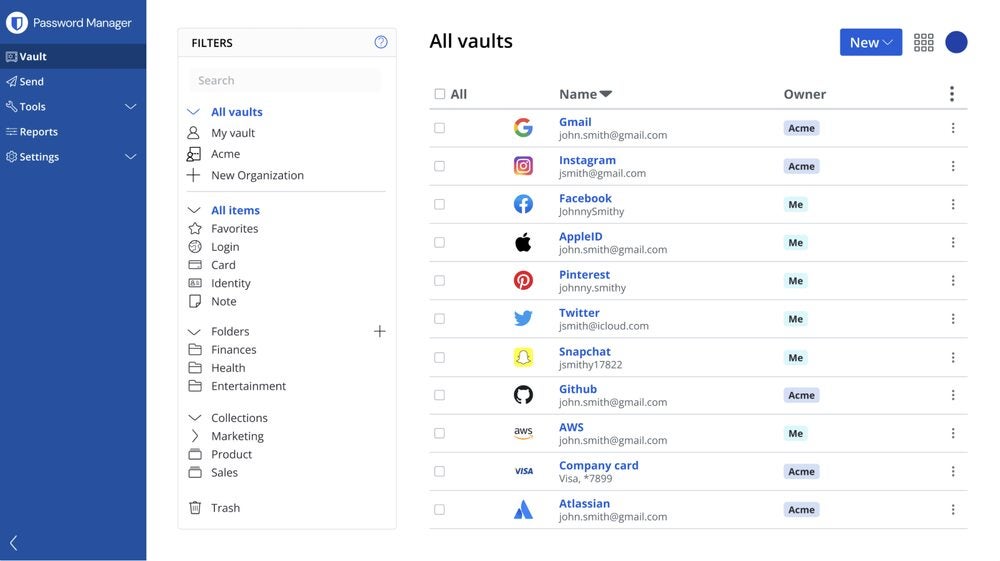
Bitwarden provides numerous official applications catering to various devices and OS types. Access the web app (Figure A) or download the desktop app for Windows, MacOS, or Linux. Mobile apps are obtainable for both Android and iOS devices (inclusive of Apple Watch). Browser extensions are on offer for Google Chrome, Safari, Firefox, Vivaldi, Opera, Brave, Microsoft Edge, Tor Browser, and DuckDuckGo for Mac. For skilled users, the Bitwarden command-line interface allows scripting capabilities for your vault operations.
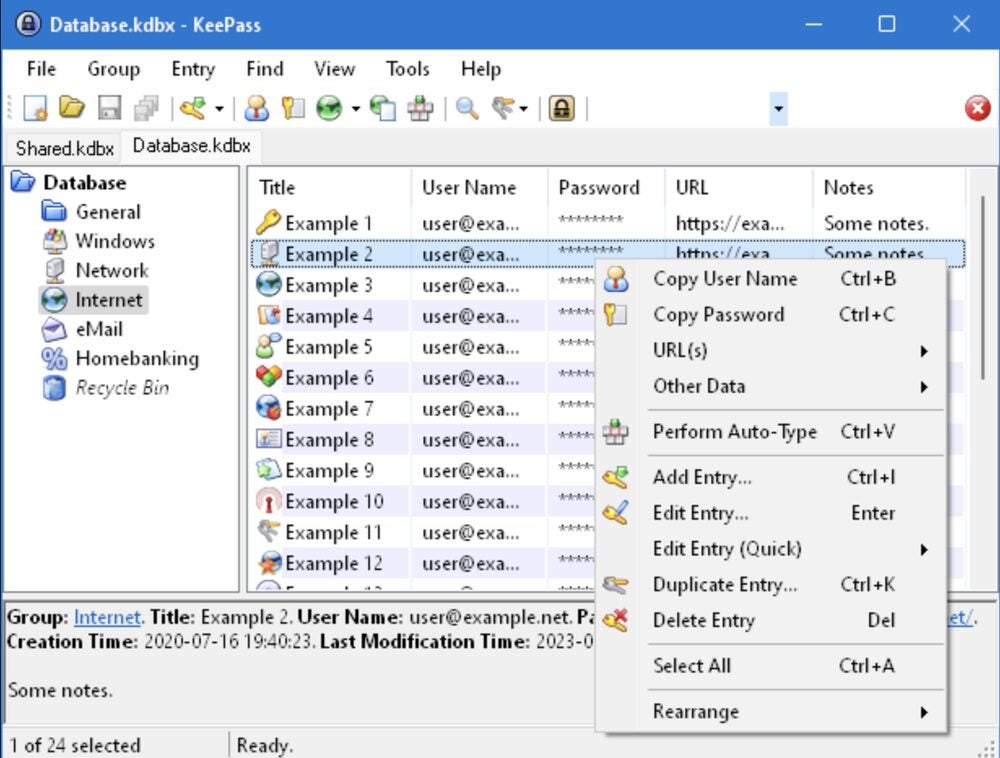
By comparison, KeePass solely presents a single official download option for Windows desktops (Figure B). There exist numerous user-generated adaptations available for MacOS, Linux, Android, iOS, and web browsers. It’s important to note that each version of KeePass boasts a distinct interface from the others as they were crafted independently by various users. To synchronize passwords among different devices, you can opt for local network shares, FTP, HTTP, WebDAV, or a third-party cloud-based alternative like Google Drive or OneDrive.
When considering the utilization of your password manager across various devices, Bitwarden stands out as the logical selection due to its uniform interface design and simple synchronization. I’ve encountered no issues using Bitwarden on my web browser, laptop, or phone. To replicate this in KeePass using free applications, I would need to download one version for my MacBook, an extension or another version for my browser, and yet another version for my iPhone, and then integrate them all through a service like Google Drive to sync.
User interface
The simplicity of functionality is a pivotal factor when deciding on a password manager for personal or professional purposes. If the password manager proves too intricate to operate, individuals will likely abandon it and resort back to using “password123” across all their accounts, which contradicts the purpose of a password manager.
SEE: 10 Myths about Cybersecurity You Shouldn’t Believe (TechRepublic Premium)
Having experimented with both Bitwarden and KeePass, it’s evident that Bitwarden is significantly more user-friendly compared to KeePass. This is why I’ve opted to manage my personal passwords with Bitwarden for years and have no intentions of switching. Individual passwords sync automatically, while organizational passwords synchronize every 30 minutes (Figure C). Conversely, KeePass is tailored for highly tech-savvy users willing to invest substantial time and effort in configuring various versions and plugins to precisely match their requirements.
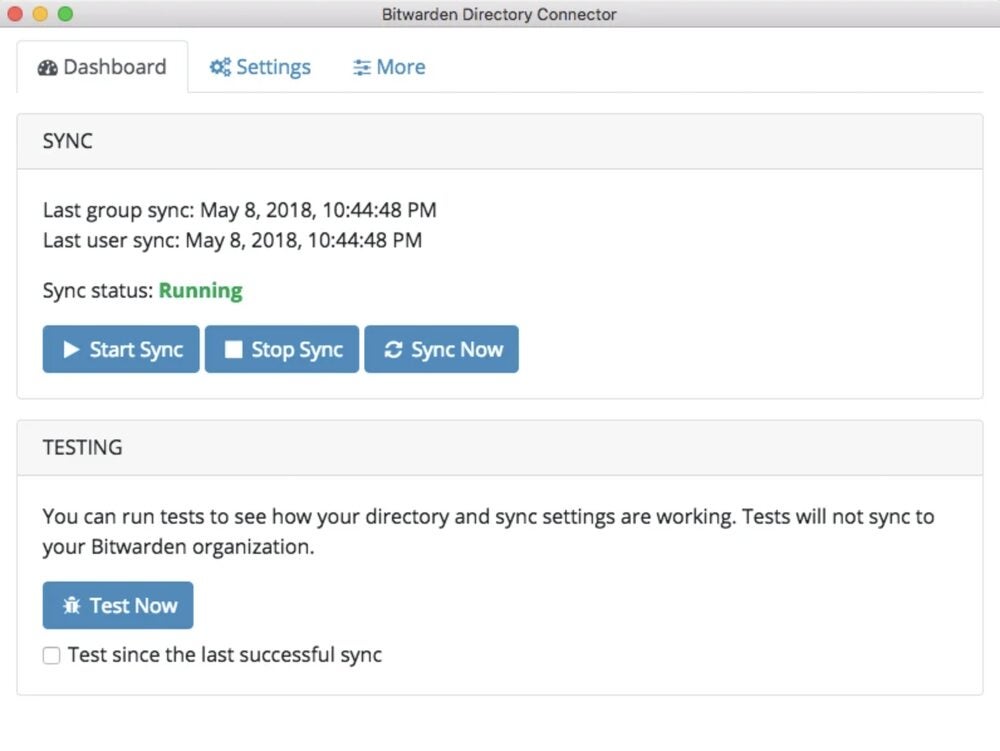
For a more comprehensive evaluation of the user interface, refer to our detailed walkthroughs that elucidate how to operate KeePass and how to utilize Bitwarden.
Security
Both Bitwarden and KeePass are open-source, with Bitwarden’s source code being publicly hosted on GitHub for scrutiny on its security levels (Figure D). Passwords are securely encrypted to prevent unauthorized access to your password information. Bitwarden employs AES-CBC 256-bit encryption for vault data and uses PBKDF2 SHA-256 or Argon2 to derive the encryption key. Conversely, KeePass utilizes AES-256, SHA-256, HMAC-SHA-256, and SHA-512 unless specified otherwise by the user.
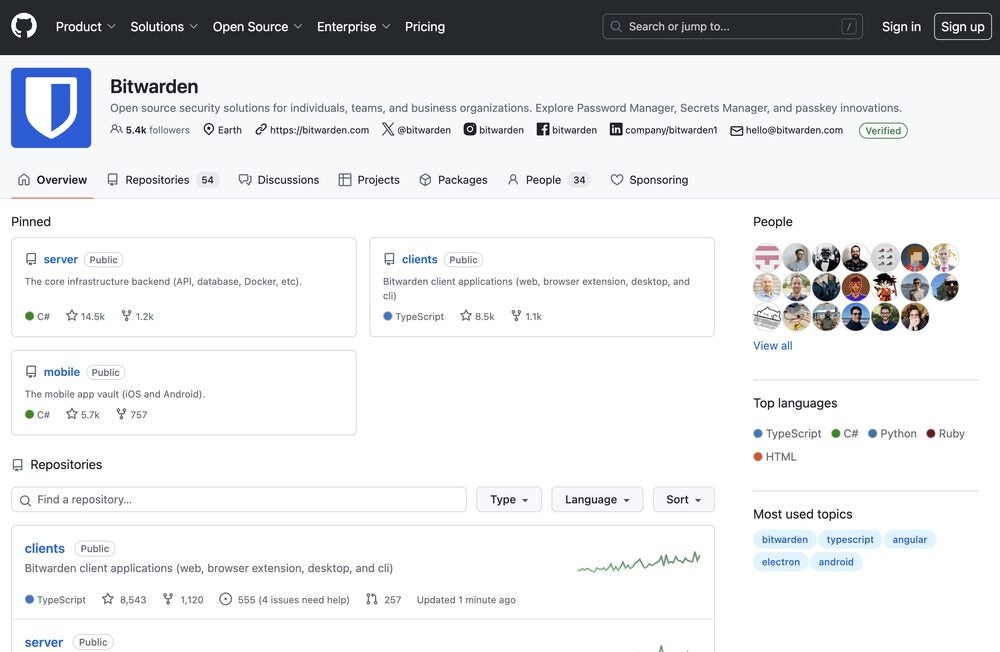
Bitwarden undergoes regular audits by third-party security firms and independent security researchers to proactively identify any vulnerabilities. A security audit conducted by the European Commission’s Free and Open Source Software Auditing (EU-FOSSA 1) project found no security flaws in KeePass.
Customer assistance
Bitwarden provides various resources for assistance, such as informative articles in the Help Center and instructional videos in the Learning Center. Additionally, a community forum is available with a specific section dedicated to the password manager where users can seek advice from each other. If these resources do not resolve your issue, you can submit a support request through the website (Figure E), and the support team will address your concerns. Unfortunately, direct phone or live chat support is not offered, so you will need to await their response.
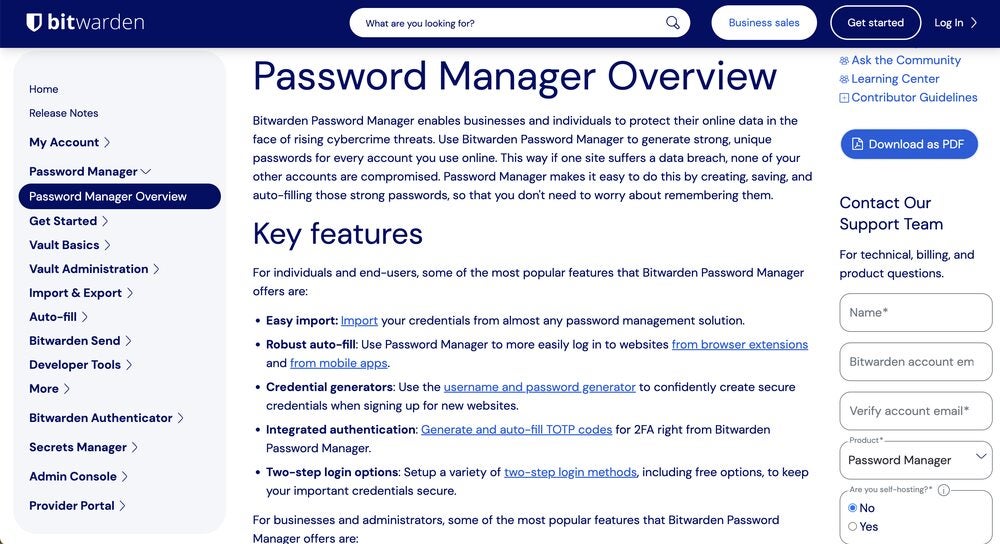
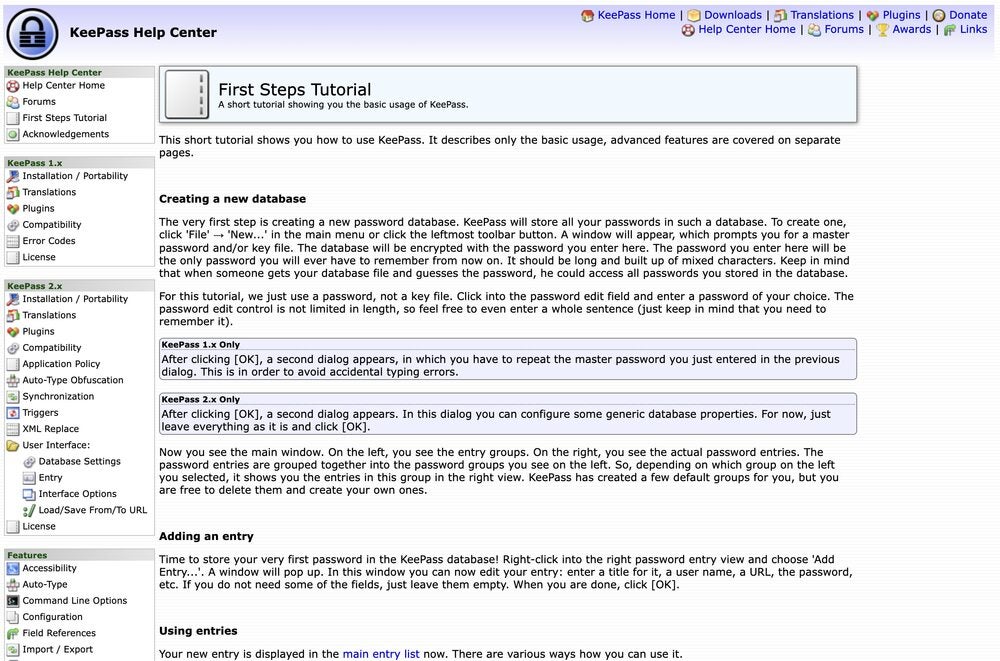
Since KeePass operates on an open-source model, there is no dedicated customer support team available for direct assistance. However, an official Help Center is provided for KeePass users containing articles that address common topics and functionalities, such as installation and plugins (Figure F). Each of the different user-generated ports…
additionally presents its own documentation, which varies in terms of comprehensiveness and utility. If you foresee requiring assistance while using your password manager, then I suggest opting for Bitwarden instead of KeePass.
Integrations
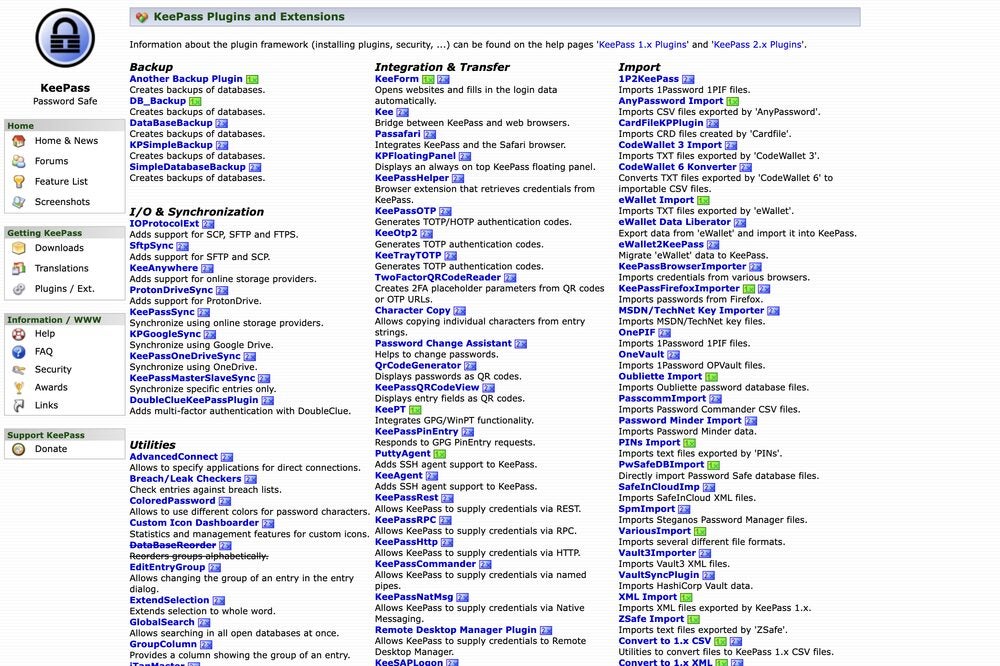
Bitwarden does provide a few integrations with single sign-on providers like Okta, however, it lacks a wide array of other alternatives. KeePass offers over 100 plug-ins and extensions (Figure G), but I wouldn’t categorize them as integrations per se. Instead, KeePass depends on these plug-ins to deliver numerous features — such as password generation and existing password imports — that are inherently built into Bitwarden. Each of these add-ons must be individually set up and configured, which contributes to the complexity of implementation.
Bitwarden advantages and disadvantages

Bitwarden advantages
- Complimentary version for individuals with limitless passwords.
- Budget-friendly, transparent pricing models.
- Open-source.
- Straightforward to configure and operate.
- Outstanding security track record.
- Various alternatives for customer support and educational materials.
Bitwarden disadvantages
- Desktop user interface could use enhancement.
- Specific features are restricted to paid subscriptions exclusively.
KeePass advantages and disadvantages
Advantages of KeePass
- The official application is perpetually free.
- Extremely adaptable because of the variety of extensions available.
- Open-source and reliable.
Disadvantages of KeePass
- Many features depend on extensions.
- The official app is compatible with Windows exclusively.
- Support is minimal.
- Challenging to configure and utilize.
- The interface is notably outdated.
Determining whether Bitwarden or KeePass is suitable for your organization
From my perspective, for both personal and business purposes, Bitwarden is a preferable choice over KeePass. Bitwarden offers a comparable level of security as KeePass but is significantly easier to set up and operate, hence reducing the learning curve especially for beginners. Although I had no prior experience with password managers before Bitwarden, I found it intuitive to use immediately upon joining. Conversely, despite several years of employing a password manager, configuring KeePass and understanding which ports were necessary for specific devices and how to synchronize them proved to be a challenge. Additionally, if you intend to utilize KeePass across multiple devices, the experience can be disjointed as each port feels like a distinct application in terms of design and interface.
The official KeePass app remains permanently free, without any features hidden behind a payment barrier. Nonetheless, a majority of these features are reliant on extensions that must be set up individually. Fundamental features present in Bitwarden’s free plan, such as passphrase generation, are only accessible as extensions within KeePass. Although certain KeePass ports introduce additional native functionalities (as well as modernizing the interface to shed its antiquated appearance), several of these demand payment for ongoing usage.
I believe that only technically proficient users who are ready to invest considerable effort in customizing their password manager to meticulous standards would prefer KeePass. However, for the majority of users, I suggest Bitwarden due to its simplicity and consistent application experience across various devices.
Evaluation method
In comparing Bitwarden with KeePass, I downloaded the free versions of both applications and established accounts. As I possess a Mac device rather than a Windows system, I opted for one of the unofficial KeePass ports and selected KeePassXC due to its free availability. Throughout my evaluation, I prioritized user-friendliness, interface design, and synchronization. I also took into account factors such as cost, security, and customer assistance.
About Author