
Sign of the times: CCAs dominate a major fighter conference
The annual International Fighter Conference, held in Munich in early November, has been an important calendar event for 30 years. This year, people joked that it should have been called a Collaborative Combat Aircraft Conference.
CCA contractors were the lead sponsors, bought the beer – an important matter in a gathering of fighter pilots – and filled a cavernous event space with six mock-ups of their fighter-like drones, five of them full-size. Three were from the United States and three from Europe.
Presentation sessions were heavy on autonomy, CCA projects and the future force structures made possible by a mix of piloted and autonomous vehicles. (The conference was held under the Chatham House Rule, restricting the identification of speakers.) There were few briefings about crewed-fighter programs: details of the multi-national Global Combat Aircraft Program remain closely held, as are those of the Boeing F-47 and F/A-XX, and there is not much news about the Lockheed Martin F-35 that its builders want to share.
It was late on the second day that the flashbacks started.
In October 2005 I attended a conference in London on what we then called uninhabited combat air vehicles (UCAVs). I had just enough time to file a story on plans for fleets of fighter-sized UCAVs before the January 2006 Quadrennial Defense Review whacked the entire US program. The problem was that the UCAVs were getting more expensive and there was little agreement on why they were needed, and when real money was needed – to put the project on track to full-scale development – it wasn’t there.
Are CCAs at the same tipping point? The concepts discussed in Munich and the mock-ups on show looked to be of similar sizes but some were fundamentally different. Ryan Tseng, co-founder of Shield AI, preached of the tail-sitting, truck-transported X-Bat and promised a December flight demonstration to a sceptical audience. It was a lively presentation, Tseng striding so confidently on the stage that he almost went over the side.
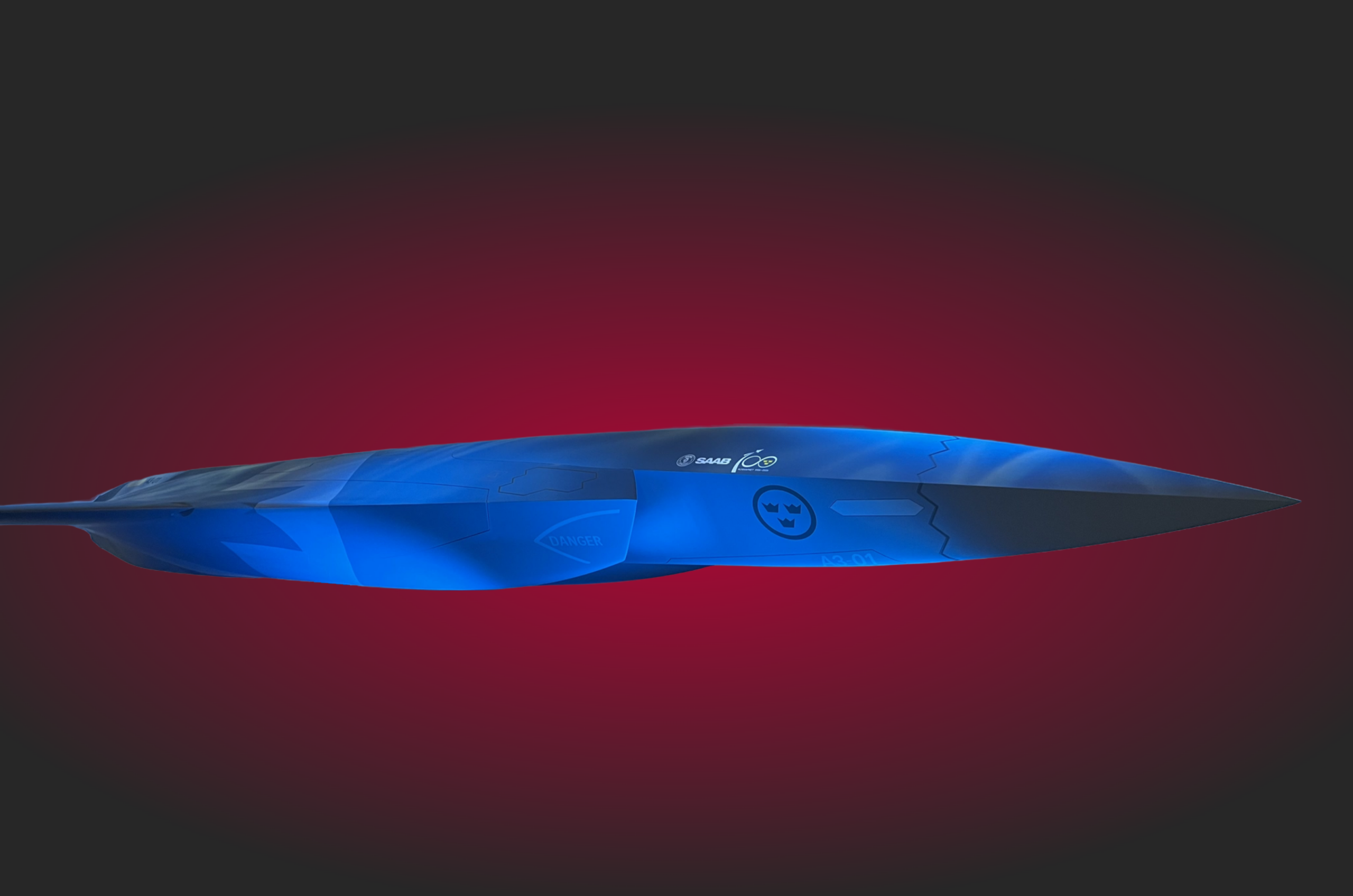
Saab was more moderate in delivery but had a strong message about CCAs – ‘the next two years will matter more than the last 15 years’ – and the revelation that it will fly a supersonic autonomous collaborative platform (ACP) demonstrator, A1, next year. So far as is known, no supersonic CCA is under development in the US.
Saab’s ACP model at Munich, a highly blended, tailless double-delta (with a striking resemblance to Saab’s J35 Draken of the 1950s, the best supersonic fighter of its era) represented the third, operational iteration of the series, the A3. The A1 differs from the A3 in having tailfins, a non-stealthy feature. But it also has a stealth-representative inlet and outer shape and an internal weapon bay, entirely new to Saab. The engine is a General Electric F414, as is the JAS 39E Gripen’s.
The second iteration, the A2, will demonstrate conformal radio-frequency apertures built into structural skin panels – being developed by Saab’s radar and electromagnetic warfare unit and made possible by additive manufacturing – and the integration of AI. The operational A3 could be in service by 2035.
Saab says it’s well placed to take the lead in AI air combat. Integration of a Helsing AI combat system on a JAS 39E in 2025 was fast and easy, it says, and, because of its partitioned mission system, the addition of AI could be tested in international airspace. Similar US tests have been confined to controlled ranges. Saab has its own radar, electromagnetic warfare and missile units; at the combat-system level, it has deep experience with fighter datalinks and owns the GlobalEye long-range radar surveillance aircraft, ‘an ACP enabler.’
Saab contends that for a small air force, there are no attritable systems, just expendable weapons and survivable aircraft, whether crewed or not. ‘I can easily achieve half the life-cycle cost of a Gripen in the ACP,’ comments one Saab executive. ‘Half the acquisition cost is the goal, but more difficult.’
Saab’s presentation brought a favourable comment from a senior US Air Force officer, whose own presentation linked CCAs strongly to the emerging F-47. This makes sense: the F-47 on its own is not going to bring ‘affordable mass’ – the current Air Force buzzphrase meaning lots of aircraft and missiles – to the force. The fact that the service is testing its Increment 1 CCAs alongside the F-22 underscores this relationship: the F-22 is being upgraded as a lead-in to the F-47 and retains a primary air-to-air role.
Another USAF presentation looked at the cost of adding CCAs to the force. ‘What we mean by affordable mass depends on the problem you’re trying to solve,’ the presenter said. In the case of the USAF, looking out through the 2030s, ‘if we could build more fighters, we couldn’t find the pilots.’ That may, ultimately, be the decisive selling point of autonomy as populations age.
‘Operations and support are what make the fifth-generation platform expensive.’ CCAs, the presenter suggested, would not need to fly to train pilots to fly, but a pilot playing the quarterback role to a number of CCAs would need ‘one or two live flights’ a year in addition to simulated training.
There is interest in increasing the size of the aircraft for Increment 2 of the USAF’s CCA program. They’d also be more versatile and able to self-deploy. The Anduril and General Atomics CCAs built for Increment 1 are wrapped around the reliable Williams FJ44. That engine is working hard to propel them and is not designed to provide power and cooling for electronics, as it would need to if the customer wanted multi-mission capability. Lockheed Martin’s Vectis CCA, not part of the USAF program, will make its first flight with the FJ44, but the company is talking to GE, for one, about a new engine.
There is no modern, existing engine in the thrust class of 4,000 to 7,000 pounds (18 to 31 kN), which is what’s needed for a step up in CCA size. At first sight, you might think that you could make an engine for less money if it wasn’t required to run for thousands of hours – as a crewed fighter’s engine is, mostly for training. But this isn’t necessarily true. The engine still must be reliable. Investing in a cheap, low-margin product that has no spares and support tail is a poor business case.
A substantial change in the specification for Increment 2 may be a cold shower for the venture capital contenders like Anduril, who are already sounding unhappy about delays in funding the second batch of early production aircraft. The trouble with working for the government is that it reserves its right to change its mind – and there isn’t another US Air Force you can sell to.
About Author


