Kogan taps AI agent to handle customer service
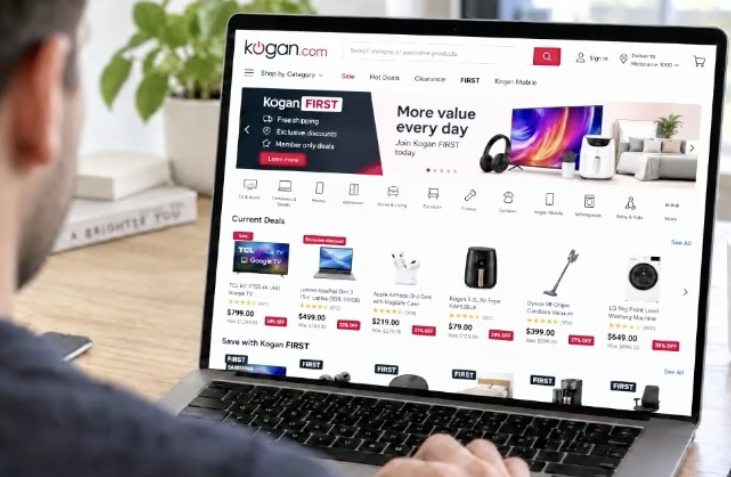
Australian e-tailer Kogan has identified 10 customer service use cases so far for an AI agent that it built in collaboration with Salesforce.

Appearing at the vendor’s annual Dreamforce conference, CTO Goran Stefkovski said that customer service had traditionally been handled through web forms and emails.
He said the online retailer saw an opportunity to use AI to reduce the effort that customers had to go to for support inquiries, and see faster responses.
Initially, a deterministic bot was deployed – using “a technology that was available to us” – which was able to resolve about six percent of inbound customer inquiries.
Stefkovski said the resolution rate did not discourage the company from going down the AI path, effectively noting that everyone has to start somewhere.
“You’ve got to be comfortable with a starting point,” he said.
“You can’t wait and hope for a 60 percent, 90 percent or 100 percent [resolution] rate from day one – that’s not realistic, and I think that’s where a lot of businesses fail in getting things in front of customers because they’re too precious about iterating and improving from [square] one.”
Kogan elected to rearchitect the customer service bot with Salesforce’s Agentforce technology, partnering with the vendor’s forward deployment team.
Forward-deployed engineers are becoming a more common sight in AI programs, with the intent of vendors helping customers get AI up and running in production and realising tangible value.
The e-tailer is using four Agentforce services – NextGen Authoring, Agent Script, Observability and Testing Center – in its rearchitected customer service agent.
It prototyped its first use cases in an internal “hack day” and went live in production after about six weeks.
So far, 10 customer service use cases can be handled by the AI agent.
One of these is WISMO – where is my order? – which, according to a blog post published in July, accounts for “roughly 60 percent of Kogan’s inbound customer requests”.
WISMO is designed to pick up the order status directly from SAP and pass it on to the customer.
Other use cases include a product concierge to provide personalised recommendations across 16 million SKUs, membership, mobile voucher redemption, unknown charge investigations, troubleshooting and identity verification.
Handling returns and warranty issues are other areas where there are strong use cases for the AI agent.
An emerging use case uses images captured by the customer to show damage to products as part of a return case.
For damage that occurs in transit, the e-tailer commonly asks for photographic evidence.
“To do image recognition classically or a few years ago, it’s a lot of machine learning, training models, lots of data, labelling that this is right and this is wrong; but generative technologies in LLMs make this super easy,” Stefkovski said.
“It means that we don’t have to build out that whole model training data set to be able to do image detection or just description of what the images are.
“On top of that, it’s actually solved a second [issue] which is when you have people that are trying to do bad things like … pretend that the product’s damaged by finding a picture of a damaged product online.
“[The AI] can detect that multiple people have submitted [the same] image for this case or for different cases, and so we’ve actually been able to eliminate that type of aspect of nefarious behaviour that sometimes happens.
“The great thing that came out of this solution is we’re making everyone’s lives easier, but we’re also catching those edge cases that [we] need to catch.”
The July blog post states that Kogan isn’t applying the AI agent to all product types, and is instead expanding the reach of the agent progressively.
About Author