China’s new ambassador arrives in Australia – and immediately gets to work
China’s new ambassador arrives in Australia – and immediately gets to work

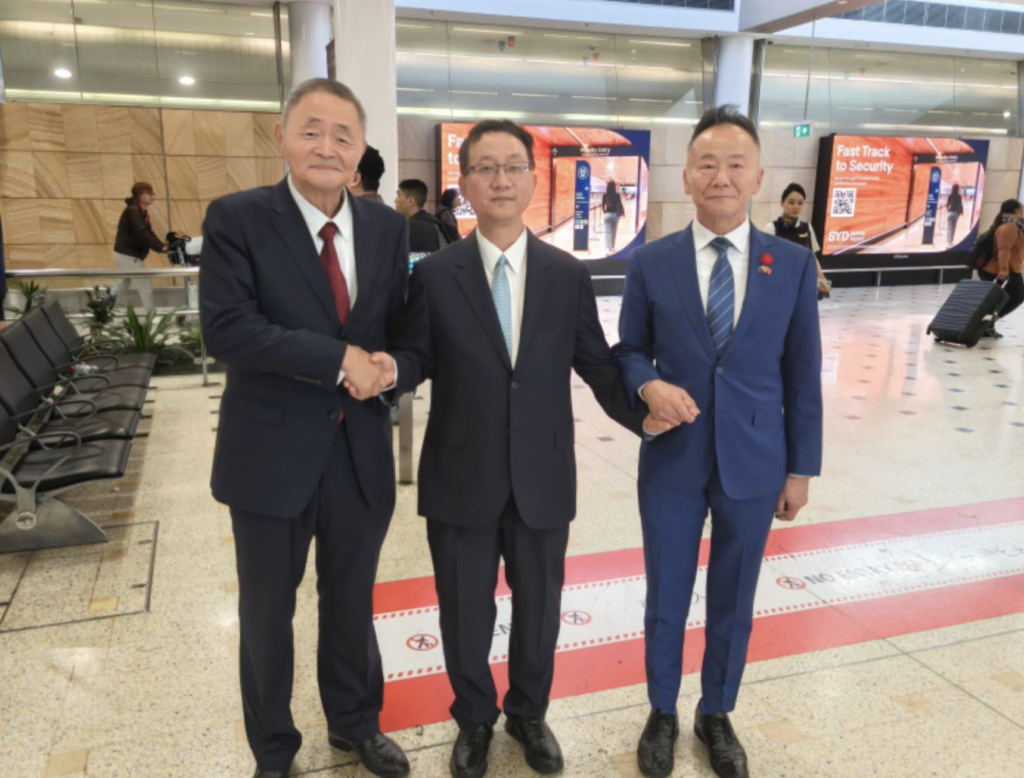
The first thing the new Chinese ambassador to Australia Liu Jinsong did on arrival in Sydney yesterday was to publicly pose at the airport with two prominent United Front figures – Qian Qiguo, Chairman of the Australian Alliance for Peaceful Chinese Unification, and Tian Fei of the Oceanic Alliance for the Promotion of Peaceful Reunification of China. In doing so, Liu immediately underscored the role of the United Front in Australia. The Chinese embassy then posted the photo of the new ambassador and the two ‘peaceful reunification’ activists on its Chinese-language website.
Tian had only recently returned from China after attending the 11th World Conference of Overseas Chinese Associations, held in Beijing on 13 and 14 July, where he had been interviewed by China News Service.
There’s nothing illegal about these meetings and public displays, but they shouldn’t be ignored. In a statement Liu issued shortly after arriving, in addition to pleasantries about mutual respect in the bilateral relationship, he urged Australia to respect Beijing’s ‘core interests and major concerns’ and said that would be done by Canberra ‘reserving differences’. None of these requirements imposed on Canberra is reciprocated by Beijing, as Chinese ministers, officials and diplomats routinely air their differences with Australia. Meanwhile, United Front groups are utilised in Australia and elsewhere around the world to promote the Chinese Communist Party’s core interests, not Australia’s.
Liu is a seasoned diplomat, having served the Chinese Foreign Ministry for 30 years in Thailand, Japan, Britain, India and as ambassador to Afghanistan. He has been depicted in some media as having a ‘wolf warrior’ reputation. Liu’s current public profile derives mainly from his November 2025 engagement with Masaaki Kanai, director-general of the Japanese Foreign Ministry’s Asian and Oceanian Affairs Bureau. This meeting was aimed at defusing tensions after Japanese Prime Minister Sanae Takaichi’s comments suggesting Japan may become involved in a conflict over Taiwan. A photograph of Liu after the meeting, hands in pockets, looking down at the Japanese diplomat, was spread globally through Chinese media. The Chinese state media implied that Japan had been forced into a submissive posture, reinforcing its narrative of great power prestige.

We have little else upon which to base predictions about Liu’s future actions in Australia, other than that the policies he pursues and the actions he takes will undoubtedly be determined by Beijing. But Liu’s letter setting out his own expectations of Australia before he has even provided his credentials to the government and governor-general is instructive. While the bilateral relationship has thawed in recent years, his arrival and instructions to Canberra come as Beijing has increased its aggressive actions in the region, including last month’s testing of a submarine-launched nuclear-capable ballistic missile.
The immediate public display of affection with United Front members should also be a clear signal as to the assertive stance Liu will take.
The aim of the United Front bodies these figures lead is the incorporation of Taiwan into the Chinese state. As China’s claims over Taiwan continue to escalate, the role of overseas Chinese and their organisations as influence agents globally is becoming increasingly important. During the 11th World Conference of Overseas Chinese Associations, the 400-plus delegates heard from Li Ganjie, head of the United Front Work Department of the Chinese Communist Party Central Committee. He urged them to ‘actively contribute to the great cause of national rejuvenation’ and ‘enhance unity and cooperation among overseas Chinese associations.’
At the end of July, Xi Jinping’s instructions were cited as the main guide for the National Conference on Overseas Chinese Affairs Work, also held in Beijing:
Xi called for fully implementing the Party’s policies on work related to Chinese nationals overseas and encouraging overseas Chinese, as well as returned overseas Chinese and their families, to leverage their unique strengths in support of the cause of national reunification.
Here then we see the rationale for the public show at Sydney airport. A major element of Liu’s tenure will be the mobilising of overseas Chinese in Australia, encouraging and guiding them in serving the interests of the CCP, including its efforts to incorporate Taiwan. This is certainly not a new agenda, but the actions of the ambassador suggest that this program will be accelerated. This will present stepped-up challenges for Australian politicians, Australian society and our National Intelligence Community.
About Author