RSA 2026: Agentic Future, Analog Fundamentals — The Paradox of Why the Old Guard Still Survives
OK, RSA 2026 is over. If my record keeping is correct, I first attended RSA in 2006. At that time, I was annoyed by … AI? XDR? NIDS? …. noooo… I was annoyed by NAC (“As many other RSA observers agreed, under each tree you now see a NAC.
RSA 2026: Agentic Future, Analog Fundamentals — The Paradox of Why the Old Guard Still Survives
OK, RSA 2026 is over. If my record keeping is correct, I first attended RSA in 2006. At that time, I was annoyed by … AI? XDR? NIDS? …. noooo… I was annoyed by NAC (“As many other RSA observers agreed, under each tree you now see a NAC.” NAC rapidly arose from the “wormy” early 2000s and quickly vanished inside network infrastructure devices).
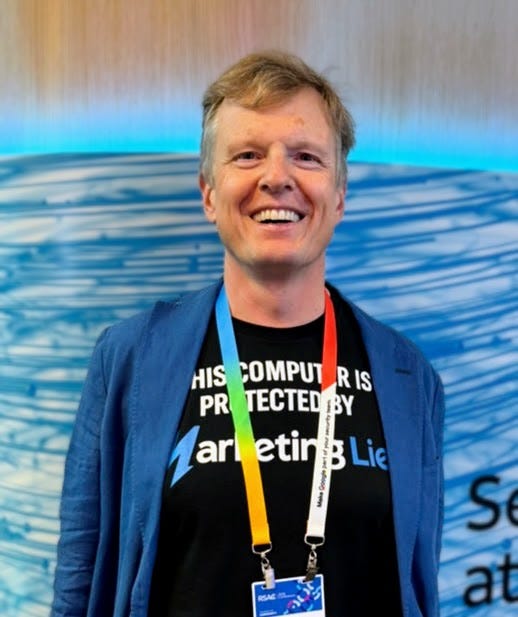
That t-shirt
Anyhow…
If the RSA Conference is the annual, sprawling theme park of the cybersecurity industry, then RSA 2026 was the year the park owners unveiled the shiny, terrifying, and utterly bewildering “AI Rollercoaster.” But as my co-host Tim Peacock and I sniffed around the expo floor, a familiar suspicion crept in: half the queue signs were blatant fabrications, and the ride itself might only be half-built.
For decades, we’ve attended this annual security pilgrimage expecting consolidation, disruption, and an industry growing up. And every year, we leave with the same truth: the more things change, the more they stay the same (and no, I am not old enough to be called “a curmudgeon”). This year, the force of AI agents was everywhere, yet the industry’s response — the good, the bad, and the baffling – revealed more about our collective inability to do the fundamentals than it did about the technology itself.
The first thing you notice about the AI Rollercoaster is the marketing. It’s less about engineering excellence and more about colorful claims that would make a 1890s snake oil salesman blush. Our first, unavoidable observation was the sheer breadth of the AI Hype Spectrum, a problem of which AI washing is one of the levels.
We saw vendors across the spectrum: from those quietly using AI for genuine, impactful security tasks to those who merely “spray painted an AI” onto their 2021 marketing materials and called it a new platform. This latter group — the “AI touch-up” artists — are everywhere, simply adding a comma and the word “agents” to their identity management tools description, firewalls, anti-virus and calling it a day (I have booth pictures, yes)
Look, you are not an AI native company if you launched in 2003 and have a “talk to docs / manuals” chatbot in 2026. BTW, your chatbot can be easily convinced to spout political propaganda because your RAG sucks and you think “restrict via system prompt” is AI security…
This brings me to the first core truth of RSA 2026: to succeed, the buyer must be the expert. It is profoundly disappointing — though not surprising — that in an industry claiming to be on the cusp of a technological revolution (AI AI AI!), our most potent advice for a CISO is a throwback to the days of dial-up: due diligence. BTW, see this quote: “The problem is that most of the people attending the RSA Conference can’t understand what the products do or why they should buy them.” This is…. OH HORROR! .. Bruce Schneier in 2008.
The genuine use of AI in a product is now almost entirely disconnected from the glossy message on the vendor’s booth. You, the buyer, need to dig deep, get technical, and understand what they are actually selling. If they claim AI makes their firewall (or: your SOC) better, tell them to show you the numbers (Better how? Better where? By how much? Depending on what?). If they can’t produce data and solid metrics on how AI improved their thing, you must assume they are not credible and are essentially lying. Sorry, but “cloud native firewall” is not a thing.
And speaking of gloss, a related phenomenon was what we called the “Wiz Effect.” We saw a notable rise in whimsical, information-free booths — lots of pinks, purples, superheroes, and non-security-related sports figures. While a tasteful aesthetic is welcome, this strategy only works if you are already a $32 billion company named Wiz. It did work- and it still does work — for Wiz! Wiz can have soup cans in the booth, and it will sell CNAPP by the million. For others, a fantastical booth merely meant your booth was remembered, but your message was utterly lost. Goats! Also, its low-information density approach compounds the problem of AI washing.
In the past, some clowns predicted that our industry will consolidate and only a dozen large vendors will remain. In 2026, many fear a different Vendor Apocalypse where the large AI labs will simply run over existing security vendors. If a massive LLM can run on an endpoint and perform vulnerability analysis, why do you need a standalone vulnerability scanner? To me, this risk is absolutely real, particularly for product categories like Static Analysis (SAST), which seems custom-made for LLM decimation (reminder: I am not an appsec expert). The same logic applies to firewall rule analysis, policy writing, and many simple IAM/PAM decisions. However, it is not yet clear (my gut says “no”, my brain says “wait for RSA 2027, then ask again”) that the entire industry is vulnerable though…
And this is where the industry’s legendary IT inertia kicks in. The persistence of “The Old” is a stunning, annual lesson in the industry’s resistance to disruption. We saw large booths from vendors whose heyday was decades ago — the fifth best firewall and antivirus vendors are still alive and well as if the calendar still shows 2006. Do you believe that Checkpoint sells “AI security”? They do now! Anyhow, they are still collecting hard-earned money from buyers. This proves that the promised AI disruption has not yet killed off even the “number six” player in a market., much less hurt the #1. “Last vendor on the list is … still ON the list” was my insight here.
Why such epic survival skills? I think it comes down to enterprise knowledge and IT inertia. We debated whether the security industry would survive based on the same concept that keeps human analysts relevant against a giant LLM: the possession of “tribal knowledge.” This is the accumulated, aggregated, and integrated gossip … eh … customer data…that good security vendors hold about their clients’ specific environments. This tacit knowledge, the context of why things are done, is not public, and an AI robot won’t have it today (theoretically, there are ways for them to gather it, to be sure). If your security operation relies on this copious chunk of tribal knowledge, a super-intelligent chatbot won’t replace your vendor — at least not yet.
Another odd observation here. For some vendors, promoting “openness” seems like a signaling maneuver for weakness, not strength. We walked past booths proclaiming “open data lake,” “open detection,” and “open ecosystem.” While I believe openness has inherently positive value, my cynical analyst brain immediately wondered: are they more open or are they just not better? See, vendor A sells EDR, and it is really good. Vendor B EDR sucks compared to vendor A. So they market it as “open EDR” because they cannot market it as “the better EDR” (it ain’t better, even according to them). Reactions?
While the hype around AI for security was overwhelming, there was a positive and genuinely exciting shift: the rise of securing AI and agents. Last year, I lamented the lack of focus on protecting AI systems. This year, I was pleasantly surprised to see vendors focusing on securing agents, securing agent identity, and doing data security for the AI supply chain and training data.
The third pilar of this is the bad guy with AI. To me, the real fear isn’t the “Bad Guy with AI” or even the coming “Bad AI”; the fear is the acceleration of the inevitable. If your security posture is bad before AI, it’s just going to be bad — and faster — after AI. As attackers modernize their business with AI, the average time to compromise will drop even further and — IMHO more importatny — a chance of a compromise will go up (ref this week suppy chain hits)
The ultimate takeaway here is the “boring” lesson: Get the fundamentals right (and, yes, AI can help here too). No amount of AI from a threat actor will exploit your cloud misconfiguration if you don’t have one (well, either cloud or misconfiguration). If your defenses against misconfigured systems, containers, and instances are robust, it doesn’t matter that the bad guy has AI; your stuff is more secure. The acceleration brought by AI will simply kill off “luck-based security.” The old adage is true: if your app has no obvious exploitable holes, there’s nothing for the AI-armed attacker to find. Magic!
So my single piece of advice for dealing with this reality, whether you are a buyer, a seller, or an analyst, is simple: demand the data. Do not let vendors get away with buzzword bingo. If a vendor says AI helps, make them prove it with solid metrics. The time for “trust-me-bro” security better be over!
Finally, some reactions from my 3 sessions. The most shocking reactions came from my “AI SOC” peer discussion on Thursday. I noticed a shocking, near-total lack of enthusiasm about AI SOC startups (total) and AI SOC concepts (near total). The best I got was “AI in a SOC sounds great, we will just wait for our SIEM/SOAR vendor or MDR to build it” and “this is better SOAR and we want this, but later.” And think about it: this was for people biased in favor of AI SOC (because they showed up for the session)… Not sure yet what to think of it!
Fun takes from other people(and there are many) are here (key quote: “Perhaps I’m being overly dramatic but I was surprised with the generally relaxed tone about the impending wave of vulnerabilities and the extent of industrialized attackers coming in the coming quarters. Everyone seems to know vulnerability management isn’t where it needs to be in most companies and what’s coming will pile on the pressure.”), here.
Related blogs:
RSA 2026: Agentic Future, Analog Fundamentals — The Paradox of Why the Old Guard Still Survives was originally published in Anton on Security on Medium, where people are continuing the conversation by highlighting and responding to this story.
*** This is a Security Bloggers Network syndicated blog from Stories by Anton Chuvakin on Medium authored by Anton Chuvakin. Read the original post at: https://medium.com/anton-on-security/rsa-2026-agentic-future-analog-fundamentals-the-paradox-of-why-the-old-guard-still-survives-bf93e81eaaa6?source=rss-11065c9e943e——2
About Author