Within the intricate world of cybersecurity, where stories of mystery and creativity intersect, a narrative emerges from the depths of history. It is a tale that commences in the early 1990s, amid the era of DOS, a time when computer viruses were a new and enigmatic threat. This is the chronicle of Joshi, a virus born in India that transcended boundaries to spread across the globe, etching its mark in the archives of cyber chronicles.
Imagine this scenario: it is June 1990. Computers are bulky, floppy disks are the primary source of data storage, and the notion of a “virus” infiltrating a system is still a shock to many. Against this backdrop, a boot sector virus emerges, sly and clever, infecting the Master Boot Sector of hard drives and the boot sectors of floppy disks. Its name? Joshi.
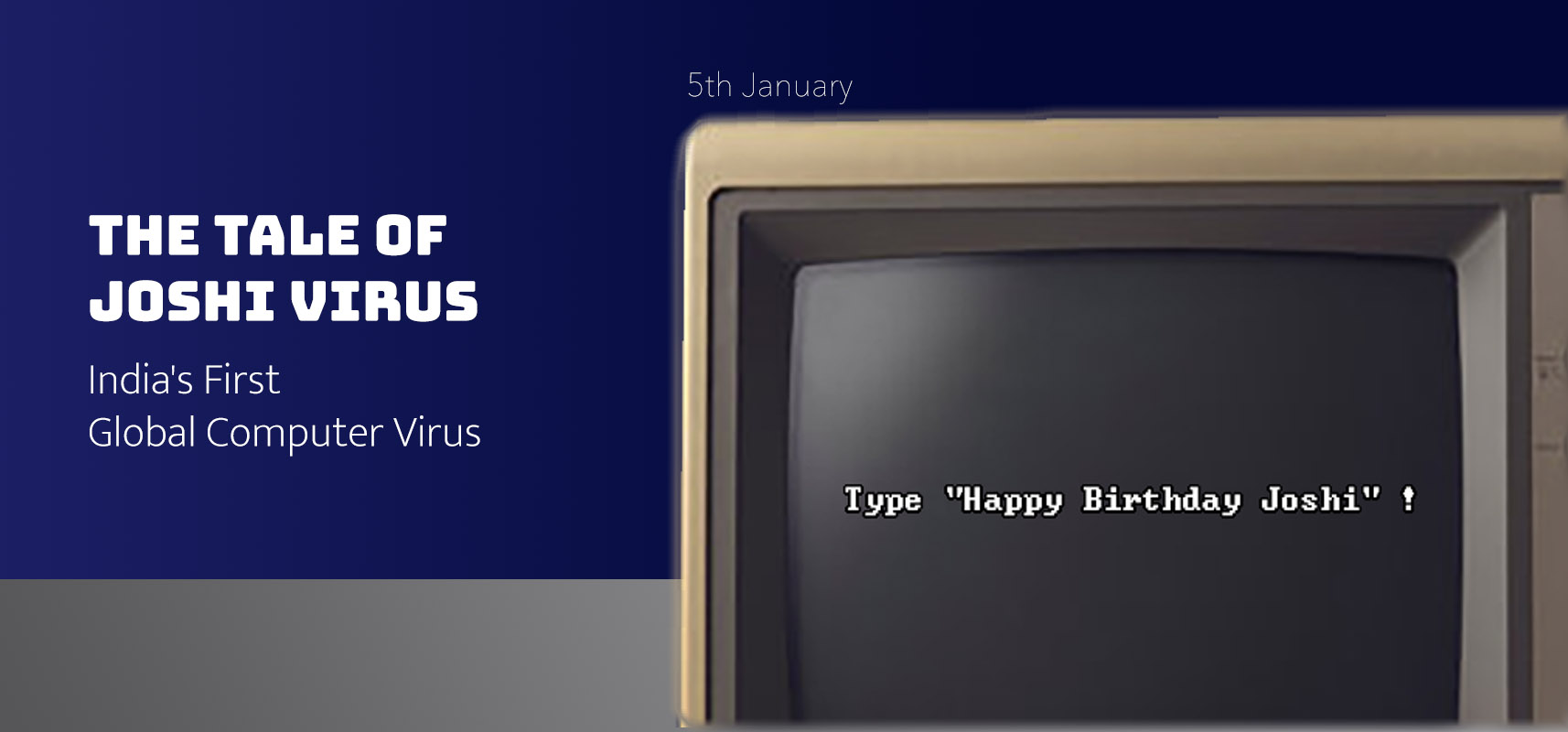
Distinct from the malicious viruses that would later seize the spotlight, Joshi leaned more towards mischief than malevolence. It carried an intriguing payload — one that transformed an ordinary day into a moment of amusement. Every 5th of January, when an infected computer booted up, users were met with a prompt: “Type ‘Happy Birthday Joshi!'” The screen froze, compelling users to comply with the demand. Only after entering the phrase could the computer’s boot process continue, almost as if Joshi demanded its yearly tribute.
However, Joshi was not a mere jest. It exemplified stealth and deception, akin to a magician’s sleight of hand. Once entrenched in a computer’s memory, it executed a sequence of clever maneuvers to remain concealed. It intercepted crucial system functions such as INT 8, INT 9, INT 13, and INT 21, ensuring that tools like Norton Utilities exhibited a clean boot sector, masking the infection.
On floppy disks, it crafted an additional track at the disk’s end, housing its own code and the original boot sector, ready to activate. This often resulted in the floppy drive emitting an unusual noise as the magnetic heads traversed back and forth while booting from the floppy, attempting to decipher the extra formatted track at the disk’s end.
I recall how merely by the sound of the head’s movement, I could deduce whether the floppy was infected by the Joshi virus. This virus relied on the exchange of floppy disks between PCs for dissemination. Despite this limitation, its stealthy nature and seamless operation facilitated its spread from India to various corners of Europe and the US.
I have yet to encounter another virus that originated in India and extended its reach globally to the extent achieved by the Joshi virus. As a young college student pursuing my degree, I encountered Joshi during its era of mischief. Unraveling the intricacies of this virus through reverse engineering was truly enlightening. I vividly remember being astounded and captivated by its methodologies — the manner in which it occupied 6 KB of memory, meticulously checked for its presence before activation, and persevered through a warm boot (Ctrl-Alt-Del).
It posed a formidable challenge, and comprehending its workings felt akin to deciphering a puzzle. In those days, eradicating Joshi from an infected PC was no trivial task. In the absence of tools like Norton Utilities, it often necessitated a complete hard drive format to cleanse the infection. Only individuals well-versed in the intricacies of master boot sector coding stood a chance at manually removing it.
The exact origins of Joshi remain shrouded in conjecture. Some believed it originated in Mumbai or Gujarat, while whispers suggested Pune as its birthplace. Wherever it sprung from, Joshi swiftly transcended its local origins, spreading across Europe and Asia like wildfire, leaving a lasting impression on an unsuspecting populace. It surprised me that a cursory internet search regarding major viruses or malware from India that attained global reach fails to yield the correct answer. The name of this virus doesn’t even grace compilations of viruses from India that achieved worldwide dissemination. Yet, to the best of my knowledge, no other virus from India has traversed as many countries as the Joshi virus.
While I would have relished delving deeper into the technical intricacies and nuances of how this virus infected hard disks and persevered post a warm boot of the PC, I endeavored to craft this article in a manner accessible to all. Today, the story of Joshi stands as a testament to an era characterized by exploration and revelation in the realm of cybersecurity. To me, it embodies more than a historical artifact; it symbolizes a memory of an epoch when inquisitiveness and resourcefulness underscored the battle against these digital trespassers.
The methodologies employed by Joshi were well ahead of their time, and although its pranks were relatively benign, its legacy as India’s initial global computer virus endures.
So, the next time you find yourself typing “Happy Birthday” for a loved one, spare a thought for Joshi — the playful fragment of India’s cyber heritage that prompted a generation of users to do just that.
#JoshiVirus #IndiasFirstComputerVirus #CyberSecurity #ComputerVirus #Malware #CyberHistory #RetroTech #VintageComputing #IndianCyberHistory #TechNostalgia #ComputerSecurity #VirusAnniversary #January5th #HappyBirthdayJoshi #BootVirus #MBR

Sanjay Katkar
About Author