Top AI Security Solutions: Comparison of Leading Tools

Utilizing generative AI functionalities within business applications can present both advantages and challenges. While AI can introduce complexities and unique security concerns, it can also streamline operations and enable innovative capabilities.
The platforms highlighted here were well-regarded solutions even before the emergence of generative AI. We have evaluated these tools based on their reputation, longevity, and sustained positive feedback. In cases where AI features are crucial selling points, we have assessed them on their integration capabilities, user-friendliness, and potential to unlock new value propositions within security offerings.
Our focus has been on security solutions that integrate AI technologies, rather than companies solely focused on AI or exclusively addressing AI-related security issues. Nevertheless, we have shown a preference for organizations that prioritize AI-specific protective measures.
Comparative Overview of Top AI Security Tools
| Technology | Initial Cost | Scale | Primary Objective |
|---|---|---|---|
| SentinelOne | $69.99/year per endpoint. | Suitable for small businesses to enterprises. | Ensures protection for endpoints, cloud, and data assets. |
| Arctic Wolf | $44,000/year. | Designed for small businesses to enterprises. | Offers security operations “concierge” services. |
| Darktrace | Starting at $30,000/year. | Applicable for small businesses to enterprises. | Provides proactive cybersecurity using “self-learning” AI. |
| Vectra AI | Contact vendor for pricing details. | Tailored for small businesses to enterprises. | Emphasizes delivering high-quality attack signals through AI. |
| Zscaler | Reach out to the vendor for pricing specifics. | Geared towards enterprise usage. | Aiding in digital transformation for IT and security teams. |
Optimal Choice for Incident Handling: SentinelOne
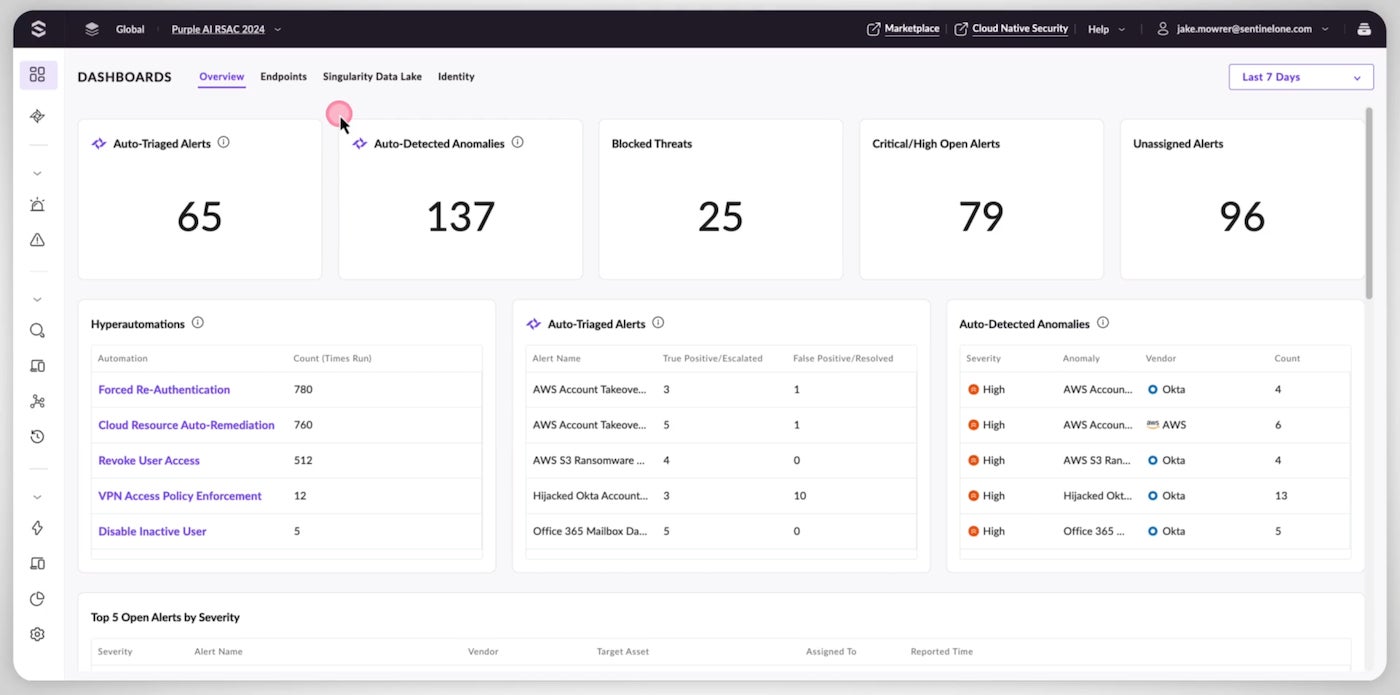

SentinelOne specializes in offering security for endpoints, cloud services, and data protection. Their solutions, specifically tailored for enterprises, provide comprehensive coverage for user endpoints, containers, cloud workloads, and IoT devices. Notably, their managed security services are exceptional as they encompass a wide range of endpoints and device categories.
A key component of SentinelOne’s AI capabilities includes Purple AI and the Singularity XDR Platform. The Singularity XDR Platform utilizes AI for preventing, detecting, responding to, and hunting threats. While not based on generative AI, the “agents” function as responsive sensors operating at speeds surpassing human capabilities. The generative aspect comes into play with SentinelOne’s Purple AI, an AI-powered chatbot akin to ChatGPT. Security professionals can interact with Purple AI using natural language to inquire about the presence of specific threat indicators or ask detailed questions. The chatbot provides responses in written format as well as relevant code snippets or URLs.
Gartner, a prominent consulting firm, recognizes the excellence of SentinelOne, ranking them as a leader in its annual “Magic Quadrant” report. SentinelOne’s Vigilance MDR+DFIR successfully identified all 14 steps of attack in MITRE’s ATT&CK Evaluations, receiving praise for its robust defense mechanisms against test assaults.
Pricing Details
The basic plan, known as “Singularity Core,” starts at $69.99 per endpoint for five to 10 workstations. This plan includes features such as role-based access control, multi-tenant management, and endpoint security. Organizations can opt for higher-tier plans, with the “Singularity Commercial” plan costing up to $209.99 per endpoint, offering additional functionalities. For enterprise-level pricing, it is recommended to contact the company directly.
Outstanding Features
- Managed detection and response capabilities.
- Expertise in digital forensics and incident response.
- Comprehensive endpoint protection solutions.
- Robust threat detection mechanisms.
and reaction capabilities for identity-focused surfaces.
| Advantages | Disadvantages |
|---|---|
| User-friendly dashboard. | Several users mention a steep learning curve. |
| Single platform encompasses a broad array of devices and amenities. |
VIEW: Generative AI may sway North American regions, impacting APAC clients.
Optimal for small enterprises lacking a SOC: Arctic Wolf
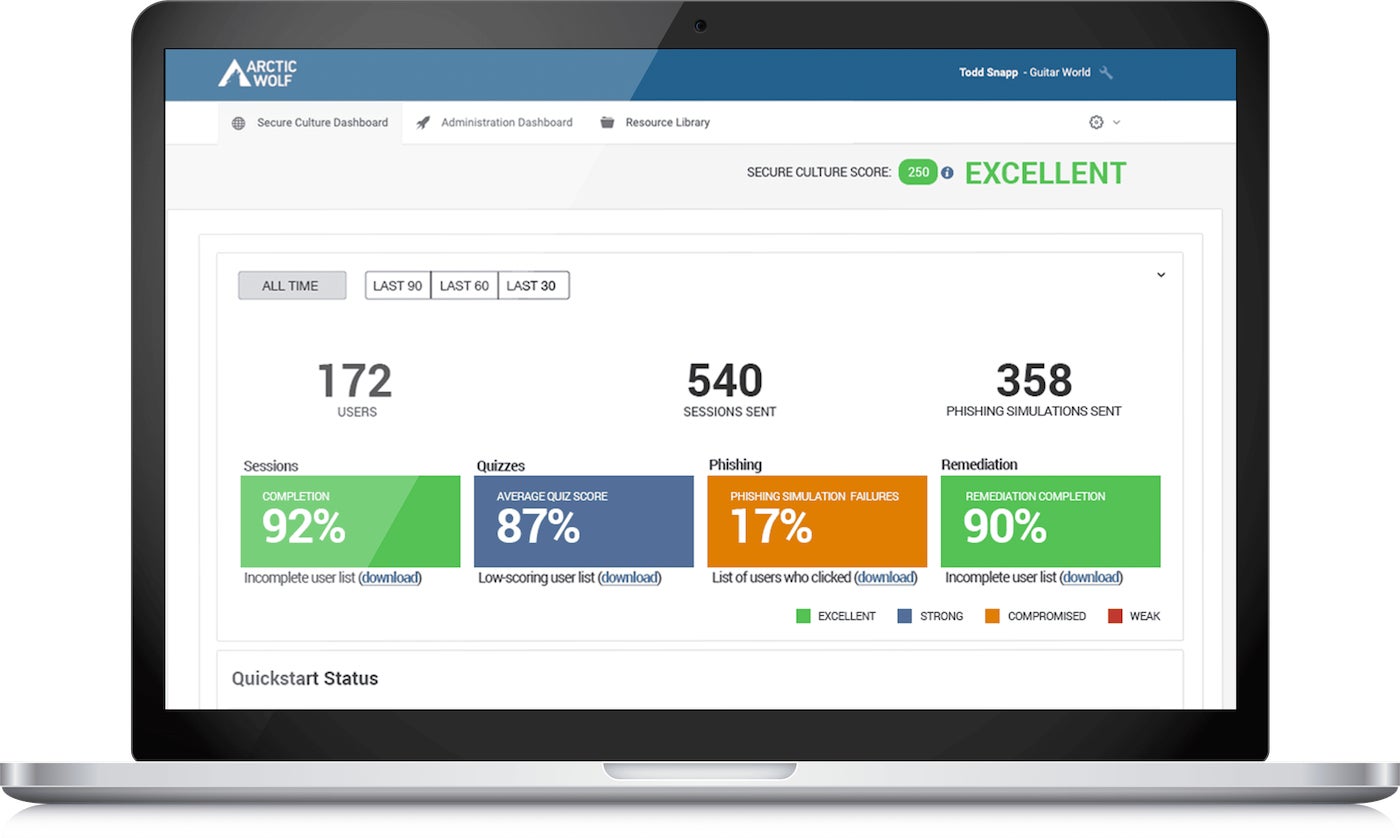

Arctic Wolf advertises itself as a “concierge” program designed to alleviate the burden of security operations centers (SOCs). It aims to supplement a small team or act as a complete SOC for small or mid-sized enterprises without one. Arctic Wolf generally receives positive feedback, with clients praising the thoroughness and dependability of the company.
Arctic Wolf advocates AI as a remedy to the challenge of sifting through the immense data available to modern SOCs and as a means to decrease ticket volume. The organization integrates advanced (though not necessarily generative) AI into its threat defense, SOC processes like examinations and reactions. AI and ML analyze data in the background within Arctic Wolf’s SecOps Cloud.
Pricing
Arctic Wolf’s “concierge” service starts at $44,000 per annum for managed detection and response for up to 100 users. Various services have differing costs based on whether they are purchased separately or bundled.
Key Features
- Managed detection and response.
- Managed risk.
- Incident response.
- Cyber insurance.
- Cloud security posture management.
| Advantages | Disadvantages |
|---|---|
| Could potentially function as an outsourced security solution. | Some evaluators express a lack of follow-up after Arctic Wolf submits logs. |
| 24/7 availability. | |
| Implementing and integrating are reportedly straightforward according to reviewers. |
Top choice for threat detection: Darktrace
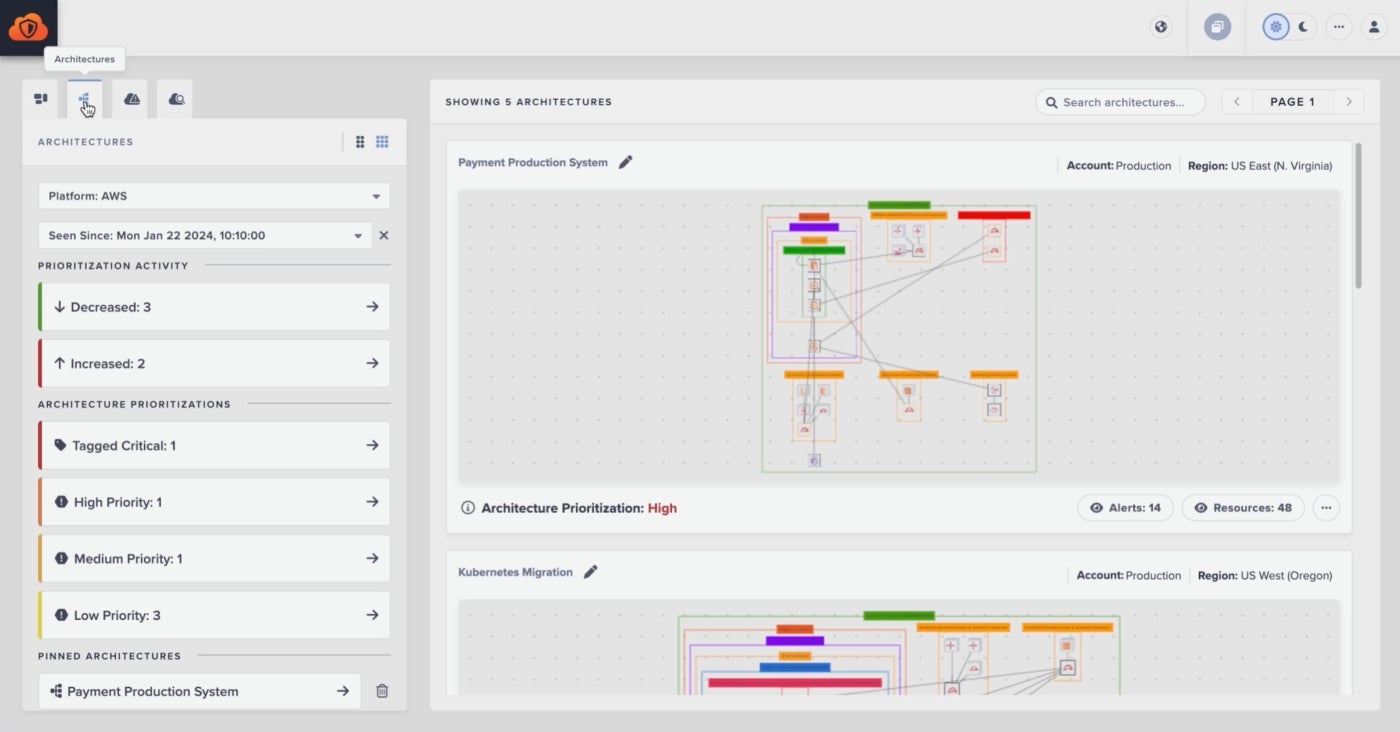

The Darktrace ActiveAI Security Platform takes pride in its proactive approach and catching emerging threats. Similar to other solutions, it is not necessarily focused solely on AI, but AI capabilities enhance existing, tried-and-tested security procedures. Darktrace also operates its own AI research hub dedicated to utilizing AI in various projects such as identifying unauthorized crypto-mining activities or distinguishing between related emails with similar content. Its AI algorithms are trained on each client’s unique business data to identify common and unusual patterns specific to them.
Darktrace’s detection capabilities and the “Darktrace Cyber AI Loop” leverage AI and machine learning, rather than generative AI. Nevertheless, Darktrace provides a generative AI tool called the “Cyber AI Analyst,” which independently conducts investigations and triages.
Darktrace adopts a forward-looking strategy, recognized by Microsoft for its distinction as the UK Partner of the Year in 2024.
Cost
Darktrace’s pricing structure is based on contract duration. When hosted on AWS, Darktrace’s services begin at $30,000 per year for up to 300 Mbps of average bandwidth and 200 hosts. Additional seats and bandwidth may increase the total cost to $100,000.
Main Features
- Monitoring of email, OT (Operational Technology), network, cloud, identity, and endpoint security.
- Management of attack surface.
- Readiness and recovery in case of security incidents.
| Advantages | Drawbacks |
|---|---|
| The AI tool is capable of conducting independent investigations. | Some reviewers have mentioned unsatisfactory customer support and aggressive sales tactics. |
| Ability to prioritize alerts based on criticality to focus on the most important matters. | Certain clients find the pricing and licensing structures confusing. |
| Reviewers have praised Darktrace’s network traffic monitoring capabilities in particular. |
Best choice for streamlining learning: Vectra AI
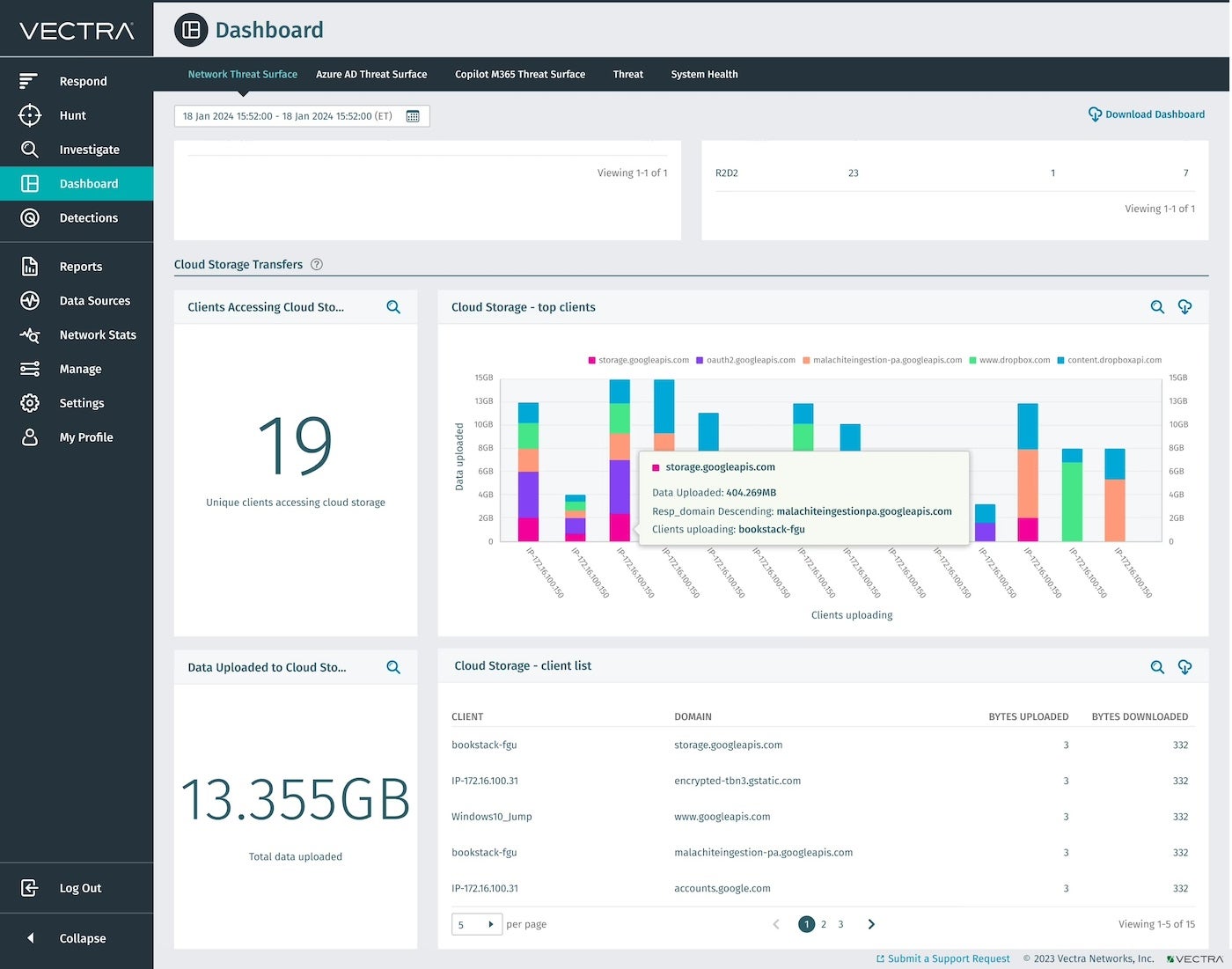

Established in 2012, Vectra AI provides a security dashboard that mirrors others in the industry. Their user interface stands out for its exceptional user-friendliness, prominently displaying a severity rating. Security experts can track their investigations through easily accessible tabs. The “AI” in their name emphasizes “AI-driven detections,” particularly anomaly detection through machine learning. The system analyzes user behavior to identify the tactics, techniques, and procedures commonly associated with known threat actors.
Vectra AI also features the Attack Signal Intelligence, a crucial component of their platform. It offers similar investigative, defensive, and responsive capacities found in other providers, but its straightforwardness distinguishes it.
Cost
For pricing inquiries, contact Vectra AI.
Main Features
- Enhanced detection and response capabilities.
- Insights into attacks and vectors across different networks, including public cloud, SaaS, identity, and data centers.
- Modernization of Security Operations Centers (SOC).
- Effective risk management solutions.
- Defense measures against various hybrid attack strategies.
| Advantages | Drawbacks |
|---|---|
| Clear classification of threats with an easy-to-understand “urgency score.” | Vectra AI’s dashboard may lack in-depth data analysis. |
| Positive feedback on customer service and vendor relationships from some clients. | Limited customization options. |
| Efficient and responsive system. | Limited integration possibilities. |
Excellent Choice for OT and IoT: Zscaler
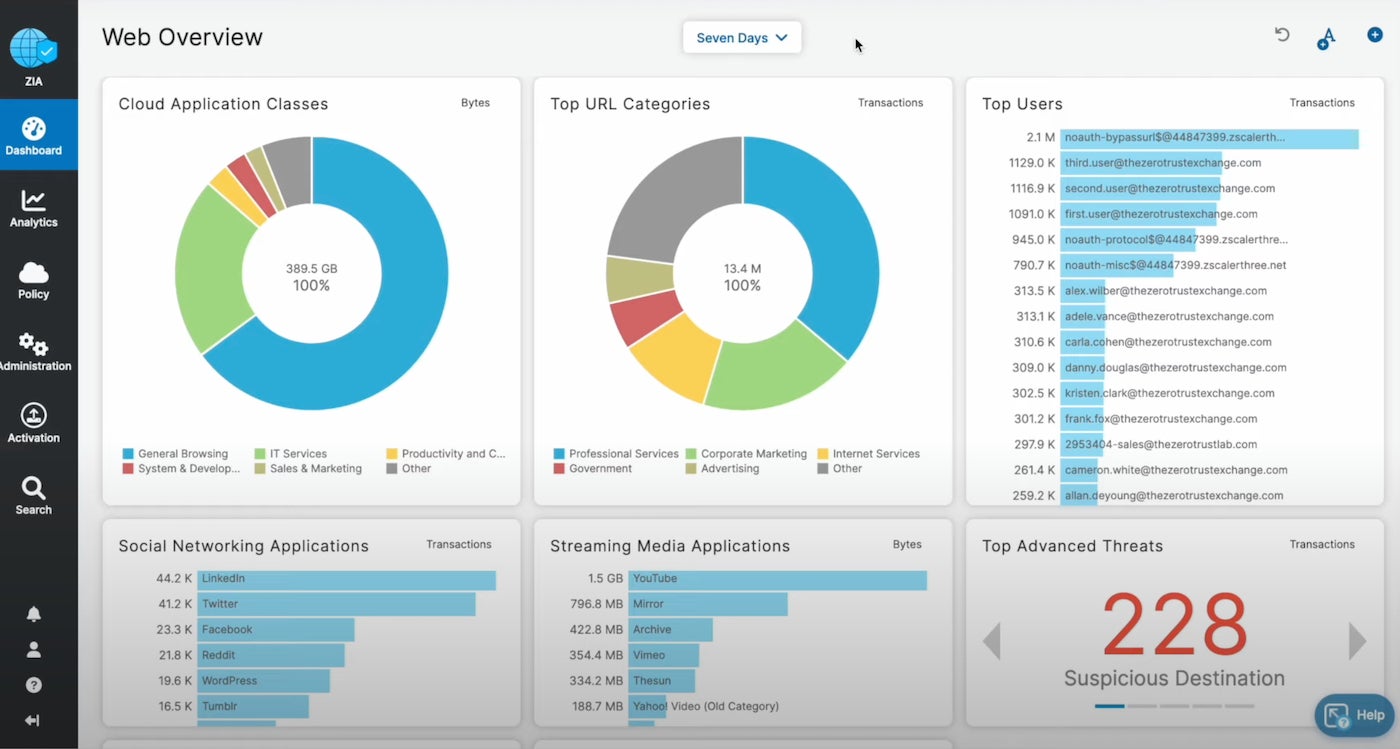

Zscaler’s cybersecurity solutions primarily emphasize zero trust and cloud security, encompassing a diverse range of products and services. As a key provider of security solutions to large enterprises heavily reliant on the cloud, Zcaler can assist organizations in navigating their digital transformation journey. The company has been recognized as a leader in security service edge in Gartner’s 2024 Magic Quadrant report.
Regarding AI, Zscaler offers conventional AI and ML technologies within its digital experience solutions (ZDX) through adaptable monitoring systems for enhancing customer experience, including minimizing ticket volumes. ZDX leverages AI to identify the root causes of issues or provide guidance to users on self-resolution.
Zscaler’s offerings can also safeguard against generative AI threats. Through the Zscaler Zero Trust Exchange, companies can shield specific data from employees’ access to public generative AI platforms like ChatGPT. This protection involves basic URL blocking, as well as more intricate measures such as predefined ChatGPT Cloud Application controls, detailed logs on employees’ AI interaction, and Zscaler’s comprehensive data loss prevention suite featuring safeguards to prevent inadvertent sharing of confidential information with AI tools.
Cost
Zscaler’s pricing varies depending on the plan. Contact the company for more specific pricing details.
Key Features
- Security for OT and IoT.
- Secure Access Service Edge (SASE).
- Zero trust access.
- Posture management.
- Data protection.
- Digital experience solutions.
- Digital transformation services.
| Advantages | Disadvantages |
|---|---|
| Defends against AI and AI threats. | Certain reviewers have cited issues with latency or slow connections. |
| Comprehensive range of OT, cloud, and digital transformation services. |
How Can AI Enhance Cybersecurity?
Similar to any product, the efficacy of AI security tools will rely on the specific requirements and circumstances of an organization. In cybersecurity, distinguishing between traditional AI/ML and generative AI can be challenging, based on the use case. Nevertheless, transitioning to an AI-empowered cybersecurity solution may yield beneficial outcomes, including:
- Accelerated threat detection and hunting.
- Enhanced accuracy in predictions.
- Natural language interactions enabling security experts to discuss complex issues (in the context of generative AI).
- Generative AI can propose queries, essentially training employees on its usage.
Challenges Faced by Businesses in Adopting AI Security Tools
AI security tools often entail a steep learning curve. Automated threat detection may overlook clues or trigger false positives, while generative AI could produce erroneous information. Many organizations have forbidden the use of AI-generated code in security teams, partially due to developers’ potential lack of motivation to thoroughly verify the code. Introducing generative AI models, in particular, might introduce additional security concerns, such as potential data leakage.
About Author