The Recruitment of Cybersecurity Professionals: Strategies to Address Talent Shortages and Expertise Gaps

A recently published study and expert panel organized by the International Information System Security Certification Consortium has highlighted the urgent need for more cybersecurity experts in the technology sector, despite facing significant challenges.
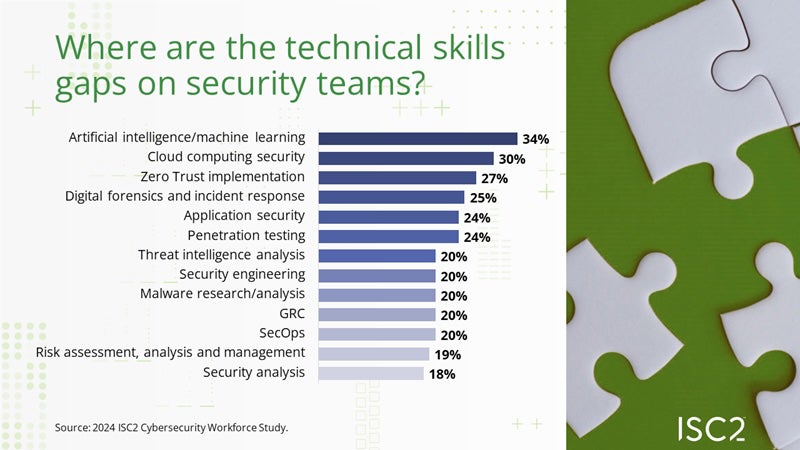
The 2024 ISC2 Cybersecurity Workforce Study, based on insights from 15,852 cybersecurity professionals and decision-makers worldwide, revealed that 90% of participants encounter shortages in specific skills within their organizations. These gaps are particularly pronounced in fields such as artificial intelligence, cloud computing, security, and the implementation of zero trust frameworks.
Some of these deficiencies may arise from discrepancies between job seekers’ expectations and what prospective employers offer. During a panel discussion titled “Bridging the Gap: Challenges in the Cyber Workforce” on September 10, Brandon Dunlap, Gartner’s senior executive partner in security and risk management, mentioned the common scenario of demanding “entry-level jobs with five years of experience.”
On a global scale, the shortfall in the cybersecurity workforce stands at 4.8 million professionals, according to ISC2. This translates to a 19% disparity between the roles required to fortify systems and the professionals adept at fulfilling these roles. Despite this, certain countries like Canada, Brazil, Mexico, the Netherlands, and Spain have witnessed a reduction in this gap (ISC2 clarifies that this number may not align with the actual number of vacant positions).
Challenges in Defining Cybersecurity Roles
These impediments can hinder companies from filling vacancies or make it arduous for job seekers to locate suitable positions. Defining cybersecurity roles can pose a considerable challenge for HR teams. Simon Salmon, an ISC2 instructor and head of IT at Nottingham City Council, compared referring to “cybersecurity” as a blanket term to mentioning “medicine” without specifying the medical specialization.
Chair of the ISC2 board of directors, Dan Houser, stressed the importance of engaging in thorough discussions with recruiting and staffing personnel to ascertain the specific requirements for hiring suitable talent.
Emerging Trends: Budget Constraints and Rise in Layoffs
Many organizations prioritize hiring for intermediate to advanced roles, indicating a lack of initiatives to nurture foundational skills. Among the surveyed entities:
- 39% identified insufficient budgets as the primary cause of cybersecurity skill shortages, compared to the previous year’s emphasis on talent scarcity.
- Layoffs have increased by 3% year-over-year, reaching 28%.
- 37% of companies have experienced budget reductions, marking a 7% rise from the previous year.
- There has been a 6% surge in hiring freezes, affecting 38% of organizations.
Houser highlighted the issue of companies failing to offer competitive salaries, particularly government positions struggling to match the pay levels in the private sector.
Addressing this, Houser pointed out, “The challenge lies not in the scarcity of labor but in the availability of labor at a reasonable compensation rate.”
Lisa Young, vice chair of the ISC2 board of directors, emphasized that companies should provide fair remuneration, cultivate a supportive and collaborative work environment, and ensure employees feel valued and empowered to contribute meaningfully.
She questioned, “How often do businesses express gratitude for our efforts?” This aspect poses a particular challenge in cybersecurity because “the absence of negative incidents is often viewed as successful,” she noted. “The effectiveness of our work is frequently inconspicuous.”
Nurturing Novice Professionals
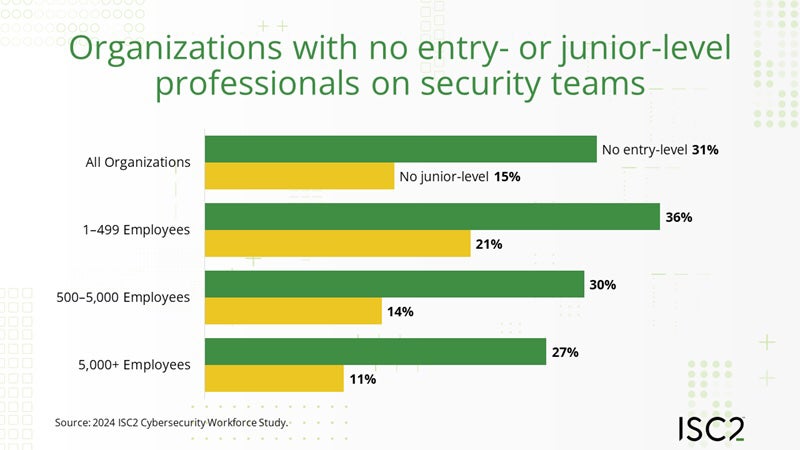
While experienced professionals tend to sustain high job satisfaction as they progress in their careers, nearly one-third of surveyed organizations disclosed a lack of entry-level cybersecurity personnel.
Although larger corporations are more inclined to offer entry-level and junior roles (1-3 years of experience), the predominant focus of most entities remains on recruiting for intermediate to advanced positions. This practice may contribute to the proficiency gap by neglecting the cultivation of a talent pool capable of eventually assuming senior positions as seasoned employees retire or depart.
SEE: Why Your Business Needs Cybersecurity Awareness Training (TechRepublic Premium)
Dunlap recommended additional initiatives to bolster cybersecurity job growth:
- Establishing cybersecurity training schemes.
- Linking employee compensation to training efforts.
- Launching internal mentorship programs, matching mentors with employees based on compatibility.
Given the rapid evolution of the technology landscape, Young stressed the importance of continuous professional development. Continuous learning enables professionals to acquire the necessary skills to address the technical gaps highlighted by ISC2, such as artificial intelligence/machine learning, cloud computing security, zero trust implementation, digital forensics, and application security which rank high on the list.
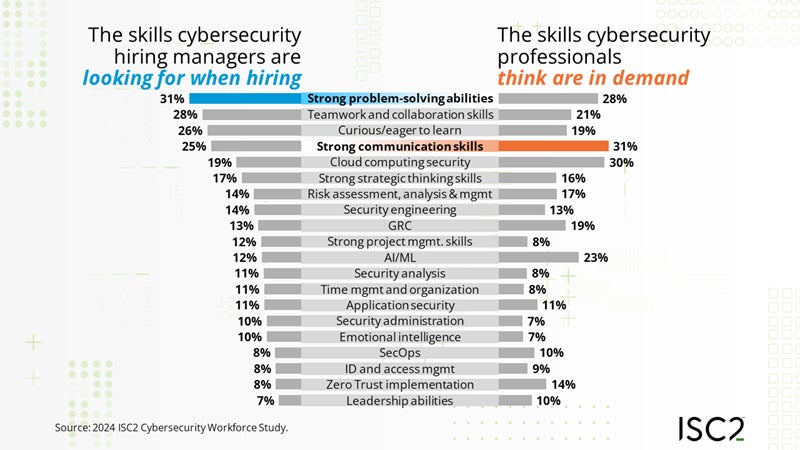
The report uncovered a discrepancy in perceived versus desired AI competencies: While 23% of cyber security professionals acknowledge the demand for AI/ML skills, only 12% of recruiters seek these skills for cyber security roles.
Opting for early recruitment or unconventional sources
According to Dunlop, vocational schools and community colleges can serve as abundant talent pools for cyber security professionals.
Salmon is involved in a project that identifies adolescents possessing the soft skills essential in cyber security — traits such as eagerness to learn, effective customer communication, personable demeanor, and punctuality — and provides them with technical training.
“Remarkably, we noticed that individuals with neurodivergent conditions or dyslexia were often overlooked, yet they showed exceptional performance,” explained Salmon.
“By promoting inclusivity, we can help combat the shortage,” Salmon emphasized.
About Author